
Calculate the Reorder Point for Each SKU
A reorder point answers one practical question: when should you release the next purchase order so replenishment can arrive before expected demand consumes available stock?
Reorder point = expected demand during lead time + safety stock
Calculate it separately for each variant. For example, do not combine 1.5mm and 2.0mm tile leveling clips into one demand line if customers cannot substitute one for the other. Use the same unit throughout—bags, boxes, or pieces—and make sure sales and inventory records use that unit consistently.
Expected lead-time demand can be estimated from the SKU’s average weekly sales multiplied by the replenishment lead time in weeks. Safety stock is an additional buffer for uncertainty; it should reflect actual variation in demand and receipt timing, not an arbitrary percentage applied to every item.
Build Safety Stock From Your Own Variability
Start with the last several replenishment cycles for each SKU. Compare actual demand during lead time with the average, and check how often receipts arrived later than the supplier’s quoted schedule. A distributor with stable demand and reliable receipts may need a smaller buffer than one serving project-driven orders or markets with variable transit times.
- Record weekly sales and stockouts by SKU; mark weeks affected by one-off projects.
- Record order date, production completion, dispatch, customs release, and warehouse receipt for each replenishment.
- Choose a service target based on the cost of a stockout versus the cost of carrying extra inventory.
- Set and review the safety buffer against observed demand and lead-time variation; document any manual override.
If a SKU has little sales history, treat the estimate as provisional. Use sample orders and early sell-through to update it instead of presenting an untested forecast as a market benchmark.
Use Inventory Position, Not Shelf Count Alone
Before reordering, calculate inventory position: on-hand stock plus confirmed incoming purchase orders, minus units already committed to customers. Comparing this figure with the SKU’s reorder point helps avoid both duplicate orders and false confidence from stock that is already allocated.
Keep clips, wedges, spacers, and reusable systems as separate SKU records. The product mix should follow your own order history, customer requests, and market tests. Our wholesale tile leveling combo buying guide explains how to structure mixed-product orders; the tile leveling system distributor guide covers choosing an initial range.
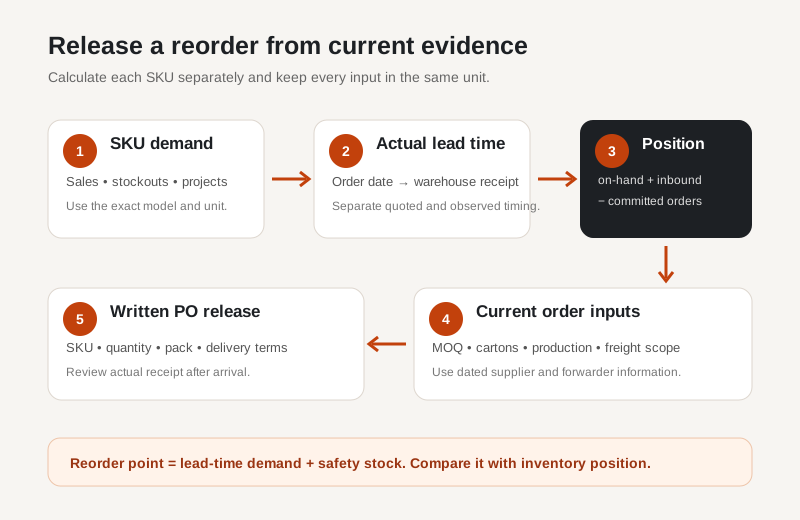
5 Checks Before Releasing a Reorder
- Demand: confirm sales, stockouts and one-off projects for the exact SKU and unit.
- Lead time: compare quoted timing with actual order-to-receipt records.
- Inventory position: add confirmed inbound stock and subtract committed customer quantities.
- Order feasibility: confirm current MOQ, carton data, production schedule and dated freight scope.
- Release record: issue the purchase order with the approved SKU, quantity, pack and delivery terms.
Check MOQ, Carton Data, and Freight Before Placing the Order
A reorder point tells you when to act; it does not decide the order quantity or shipping method. Confirm the current MOQ for each SKU, carton dimensions and gross weight, production schedule, shipment route, and destination charges with the supplier or freight forwarder. These details can change the economics of a mixed order, so a fixed “LCL-to-container” bag threshold is not reliable across products and destinations.
Compare the landed cost of the actual order configurations you can place. Include origin handling, freight, insurance if applicable, destination charges, customs duty and tax, and inland delivery. Keep the quote date and assumptions with the calculation, then refresh it before purchasing. For current product MOQs and wholesale terms, see our tile leveling system wholesale supplier page.
Review the Plan After Every Replenishment
When a shipment arrives, compare the actual receipt date and SKU sell-through with the assumptions used for that order. Update the lead-time estimate when repeated shipments differ from the plan, and revise demand after customer wins, losses, or seasonal changes. Review slow movers separately so a large total stock figure does not conceal a shortage of the sizes that are selling.
Frequently Asked Questions
How do I calculate a reorder point for tile leveling products?
For each SKU, add expected demand during its replenishment lead time to its safety stock. Estimate both from that SKU’s sales and actual supplier receipt history, using consistent units such as bags or boxes.
Should I add 20% to every tile leveling SKU as safety stock?
No universal percentage fits every SKU. Set the buffer using observed demand variation, lead-time variation, and the stockout risk you are willing to accept; review it as new sales and receipt data arrives.
How should a distributor choose which clip sizes to stock?
Track sales, stockouts, and customer requests by clip size, then prioritize variants with repeat demand. Test new sizes in measured quantities and keep their results separate from established SKU history.
When should I switch from LCL to a full container?
Compare current quotes for the actual SKU mix, carton dimensions, route, and destination charges. There is no dependable universal bag-count threshold: freight rates, handling costs, and container utilization vary by shipment.
Share your market, SKU sales history, and destination with our team if you want to discuss a replenishment plan for your next order.