
Bottom line: Ask the Moroccan importer to confirm the current control scope before production and booking. If the item is regulated, follow the specified conformity route; if it is outside that list, keep the written classification and scope basis with the customs file.
Import Tile Leveling Systems to Morocco in 6 Steps
- Define the SKU. Record material, function, dimensions, components, photos, origin, labeling, and set configuration.
- Confirm HS classification. The importer and broker should agree the code and description used for the declaration.
- Check control scope. Compare the exact product with the Ministry's current industrial-product rules and official list.
- Choose the conformity route. If controlled, establish whether verification occurs at origin or arrival, which approved body is involved, and which evidence is required.
- Prepare PortNet and customs records. Align importer identity, invoice, packing list, transport, origin, product evidence, and filing references.
- Quote the live route. Compare the same cargo and final address, including transshipment, destination charges, free time, and delivery appointment.
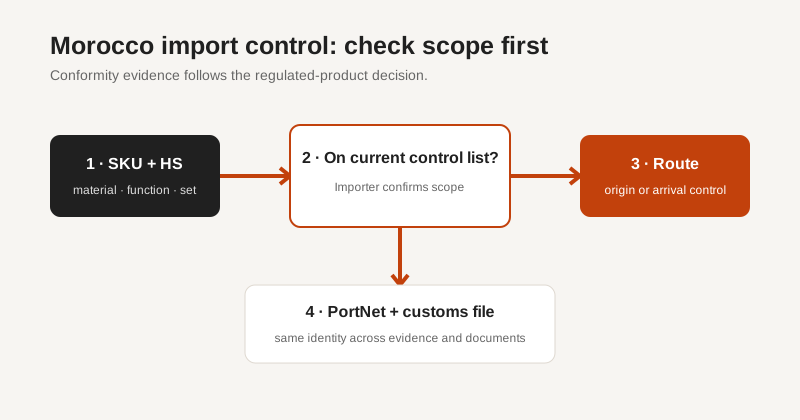
Conformity Control Depends on Product Scope
The Ministry of Industry and Trade explains that industrial products subject to Moroccan technical regulations must demonstrate conformity. Its market-surveillance guidance describes documentary checks, physical checks, sampling where applicable, and the market-access decision. Some product categories are controlled at origin and use an approved inspection body; others are handled on arrival.
That does not mean every plastic clip, wedge, plier, or kit automatically follows one certificate path. The importer should match the current list to the SKU and HS classification, document the result, and identify the evidence needed before the factory prints labels or seals cartons.
3 Records to Align in PortNet
Product identity, commercial documents, and conformity references must describe the same goods. The product name and model on the invoice should match the specification and any inspection or test record. Quantities, weights, carton counts, origin, and transport data should also reconcile.
The Ministry's import-control modernization page describes the electronic filing and traceability role of PortNet. The importer or its representative should confirm the current filing sequence and status fields for the product.
Customs Value, Duty, and Tax Need a Dated Calculation
Do not apply one duty percentage to every tile leveling product. Build the calculation from the agreed classification, origin, customs value, and rules effective on the declaration date. Separate duty and tax from brokerage, terminal handling, freight, inland delivery, storage risk, and conformity-service costs when applicable.
The supplier should provide a consistent commercial invoice and packing list. The importer and broker should own the Moroccan calculation. Keep the code, rate source, exchange rate, and calculation date beside the landed-cost sheet so a later order can be updated cleanly.
Tanger Med or Casablanca Is a Door-Route Choice
Port selection should follow the final warehouse and current carrier service. Compare cargo-ready date, direct or transshipment route, estimated departure and arrival, destination charges, customs location, free time, inland delivery, and appointment constraints. Red Sea routing and carrier choices can change, so a historic transit figure is not a planning guarantee.
LCL may suit a first tile leveling clips order, but consolidation and destination charges must be visible. A container can improve handling at scale if the receiving site has unloading capacity. Ask for the full door assumptions, not only the ocean line.
Morocco Entry and North Africa Re-Export Are Separate Files
Clearing goods into Morocco does not automatically authorize sale in Algeria, Tunisia, Mauritania, Senegal, or another market. Each destination can have its own importer, tariff, foreign-exchange, conformity, labeling, tax, and product-registration rules. A free-zone or transit procedure also differs from Moroccan home use.
If Morocco is a distribution hub, map each flow before ordering: local sale, bonded storage, processing, or re-export. Keep origin and inventory records capable of supporting that procedure. Use our tile leveling system wholesale supplier page to define the SKU and packaging file, then let the destination importer confirm its market-access route.
Frequently Asked Questions
Does every tile leveling system need a COC for Morocco?
No universal answer should be applied to every tile tool. Morocco's conformity controls are linked to products subject to technical regulations and the current control list. Confirm the exact SKU and HS classification with the Moroccan importer, Ministry guidance, and PortNet workflow before shipping.
What documents are used to import tile tools into Morocco?
The file commonly connects the commercial invoice, packing list, transport document, origin and importer data, customs classification, and any product-specific conformity evidence or PortNet references. The importer and broker should confirm the current list for the SKU and procedure.
How long does shipping from China to Morocco take?
Use a current carrier or forwarder schedule for the specific port pair and cargo-ready date. Routing, transshipment, security conditions, congestion, and inland delivery can change the result. Record the quote date and treat the estimate as planning data.
Can a Morocco import file cover re-export across North Africa?
No. Each destination can have different importer, tariff, conformity, labeling, tax, and foreign-exchange rules. Separate Moroccan home-use clearance, free-zone or transit treatment, and the destination-country market-access file.