
Disposable vs Reusable Tile Leveling: 3 Architectures
The labels describe only part of the system. Buyers should map each component before comparing bags:
| Architecture | Consumed during installation | Normally recovered | Verify before ordering |
|---|---|---|---|
| Clip + wedge | Break-off clip | Wedge, if undamaged | Clip/wedge pairing, joint width, removal behavior |
| Screw-cap | Under-tile base or embedded part, by model | Removable tightening components | Bill of materials, removal method, replacement parts |
| Twist-cap | Threaded base | Cap, after removal and inspection | Base width, tile range, cap/base compatibility |
Bottom line: compare the cost of the whole working system over accepted installations. Calling one bag “reusable” does not establish how many jobs it completes or whether replacement bases are available when customers need them.
The 5 Inputs Behind a Defensible TCO Result
- Architecture: list every part in the working set and identify the consumed and recovered parts.
- Current purchase cost: record the quotation date, pack count, MOQ, Incoterm and currency. Keep freight, duty and local handling separate until current evidence is available.
- Replacement parts: record the price and availability of clips, bases, wedges or caps separately. A recoverable component has limited value if its matching consumable cannot be replenished.
- Observed field life: issue numbered working sets to installers and log recovered, cleaned, damaged, lost and retired parts after each project.
- Commercial result: use the same period to measure units sold, returns, claims, replacement orders and gross margin for each SKU.
The calculation is:
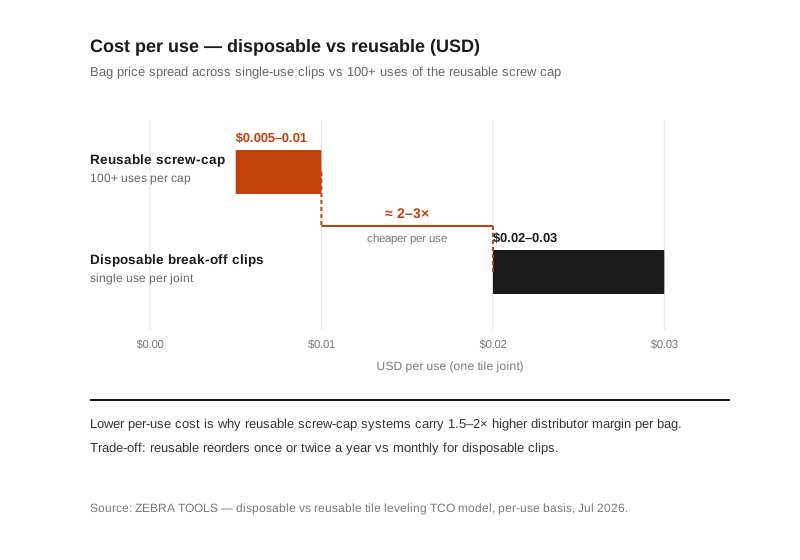
TCO per accepted installation = (purchase cost + replacement parts + handling/labor + returns or claims) ÷ accepted installations
Define “accepted installation” before the trial. For a distributor, that may mean a contractor project completed without a product return. For an installer, it may mean a recorded set of clip positions completed and removed according to the system instructions. Apply the same denominator to every system, and preserve the underlying records for review.
3 Published Price References — and What They Do Not Prove
| ZEBRA product family | Pack | FOB Ningbo at MOQ |
|---|---|---|
| Tile leveling clips | 100 pcs/bag | $0.70–0.85/bag |
| Reusable tile leveler | 50 pcs/bag | $1.30–1.70/bag |
| Spin-type leveling system | 50 pcs/bag | $1.45–1.60/bag |
⚖️ Guide prices are FOB Ningbo at MOQ and subject to raw material cost fluctuations — contact us for current pricing.
These figures are SKU price references from the site’s wholesale price source, accessed October 1, 2026. They do not include the complete working set in every architecture, freight, duty, marketplace fees, jobsite labor or losses. They also do not establish a selling price, gross margin, annual demand or reuse count.
How to Run a 4-Record Distributor Pilot
A small pilot can produce better assortment evidence than a fixed “first container” percentage. Use the same target customer group and keep four records:
- Issue record: SKU, lot, components issued, installer and project.
- Return record: recovered, damaged, lost and retired components, with the reason.
- Service record: questions, installation training, complaints, returns and replacement requests.
- Sales record: sell-through, repeat order, selling price and actual gross margin by SKU.
Test the exact joint width, tile-thickness range and tightening method on representative tile before committing to volume. A cap-based system may reduce dependence on separate pliers, while a clip-and-wedge system may fit customers who already know that workflow. Those are trial questions, not universal performance conclusions.
Which System Fits Which Buying Question?
Choose clip + wedge when the buyer wants a separately replenished break-off clip, already stocks compatible wedges and can verify the clip size and removal behavior. Choose a screw-cap option when the customer wants adjustable tightening and the supplier can document the exact consumed base and recoverable components. Choose a twist-cap option when a hand-tightened cap suits the installer workflow and matching replacement bases will remain available.
A distributor may ultimately carry more than one architecture, but the assortment should follow measured customer groups and pilot results. The tile leveling systems catalog provides the current product families; the tile leveling system wholesale supplier page is the place to request current SKU, pack, MOQ and quotation details.