
Bottom line: Retailers should choose from documented model features and customer demand, publish the exact rated load and instructions, and avoid promising that a cup suits every slab.
Manual vs Electric Tile Suction Cups Use Different Mechanisms
A manual suction cup creates vacuum through a hand-operated mechanism. An electric model uses a powered pump. That difference affects how the user operates and maintains the tool; it does not by itself establish which cup is suitable for a particular tile, stone, glass, or other surface.
When comparing models, read the manufacturer’s instructions for the vacuum indicator, seal inspection, surface preparation, maximum rated load, and any limits on use. Retail copy should not turn a mechanism description into a safety guarantee. A rated-load figure is a manufacturer specification, not a substitute for the tool’s instructions or a handling plan.
Compare the Published Specifications Before You Stock
Use the same checklist for both types. If a supplier cannot document one of these fields, treat it as an unanswered product question and resolve it before listing or recommending the tool.
| Check | Manual cup | Electric cup |
|---|---|---|
| Vacuum mechanism | Hand-operated; follow model instructions | Powered pump; verify battery and charging details |
| Rated load | Confirm the exact model’s published rating | Confirm the exact model’s published rating |
| Contact surface | Check pad material, diameter, and approved surfaces | Check pad material, diameter, and approved surfaces |
| Care and inspection | Use the supplier’s seal and pad inspection steps | Check the pad, vacuum function, battery, and charging guidance |
For reference, the ZEBRA BM-069 is listed at 100 kg rated load with an 8-inch (200 mm) NBR pad, an 1800 mAh battery, and a unit weight of 1.4 kg; its MOQ is 50 sets. These are product specifications from our factory data. They do not establish a safe working load for every surface or lifting configuration. See the electric tile suction cup product details and use its instructions when evaluating fit.
Choose Retail Stock From Customer Tasks and Evidence
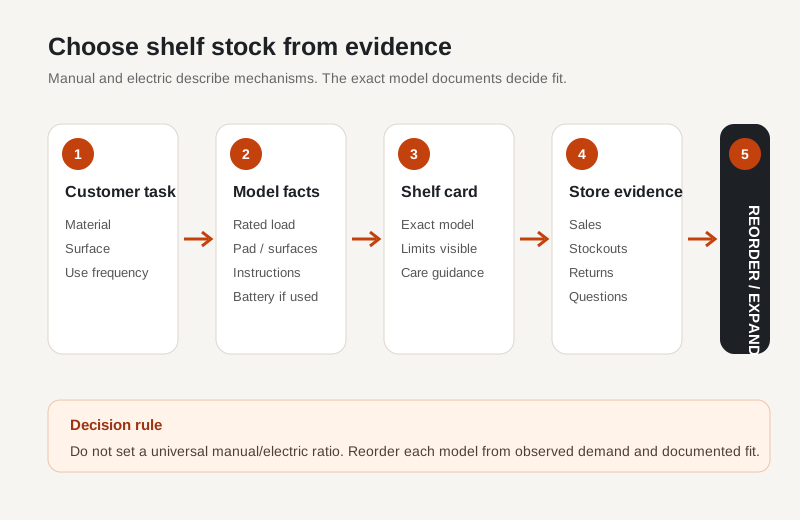
A physical tool retailer can use customer questions and sales records to decide whether to carry one type or both. Ask what materials and formats customers handle, how often they use a suction cup, whether they specifically request a powered pump, and what information they need before choosing.
- Test demand before widening the range. Record requests and completed sales by model; keep enquiries separate from purchases.
- Make comparisons legible. Put the mechanism, rated load, pad details, battery information, and care instructions on the shelf card or product page.
- Do not imply interchangeability. A customer changing cup type still needs to check the exact model rating, surface compatibility, and handling instructions.
- Reorder from observed sell-through. Review each model’s stockouts, returns, and customer feedback before adding another variant.
For wholesale orders, confirm MOQ, packaging, and model availability on the current quotation. If you are building a broader tile-tool assortment, compare suction cups with the other tile leveling systems and accessories, and discuss a combined order through our tile leveling system wholesale supplier page.
What Should a Retail Listing Tell Buyers?
A useful listing answers the questions a customer needs to check before use. State the exact model and powered/manual type; publish its rated load without relabeling it as a safe working load; specify pad size and material; describe compatible surfaces only as the manufacturer does; and include the current operating, inspection, and charging instructions. For battery models, list the supplied battery capacity and charging requirements from the product documentation.
Avoid claims such as “works on every slab,” “cannot drop,” or “safe for all large-format tile” unless the manufacturer’s documented conditions support that wording. Tile size alone does not give a complete lifting weight or establish a safe setup.
Frequently Asked Questions
Should a tile-tool retailer stock manual or electric suction cups?
Use customer requests and model-level sell-through to decide whether to stock manual cups, electric cups, or both. Before recommending a model, confirm its rated load, compatible surfaces, and instructions; there is no universal stocking mix that fits every store.
What information should a retailer show for a suction cup?
Show the exact model, manual or electric mechanism, manufacturer-rated load, pad size and material, compatible surfaces, operating and inspection instructions, and battery/charging details for powered models. Do not describe a rated load as a safe working load unless the manufacturer explicitly does so.
What are the ZEBRA BM-069 electric suction cup specifications?
The BM-069 is listed with a 100 kg rated load, an 8-inch (200 mm) NBR pad, an 1800 mAh battery, a 1.4 kg unit weight, and a 50-set MOQ. Check the current product page and operating instructions for model availability and use conditions.
Can I choose a suction cup based only on tile dimensions?
No. Tile dimensions alone do not establish the tile’s weight, surface compatibility, or a safe lifting setup. Check the specific material and thickness, the tool’s manufacturer-rated load and surface instructions, and the handling plan for the job.
For pad counts and slab-weight calculations, see the porcelain tile suction cup guide; for battery model details, see the electric tile suction cup guide.