
Bottom line: steel pliers are the wholesale default because jaw rigidity is what seats a wedge cleanly — at ~200 GPa Young's modulus, steel is about 3× stiffer than aluminum and 50–100× stiffer than nylon. Aluminum earns its place only in salt-air coastal markets where rust is the bigger enemy, and nylon lightweight pliers suit wall work. The same lever-action plier class retails at $30.61–30.90 (Raimondi, Aug 2026) and ships factory-direct at $1.10–1.50 per piece — so the material choice is a spec decision, not a price one.
What Steel, Aluminum, and Nylon Each Bring to a Leveling Plier
A leveling plier is a simple lever: it pushes a wedge down into a clip's slot and pulls two tile edges level. What the body is made of decides how that lever behaves under load. Here's the honest engineering comparison, with values from standard engineering references (engineeringtoolbox, engineersedge, Aug 2026):
| Property | Steel (A36) | Aluminum (6061-T6) | Nylon 6/6 |
|---|---|---|---|
| Young's modulus (stiffness) | ~200 GPa | ~70 GPa | ~2–4 GPa |
| Tensile strength | ~400 MPa | ~270 MPa | ~45–85 MPa |
| Relative stiffness vs steel | 1× | ~1/3× | ~1/50–1/100× |
| Density | ~7.85 g/cm³ | ~2.70 g/cm³ | ~1.14 g/cm³ |
| Corrosion | Rusts if uncoated | Resists | Resists |
| Our tool weight (body) | 310–390g | — | 250g |
Engineering values: engineeringtoolbox.com / engineersedge.com, retrieved Aug 2026. Tool weights from our BM-E01 (steel+PP, 310g), BM-E02 (steel+PP, 390g) and BM-E04 (nylon, 250g) factory specs; BM-E01 record reviewed October 7, 2026. Full range on the tile leveling pliers page.
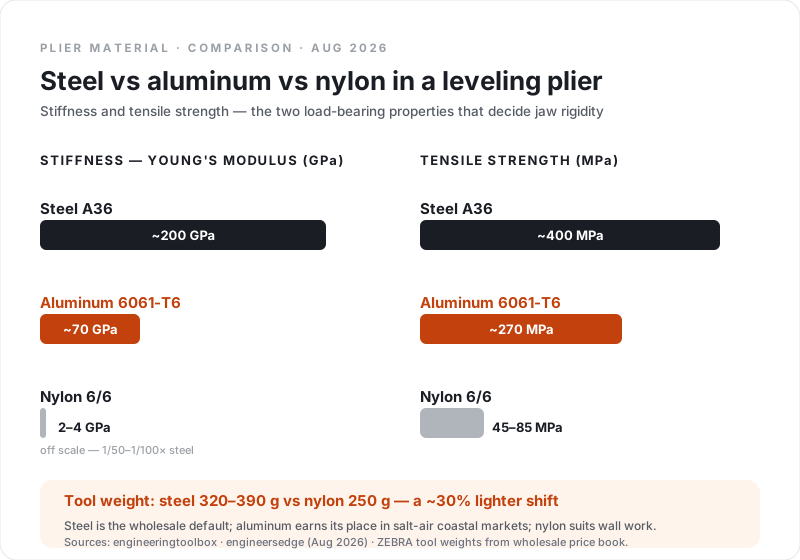
The pattern is the point: steel is the stiffness benchmark, aluminum gives up roughly two-thirds of it to save weight, and nylon gives up almost all of it. For a tool whose entire job is transmitting force without deflecting, that ordering matters far more than the raw numbers suggest.
Stiffness: Why a Flexing Jaw Destroys a Leveling Job
Here's the mechanics. When you squeeze a leveling plier, the jaw tips push the wedge down and the frame reacts by wanting to spring open. A stiffer frame springs back less, so the wedge seats to the same depth every time — which is exactly what "level" means across a floor. A flexible frame lets the jaw tips spread, the wedge seats crooked, and one tile corner sits proud.
That's why stiffness is the first spec to check, not the last. The numbers: at ~200 GPa, steel resists that deflection about 3× better than aluminum and on the order of 50–100× better than nylon. For a plier used on porcelain slabs — where the wedge needs real force to seat — an aluminum or nylon jaw can visibly give before a thick tile seats. It's not a comfort issue; it's a lippage issue.
Weight: 310g Steel vs 250g Nylon on an 8-Hour Shift
Weight is the counter-argument, and it's a real one. Our steel-body pliers weigh 310–390g depending on model; the nylon BM-E04 comes in at 250g — 19–36% lighter depending on the steel model (250g vs 310–390g). On a floor with 1,000 clip positions, an installer picks the plier up and sets it down hundreds of times, and 60–140 extra grams in the hand all day is not nothing.
But notice what the weight saving buys in a wall plier context. On walls, installers work with one hand and the tool above shoulder height, so the 250g nylon body genuinely earns its keep. On floors, the tile and the adhesive do the heavy lifting and the plier rests in the hand between squeezes — there, stiffness beats lightness. The right answer isn't "one build is better," it's "match the build to the work."
Corrosion: Where Aluminum Stops Being a Compromise
Steel's one real weakness is rust — and in salt-air environments it's decisive. Coastal GCC cities, tropical island markets, and any port-side distributor warehouse will see uncoated steel tools start to pit. That's the market where an aluminum or coated-steel build stops being a niche and becomes the sensible default.
If your customers install near the coast — think Jeddah, Dubai Marina, Miami — offer aluminum or epoxy-coated steel as the coastal spec and price it honestly. Everywhere inland, standard steel is what professionals expect and what the margin supports. The practical rule: steel for 90% of markets, aluminum for salt-air, nylon for wall-specialist stockists.
The Real Price — Brand Retail vs Factory-Direct
Now the part that decides your margin. Publicly listed dealer prices for Raimondi's steel pliers, the most recognized brand in the category, run (Aug 2026):
| Product | Type | List Price | Dealer / Source |
|---|---|---|---|
| Raimondi Floor Pliers | Steel | $30.61 | Tile This (US) |
| Raimondi Wall Pliers | Steel | $30.90 | Master Wholesale (US) |
| Raimondi Adjustable Pliers | Steel | $79.95 AUD | Tilers Trade Shop (AU) |
| ZEBRA BM-E01 / BM-E02 | Steel + PP | $1.10–1.50/pc FOB | Factory-direct |
| ZEBRA BM-E04 | Nylon lightweight | $1.10–1.50/pc FOB | Factory-direct |
⚖️ Guide prices are FOB Ningbo at MOQ and subject to raw material cost fluctuations — contact us for current pricing.
Raimondi prices are publicly listed dealer prices retrieved Aug 2026; dealer trade/volume discounts may apply but are not publicly quoted. ZEBRA pliers are wholesale FOB prices at a 100-piece MOQ — not retail prices.
Do the division and the same lever-action class comes out at roughly a 20–28× spread: $30.61 against $1.10–1.50. That spread is not a quality gap — Raimondi carries an Italian factory, a dealer network, and a brand that contractors trust, and for a single plier bought from local stock that's fair value. For a tile leveling system wholesale supplier ordering by the container, it's the reason pliers belong in your mix: they ship in the same box as your tile leveling clips, tile leveling wedges, and tile leveling system kit, and they're the highest-margin line in the basket.
Which Build Should a Wholesale Buyer Stock?
Here's the practical stocking decision, market by market:
- Default stock (steel) — steel + PP body for every inland market. Stiffest jaw, best price-to-performance, and it's what installers expect to feel in their hand.
- Coastal markets (aluminum / coated steel) — where salt air rusts uncoated steel. Offer it as the coastal spec; it costs a little more per piece and protects your brand from rust complaints.
- Wall-specialist stockists (nylon lightweight) — the 250g build for crews that work above shoulder height all day. It's a real ergonomics sell, not a gimmick.
- System compatibility — whichever build you stock, the jaws must fit the clip slot and wedge taper of the system you sell. That's a factory spec you confirm on the order, not a material property.
One more buying note: because pliers are a one-time purchase per installer, they drive new accounts while your clips drive reorders. Stock steel as the volume line, add the nylon lightweight as a differentiator, and quote the pair with every starter kit. The full range is on our tile leveling systems page, the pricing book lives on the tile leveling system wholesale supplier page, and everything we ship comes from a tile leveling system manufacturer in China that controls the steel, the molding, and the jaw geometry in-house.
Frequently Asked Questions
Are steel or aluminum tile leveling pliers better?
Steel is the wholesale default: at ~200 GPa Young's modulus it is roughly 3× stiffer than aluminum, so the jaw doesn't flex when seating a wedge and tiles sit level. Aluminum (~70 GPa) is lighter by tool weight and resists corrosion, making it the right choice for salt-air coastal markets. Nylon (~2–4 GPa) is lightest but far less stiff, best for wall work.
How much do brand tile leveling pliers cost vs factory-direct?
Raimondi's steel floor and wall pliers retail at $30.61 and $30.90 at US dealers, and the adjustable model at $79.95 AUD (public list, Aug 2026). The same lever-action class ships factory-direct at $1.10–1.50 per piece FOB with a 100-piece MOQ — roughly a 20–28× spread that is supply chain, not quality.
Why does plier stiffness matter for tile leveling?
A leveling plier transmits force from your hand to the wedge through its frame. A stiffer frame springs back less, so the wedge seats to the same depth every time and tile edges stay level. A flexing frame lets the jaws spread, the wedge seats crooked, and one tile corner sits proud — which is exactly the lippage the system is meant to prevent.
Should distributors stock steel, aluminum, or nylon pliers?
Stock steel as the volume default for inland markets, add aluminum or coated steel for salt-air coastal markets where rust is the risk, and carry a nylon lightweight build (our BM-E04, 250g) as a wall-work differentiator. Confirm jaw-to-clip compatibility on the order — that is a factory spec, not a material property.