
Do Tile Leveling Clips Need CE Marking?
The Commission's own rule has two halves, and both cut against a CE logo on clip bags. First, CE marking is compulsory only where a New Approach directive requires it — machinery, electronics, toys, medical devices, and so on. Second, and less known: affixing CE marking to a product no directive covers is forbidden, precisely because the mark would mislead buyers about oversight that does not exist. A plastic clip that holds two tiles at the same height while the adhesive cures, then snaps off and gets swept up, appears in no directive's scope. It is not machinery, not electrical, not a toy. And because it is removed before the tiled surface enters service, it is not a construction product permanently incorporated in works under the CPR either. Bottom line: the compliant clip bag carries no CE mark — and a supplier who stamps one on is signaling that he does not read directives, which is the opposite of what the logo is supposed to prove.
Which Tile Tools Do Need CE?
Run the same test across a tile container and the line splits at the power cord. Anything powered that lifts, vibrates or guides carries real directive obligations; everything plastic and passive carries none. The clearest contrast in our own range is the electric vacuum suction cup: as a powered lifting accessory it falls under the Machinery Directive 2006/42/EC plus the EMC Directive 2014/30/EU, and CE goes on only after a Declaration of Conformity and a technical file exist. For battery tools under 75 V DC, the Low Voltage Directive typically does not apply.
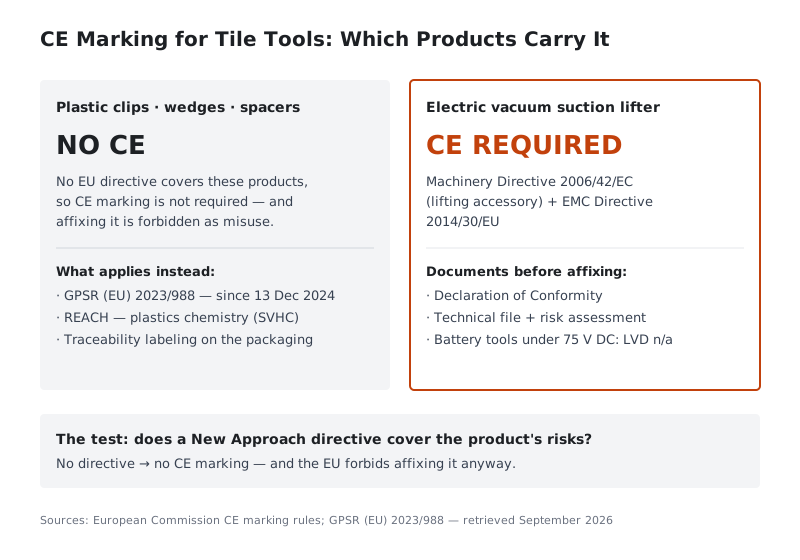
What Applies to Clips Instead: GPSR and REACH?
Two frameworks actually govern the bags. GPSR (EU) 2023/988, in force since 13 December 2024, applies to products sold in the EU where consumer use is reasonably foreseeable — and clips sold through builders' merchants and DIY channels qualify even when the invoice says B2B. It requires traceability information on the product or packaging (manufacturer name, postal address, product identifier) and, for sellers outside the EU, a responsible person established in the EU under Article 16. REACH (EC) 1907/2006 governs the resin itself — the SVHC substance list and restrictions apply to the polypropylene regardless of any marking question. GPSR is a residual rule: it steps in only where no other EU law covers the same risks, and for plain plastic clips, nothing else does.
What Goes in the EU Shipment File?
Four documents cover a clip shipment without a single wasted stamp:
- Material and REACH declaration. Resin type (100% virgin PP) plus an SVHC statement for the polymer — one page, issued per batch.
- Traceability labeling. Manufacturer name, postal address and product identifier on the packaging, exactly as GPSR expects — this is what the label on the bag is for, not a CE logo.
- EU responsible-person arrangement. If your channel reaches consumers, name the EU-established responsible person in the file before the container sails.
- Factory documents. ISO 9001 certificate and batch QC reports — the audit-based papers that actually predict consistent break behavior. For the full list of what each certificate proves, see our tile leveling system certifications guide.
Clip compliance is cheap when it is done right: no notified body, no directive, four documents. If you are quoting a container for the EU market, our tile leveling system wholesale supplier page lists the range, and the shipment file above ships with it.
Do tile leveling clips need CE marking to be sold in the EU?
No. CE marking is compulsory only for products covered by a New Approach EU directive, and no directive covers plain plastic tile leveling clips, wedges or spacers. In fact the European Commission forbids affixing CE to products outside its scope. What applies instead is GPSR (EU) 2023/988 — traceability labeling and an EU responsible person — plus REACH for the plastic material.
Why does an electric suction cup carry CE but the clips don't?
A powered vacuum lifter is a lifting accessory under the Machinery Directive 2006/42/EC and must also meet the EMC Directive 2014/30/EU, so CE marking is required, backed by a Declaration of Conformity and a technical file. Passive plastic clips fall under no directive, so there is nothing for CE to certify. For battery tools under 75 V DC, the Low Voltage Directive typically does not apply.
Is it legal for a supplier to put CE on clip packaging?
No. The European Commission treats CE marking on products not covered by any directive as misuse of the mark, and member-state authorities can act against it. A CE logo on a plain plastic clip bag is a red flag about the supplier's compliance literacy rather than evidence of extra safety.
What paperwork should an EU shipment of tile leveling clips include?
Four items: a material and REACH declaration for the resin; traceability labeling on the packaging with manufacturer name, postal address and product ID per GPSR; an EU-established responsible-person arrangement if the channel reaches consumers; and factory documents — ISO 9001 certificate plus batch QC reports. No CE documents belong in the file.
Every wholesale order ships with the compliance file — GPSR-ready labeling, REACH declaration, ISO 9001 and batch QC reports.
Request the EU Compliance File →