
Tile Warpage vs Lippage: Two Different Measurements
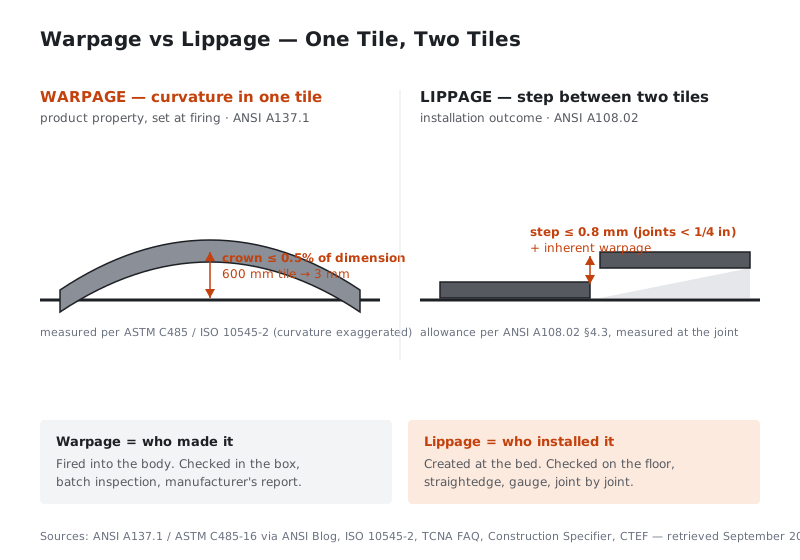
Warpage describes departure of a tile surface or edge from its intended plane. It exists in the individual tile before installation and can appear as centre curvature, edge curvature or corner lift. Lippage describes the vertical difference where two installed tile edges meet. A warped tile can contribute to lippage, but flat tile can also show lippage when the substrate, mortar bed, placement or adjustment differs across the joint.
Bottom line: start by naming the measurement. A straightedge or approved fixture on an individual tile evaluates warpage; a gauge across adjacent installed edges evaluates lippage. Neither result alone proves who caused the finished condition.
Use it before assigning a cause: warpage is measured within one tile, while lippage is measured across installed neighboring edges. After classification, use the tolerance page for acceptance limits or the large-tile page for a five-check site diagnosis.
Why 0.5% Is Not a Universal Warpage Limit
ANSI A137.1 does not give every ceramic tile the same percentage allowance. The Tile Council of North America lippage FAQ explains that allowable warpage varies by tile type and gives category-specific examples. The relevant table, tile classification, facial dimension and measurement direction must therefore be identified before a percentage is quoted.
The international measurement reference, ISO 10545-2:2018, covers dimensions and surface quality measurement for ceramic tiles and remains current after its 2024 review. A quick site check can flag a suspect batch, but a contractual pass/fail decision should use the method and acceptance criteria named in the purchase specification. The previous examples that automatically converted 600mm to 3mm and 1,200mm to 6mm have been removed because they treated one percentage as universal.
Why 0.8mm Is Not a Standalone Lippage Ceiling
The same caution applies to lippage. TCNA explains that ANSI A108.02 uses an applicable table allowance and adds the tile's actual inherent warpage under the stated conditions. Joint width and tile category affect which line applies. Quoting “0.8mm plus warpage” without those conditions makes a conditional provision sound universal.
For a claim, record the grout-joint width, tile type, actual inherent warpage and installed edge difference. Then compare the measurement with the correct ANSI table or the standard written into the contract. Our rectified tile lippage guide explains the installation variables that must be checked alongside the number.
The Five-Tile Stack Is a Screen, Not a Standard Test
Stacking several tiles face to face can reveal rocking, fanning or visible curvature quickly. It is useful for deciding whether to stop installation and sample more pieces. It is not a substitute for ASTM C485, ISO 10545-2 or the contract's named method, and it cannot assign liability by itself.
- Select pieces across cartons and record batch or lot identifiers.
- Photograph the stack and individual tiles on a clean, stable reference surface.
- Measure individual specimens using the specified method before installation continues.
- Preserve unopened samples when a supplier, laboratory or claims adjuster may need them.
Six Records Needed Before Assigning Responsibility
A sound claim file separates evidence instead of labelling the condition “factory” or “installer” from one photograph:
- Tile identity: product classification, nominal size, calibre, shade and production lot.
- Individual-tile measurement: method, direction, fixture and results for the sampled pieces.
- Substrate: flatness readings before installation and the specification applied.
- Layout: joint width, offset pattern, orientation and placement drawing.
- Installation: mortar, trowel, coverage checks, cure conditions and adjustment method.
- Finished surface: lippage readings at named joints, with lighting and observation conditions recorded separately.
Visual severity can change with grazing light even when the physical measurement does not. Contract wording and local standards decide responsibility; a tile leveling tool is one installation aid, not proof that either party complied.
What Leveling Clips Can and Cannot Do
Tile leveling clips and compatible wedges help hold adjacent edges in alignment while the setting bed cures. They do not flatten a substrate, straighten a fired tile body or replace correct mortar coverage. Excessive force can also move mortar or stress components, so use the selected system's instructions.
For large-format or visibly curved tile, approve the layout and joint strategy before installation. Avoid turning a familiar pattern recommendation into a universal rule: the suitable offset depends on the tile's measured warpage, project specification and manufacturer guidance.
Write a Verifiable Purchase Requirement
A useful purchase clause names the standard edition, tile category, test method, sampling plan and documents required. For example: “Supplier shall declare the product classification and applicable ANSI A137.1 or ISO 13006 category. Warpage shall be tested using the method named in the contract, with lot identification and results for the agreed sample.”
Do not promise a batch report unless the quotation requires and prices it. Do not insert one universal percentage. The buyer and supplier should approve the exact acceptance criterion before production.
Frequently Asked Questions
What is the difference between tile warpage and lippage?
Warpage is curvature measured within one tile. Lippage is the height difference between adjacent installed tile edges. Warpage can contribute to lippage, but substrate, mortar, layout and placement can also affect the installed result.
Is 0.5% the maximum warpage for every tile?
No. ANSI A137.1 criteria vary by tile type and measurement direction. Identify the tile category and applicable table before stating a percentage or converting it to millimetres.
Is 1/32 inch or 0.8mm the universal lippage limit?
No. TCNA explains that ANSI A108.02 applies table allowances under stated joint conditions and includes the tile's actual inherent warpage. The applicable category and joint width must be identified.
Can a five-tile stack prove a manufacturing defect?
No. A face-to-face stack is a useful field screen for visible curvature. A pass/fail claim requires the contract's named measurement method, representative samples and the applicable product criteria.
Want to discuss how this applies to your product range or installation system? Talk to the ZEBRA team →