
Why Do Floor Tiles Lift? 4 Causes and the Standard Behind Each
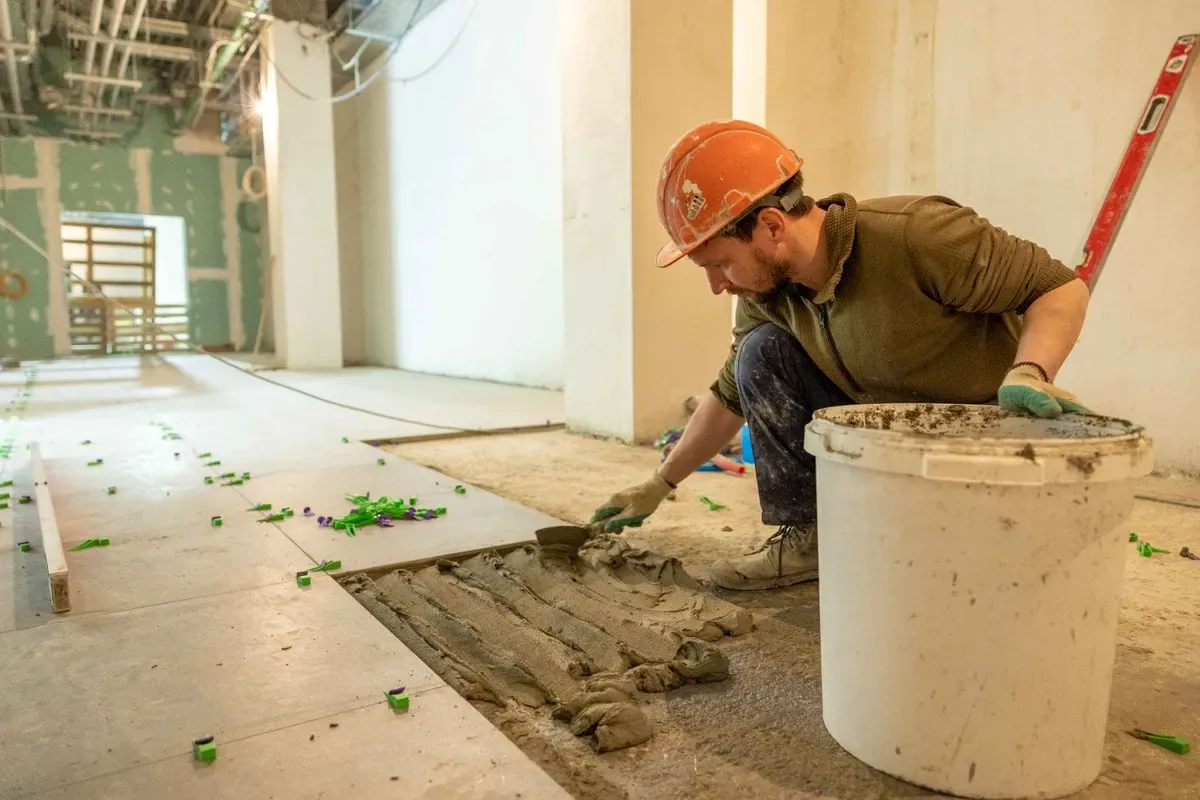
Then check mortar coverage (80% dry, 95% wet or exterior), moisture and heat, and substrate movement. Tenting usually has more than one of the four behind it.
Two rows of tile have risen into a ridge across the middle of a room, and the grout along it has cracked. Why do floor tiles lift like this when the floor was flat for years? The tile, the mortar and the slab all expand and contract at different rates with temperature and moisture. If the tile field has no room to move and the bond is weaker than the stress, the tiles release upward. The trade calls it tenting.
ZEBRA TOOLS, a tile leveling system manufacturer in Zhejiang, China, writes this for distributors and tile contractors who get the call afterwards. It traces each cause to a published standard so you can check a failed floor against numbers, not opinions. ZEBRA's clips and wedges do not prevent tenting; the scope here is diagnosis and what a reset has to include.
Why Do Floor Tiles Lift? Stress Against Bond
LATICRETE's technical data sheet on movement joints puts it plainly: all buildings move, and the substrate, adhesive and tile each expand and contract at different rates, which stresses the installation (LATICRETE TDS 256, R 6 February 2020, retrieved October 30, 2026). Grout and tile are rigid, so that movement has to go somewhere.
Two things decide whether it goes upward. The first is restraint: tile butted tight against walls, columns or another floor finish has nowhere to expand. The second is bond: a tile with voids under it or poor contact releases at a lower stress. CTaSC, a tile failure consultancy, notes that tenting normally follows several compounding conditions over years, not one event (CTaSC, retrieved October 30, 2026).
Bottom line: a lifted floor is a stress problem before it is an adhesive problem. Find what restrained the tile and what weakened the bond, or the reset will fail the same way.
4 Causes and the Number to Check for Each
| Cause | What to check | Published figure |
|---|---|---|
| Missing movement joints | Field joints, perimeter gaps, changes of plane, transitions | Interior every 20–25 ft (6.1–7.6 m) each way; sun, moisture or exterior every 8–12 ft (TCNA EJ171) |
| Low mortar coverage | Contact on the back of a lifted tile | 80% dry interior; 95% wet and exterior; full support at corners and edges (ANSI A108.5) |
| Moisture and heat | Leaks, wet slabs, sunlit areas near glazing | Sunlit or wet interiors move to the 8–12 ft joint interval |
| Substrate movement | Deflection, shrinkage, flatness | L/360 deflection for ceramic and porcelain; flatness per ANSI A108.02 |
1. Missing or blocked movement joints
Check this first: every source cited here links tenting to missing or blocked joints. TCNA's EJ171 guideline places interior field joints at 20–25 ft in each direction, and at 8–12 ft for exterior work or interior floors with direct sunlight or moisture exposure (H.B. Fuller TEC technical bulletin, September 2020, retrieved October 30, 2026). LATICRETE adds that perimeters, floor-to-wall and wall-to-wall corners, door jambs and transitions to other finishes need joints regardless of floor size, and that the tile-to-wall edge should at minimum be left open or filled with flexible sealant to prevent tenting.
A joint only works if it can move. LATICRETE TDS 256 describes a flexible sealant meeting ASTM C920 over a backer rod or bond-breaker tape, typically at least 1/4 in (6 mm) wide. A perimeter gap packed with mortar, grout or a rigid baseboard behaves as if it were not there. The design professional sets final joint locations for each project.
2. Low mortar coverage
Lift one of the released tiles and look at its back. ANSI A108.5 sets the minimum contact at 80% for dry interior floors and 95% for wet and exterior areas, with corners and edges fully supported. Isolated ridges of mortar, dry trowel lines or a skinned surface mean the tile was held at far less than its rated bond. The ANSI A108.5 mortar coverage requirements article covers how to check and record contact.
3. Moisture and heat
Water from a leak, a wet slab or a shower area, and solar heat through large windows, both increase movement. LATICRETE notes that rooms with lots of windows or direct sunlight may need more movement allowance. Find and stop the water source before any reset; re-laying tile over a wet substrate repeats the failure.
4. Substrate movement
A floor that deflects more than L/360 under load is too flexible for ceramic and porcelain tile, and a slab that shrinks as it cures pulls against a bonded tile field. Flatness matters too: a tile bedded over a hump or dip has uneven contact. The tile substrate flatness requirements article lists the ANSI A108.02 tolerances and how to measure them.
Is a Hollow-Sounding Tile About to Lift?
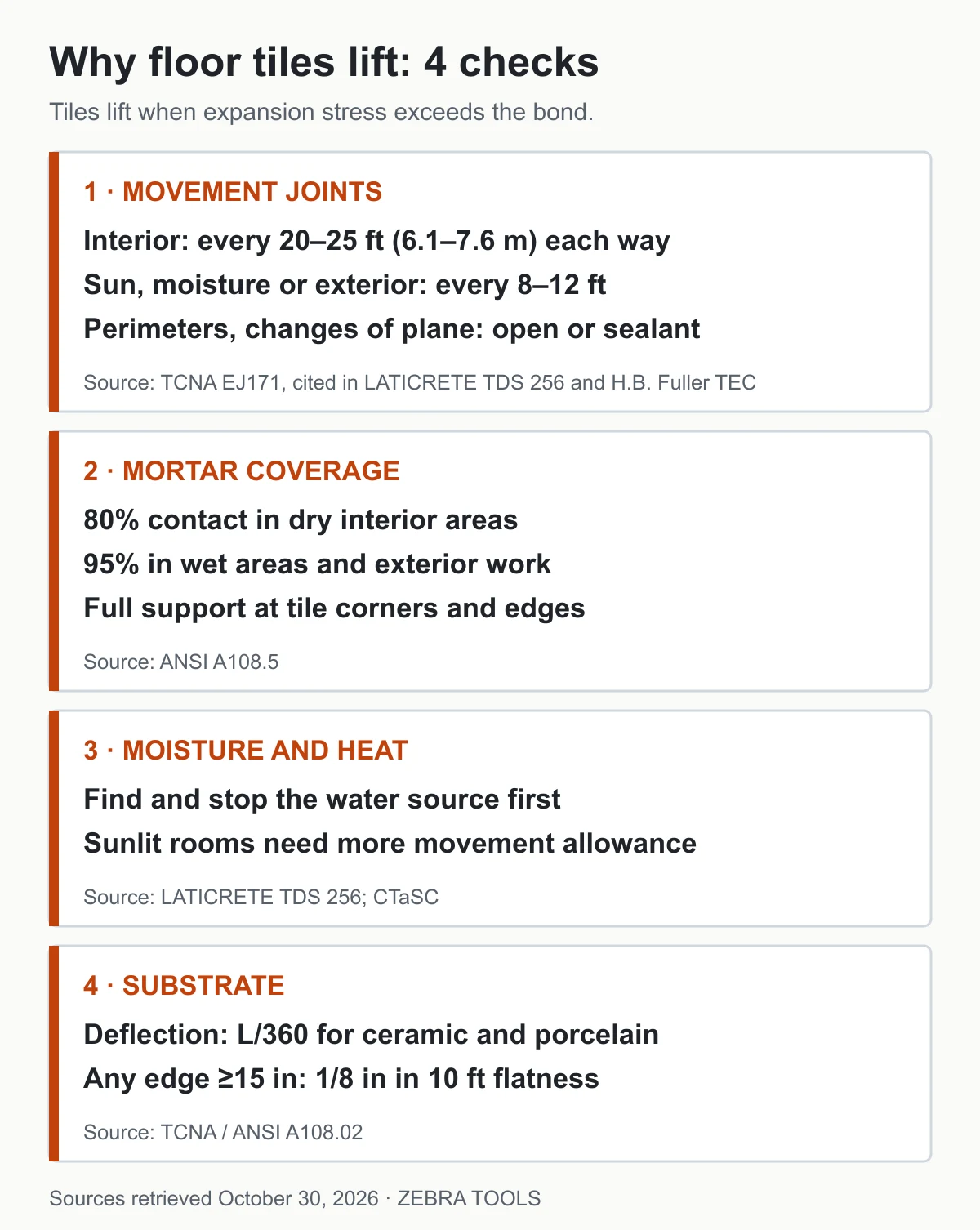
A tile that does not ring when tapped has a void or lost bond under that spot. That lowers the stress it can resist, but a hollow sound alone does not tell you the coverage or predict when the tile will move. Treat it as a map, not a verdict:
- Tap the floor in a grid and mark hollow tiles on a plan with the date.
- Recheck after a few weeks; a hollow area that grows points to active movement.
- Where a repair is planned, lift one marked tile and compare its contact against the 80% or 95% minimum.
How to Fix Lifting Floor Tiles Without a Repeat
- Make the area safe. Tented tile has sharp, raised edges; keep traffic off it.
- Find the extent. Tap-test around the ridge and mark every hollow or loose tile.
- Name the cause. Work through the four checks above. Expect more than one.
- Remove the restraint. Open the perimeter and add the missing field joints with backer rod and ASTM C920 sealant, at the locations the design professional sets.
- Reset with the required coverage. Clean the substrate, fix moisture and flatness faults, and re-bed the tiles to the 80% or 95% minimum with full edge support.
A spreading failure, a failure soon after a leak or one across a large area needs an on-site inspection before any work. Regluing the raised tiles alone leaves the stress where it was.
Do Large Floor Tiles Lift or Crack More Easily?
Large tile tolerates less error rather than failing by itself. ANSI A108.02 requires 1/8 in in 10 ft flatness for tile with any edge 15 in or longer, against 1/4 in in 10 ft for smaller tile. Tile defined as large format in ANSI A108.T (a facial dimension over 23 in) spans more of any hump or dip in the bed, so uneven contact is more likely unless the bed is flat and fully covered. The large format tile installation guide covers the full set of large-tile requirements.
Leveling systems belong to this stage but have a clear boundary. Tile leveling clips and wedges hold adjacent edges flush while the mortar cures; they do not create bond, mortar coverage or movement joints. Distributors who stock a tile leveling system wholesale range should sell clips alongside that message, so a lifted floor is not blamed on the wrong product.
Lifting Floor Tile FAQ
How far apart should movement joints be in a tile floor?
TCNA EJ171, as cited by LATICRETE TDS 256 and an H.B. Fuller TEC technical bulletin, places interior field joints every 20–25 ft (6.1–7.6 m) in each direction, and every 8–12 ft for exterior work or interior floors exposed to direct sunlight or moisture. Perimeters, changes of plane and transitions to other materials need joints regardless of floor size. The design professional sets the final locations.
Can you glue lifted floor tiles back down?
Not as a fix on its own. A tile lifts when expansion stress beats its bond; regluing it without removing the restraint leaves the same stress in place. Remove the affected tiles, add the missing perimeter or field joints, correct moisture or substrate faults, and reset with the coverage ANSI A108.5 requires: 80% in dry interiors, 95% in wet and exterior areas.
Does a hollow-sounding tile mean it will lift?
Not necessarily. A hollow sound marks a void or lost bond under that spot, which lowers the stress the tile can resist. It does not measure coverage. Map the hollow area, watch whether it grows, and lift a tile to check contact against the 80% or 95% ANSI A108.5 minimum before deciding on a repair.
Do large floor tiles crack or lift more easily?
They tolerate less error. ANSI A108.02 tightens substrate flatness for tile with any edge 15 in or longer to 1/8 in in 10 ft, against 1/4 in in 10 ft for smaller tile, and every tile needs full support at corners and edges. A large tile on an uneven or under-covered bed has fewer contact points to hold it, so the same stress releases it sooner.
Customers Asking Why Their Floor Lifted?
Want to discuss how this applies to the installers you supply, or which clip and wedge specs to stock for large tile? Talk to our team.
Talk to Our Team →