
An ET14000 authorization applies from its grant date, not retroactively.
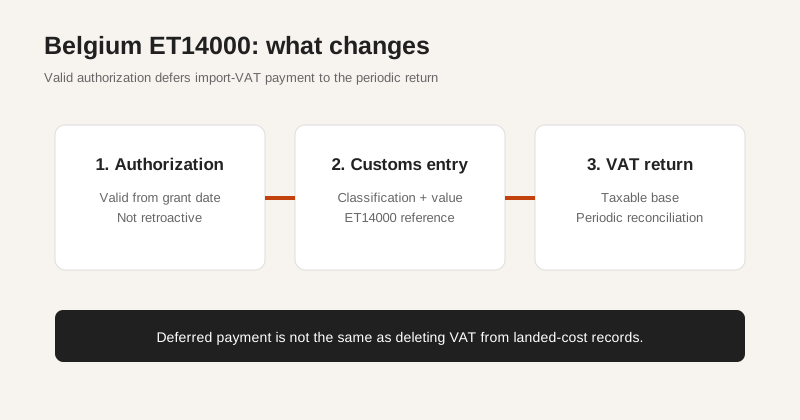
Bottom line: ET14000 can remove import-VAT pre-financing for an authorized business, while the importer still needs defensible tariff, product, declaration and accounting records.
4 official checks to import tile leveling systems to Belgium
- EORI: confirm the economic operator and declarant under the EU EORI rules.
- TARIC: check the exact product and entry date in the daily-updated EU database.
- ET14000: the Belgian Finance guidance explains eligibility, MyMinfin application and periodic-return treatment.
- Product scope: determine applicable safety and marking rules; CE applies only to covered product groups.
ET14000 changes timing, not the tax record
The authorization defers import-VAT payment until the periodic return, so the importer does not pre-finance it through customs. The taxable base and return entries remain part of the accounting trail. Confirm that authorization is valid before entry and retain the customs and return reconciliation. Do not describe deferred VAT as a universal zero-cost border.
Separate product families before classification
Plastic clips and wedges, pliers, retail kits and powered equipment should have separate product fact sheets. Include composition, function, photographs and packaging. Save the classification rationale and current TARIC output; repeat the review if the product or set changes.
Antwerp route decisions need a total-cost view
Ask the forwarder for the cargo-ready date, service, transshipment, destination charges, free time, clearance and inland warehouse delivery. Compare all-in current routes instead of publishing one transit range or assuming port scale guarantees the lowest cost.
A 6-record Belgian import file
- SKU facts and approved sample reference
- EORI, importer and declarant assignment
- Dated TARIC result and product-rule assessment
- ET14000 authorization status where used
- Invoice, packing list and transport document
- Entry, VAT-return and warehouse reconciliation
Start with our tile leveling clips, tile leveling wedges and tile leveling system wholesale supplier pages. Use the tile leveling landed-cost method for current charges.
Separate customs, VAT and product roles
The supplier provides product and shipment facts. The importer owns classification, valuation and product-market obligations. The customs representative submits the agreed declaration, and the VAT team reconciles ET14000 entries to the periodic return. Make these roles explicit before shipment so an authorization number, model mismatch or incorrect value is not discovered after arrival.
Belgium as a distribution hub requires two cost views
For Belgian local sales, model the entry and Belgian warehouse cost. For onward distribution, add the second-country transport, inventory handling and VAT/reporting consequences relevant to that movement. Port access alone does not prove a Benelux or cross-border margin. Compare the complete operational path for the intended customers.
Private label and repeat-order control
Freeze product model, joint size, material, pieces per bag, bilingual artwork, responsible-party details and carton marks. On every reorder, ask whether the material, geometry, factory, packaging or kit composition changed. Recheck classification and product evidence when a change affects the approved file.
Close the loop at the warehouse
Count cartons by SKU, inspect damage and verify joint-size labels and pack counts against the packing list. Keep photographs and discrepancy records before stock is redistributed. Customs and VAT records should reconcile to what was actually received.
As the EU importer you are also the GPSR responsible person for China-made tools, and suction cups move to the Machinery Regulation on 20 January 2027; both are covered in GPSR for tile leveling tools.
Frequently asked questions
What does Belgium's ET14000 authorization do?
Belgian Finance states that ET14000 defers payment of import VAT to the periodic VAT return, avoiding pre-financing at customs. It applies from the authorization date and requires periodic Belgian VAT returns.
Is ET14000 automatic for every Belgian importer?
No. The business applies through MyMinfin and must satisfy the official conditions. Do not assume a future authorization covers goods cleared before it was granted.
What tariff code applies to tile leveling systems?
If the declarant confirms CN 3926 90 97 (other articles of plastics) for plastic clips and wedges, the EU duty is 6.5% and Belgian import VAT 21%: €65.00 + €223.65 = €288.65 per €1,000 of customs value (TARIC and Your Europe, checked October 31, 2026). Pliers, kits and powered tools need their own classification.
Is Antwerp always the lowest-cost route?
No. Compare the current sailing, destination charges, clearance and inland delivery. Antwerp may be operationally useful, but total delivered cost depends on the shipment and warehouse.