Genoa runs 28–35 days from Ningbo, and the mix that sells into Italy's renovation-driven market is 60% clips, 30% wedges, 10% spacers and accessories.
Why Italy's Tile Market Sets the Demand
The Italian ceramic tile industry is a genuine world leader: 122 companies produced 369.8 million m² in 2024, roughly 80% of it exported, on a total turnover of €6.06 billion — about €5 billion of it from exports, the highest export value of any tile-producing country. Production concentrates in the Sassuolo district of Emilia-Romagna, and porcelain stoneware accounts for over 90% of output. Source: Confindustria Ceramica, 2024 industry data.
That industrial base matters for an importer in a specific way: Italian tile brands and the installers who lay their product expect the accessories underneath to match the tile's standard. Large-format porcelain — 60×120cm, 120×120cm and up — dominates the premium segment, and large-format tile is precisely where leveling becomes mandatory. The tile leveling clips and tile leveling wedges that Italian crews buy in volume are the same consumables the rest of Europe buys — but with a sharper emphasis on tolerance and certification, because a porcelain slab at €17/m² average ex-factory price does not tolerate a lippage redo. Source: Confindustria Ceramica (avg. tile price, 2024).
Bottom line: Italy imports under EU TARIC rules: HS 3926.90, 6.5% MFN duty on China-origin goods, 22% IVA, EORI mandatory. Genoa is 28–35 days from Ningbo. The market runs on documentation — CE plus a TÜV Rheinland credential is the difference between a quote and a reorder — and a 500-bag LCL trial order lands at roughly €800–1,000 all-in.
How Much Does Importing Tile Leveling Systems to Italy Cost?
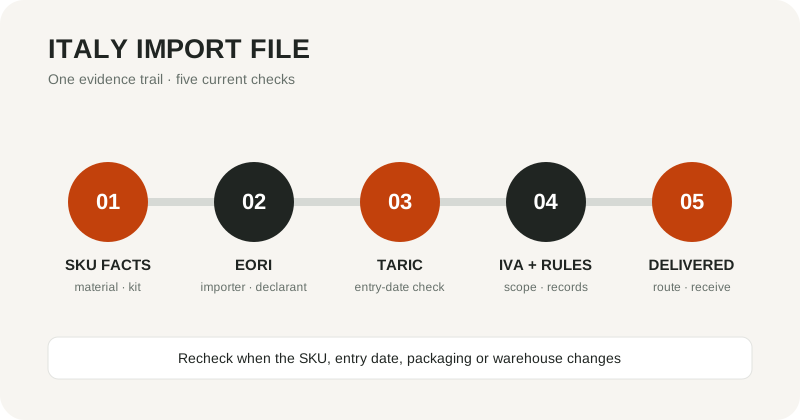
Italian customs applies EU rules with one local name: IVA (imposta sul valore aggiunto) at 22% for standard goods. It is charged on the CIF value (goods + freight + insurance) plus the customs duty — so the tax base is duty-inclusive. There is no €22 VAT exemption anymore: it was abolished in July 2021, so every commercial shipment from China is subject to IVA. Sources: commenda.io Italy import VAT guide; China Top Freight — customs clearance China to Italy (2025).
On the duty side, tile leveling clips, wedges and spacers classify under HS 3926.90 (other articles of plastics). For goods of Chinese origin, the EU TARIC subheading 3926.90.97 carries a most-favoured-nation duty of 6.5%. That is the number to build your landed-cost model on — verify it against the TARIC database for your exact subheading before quoting, but 6.5% is the standard for this product family.
Two practical consequences: the IVA is not recoverable by an EU buyer until it is offset through their local VAT return (fine for a registered importer, a real cost for a pass-through trader), and the tile leveling system wholesale supplier price you negotiate FOB Ningbo is only the first layer of the total. Most Italian distributors work on a CIF or DDP basis precisely so the duty and IVA handling sits with one accountable party.
Genoa, La Spezia, Trieste — Where Your Container Lands
Two ports handle the overwhelming share of China–Italy container volume: Genoa (roughly 40%) and La Spezia (roughly 30%). Both are on the Ligurian coast with weekly direct sailings from Ningbo and Shanghai. Source: allbestshipping.com China–Italy transit time guide (2026).
| Port | Ningbo Transit | Share of China–Italy Volume | Best For |
|---|---|---|---|
| Genoa | 28–35 days | ~40% | Northern & Central Italy, largest Italian gateway |
| La Spezia | 28–34 days | ~30% | Same northwest range, slightly faster sailings |
| Trieste | 30–38 days | — | Adriatic gateway, rail into Central & Eastern Europe |
For a first container, Genoa is the default — it is Italy's largest gateway and the transit time is well documented. Route via Suez adds roughly 28–35 days vessel time depending on the sailing; expect 3–5 days of port handling and clearance on top. If your buyers sit in the northeast or you plan to re-export into Central Europe by rail, compare Trieste — its Adriatic position and rail links change the door-to-door math. Sources: FreightAmigo, Efanda Logistics — China to Italy sea shipping (2026).
Documentation & Compliance: EORI, CE and the Italian Reality
1. EORI is mandatory. Any business importing into Italy from outside the EU needs an EORI (Economic Operators Registration and Identification) number. Registration is free through the EU customs portal and takes 5–10 business days. No EORI, no customs clearance — your freight forwarder will ask for it before booking.
2. CE marking is required; TÜV is the differentiator. Tile leveling tools placed on the Italian market must carry CE marking — a self-declaration required for EU market access. But Italian buyers, raised in a certification-heavy tile industry, read credibility differently: TÜV Rheinland factory certification (verifiable on certipedia.com) is the signal that separates an actual tile leveling system manufacturer from a trader. Our Wenzhou factory holds both CE (4 certificates) and TÜV Rheinland certification with annual on-site audit.
3. The duty threshold only matters for samples. Shipments with FOB value up to €150 are exempt from customs duty — a 5–10 bag sample order sits under the threshold and clears duty-free. IVA applies on everything, so samples still carry a small IVA component unless you route them as low-value samples through a courier's formalities. For real wholesale volumes, duty and IVA are simply part of the landed-cost line.
The Product Mix That Sells in Italy
Order patterns from our Wenzhou factory to Italian distributors look similar to the rest of Western Europe, with one tilt: Italian crews work heavily in large-format porcelain, so 1.5mm and 2.0mm clip sizes lead and reusable wedges over-index because Italian professionals value multi-project reuse.
| Product | SKU | MOQ | Italian Market Fit |
|---|---|---|---|
| Tile Leveling Clips | BM-021, 10 models | 500 bags | ~60% of order volume. Consumable; 1.5mm and 2.0mm lead. Universal compatibility with Raimondi, Rubi and QEP systems is expected. |
| Tile Leveling Wedges | BM-C01, 11 models | 500 bags | ~30% of order volume. Reusable PE rated 100+ cycles — Italian professionals pay for durability, and it is the highest-margin accessory line. |
| Y-Shaped Tile Spacers | BM-T03-YSPR | 1000 bags | ~5–10% and growing. Y-leg locks cross joints level on wall tile — valued for porcelain wall work where a standard cross only sets the gap. |
| Cross Tile Spacers | BM-T01-SPCR | 1000 bags | Base accessory line; 1.0–10.0mm coverage. The budget-friendly complement in mixed orders. |
Italian distributors typically open with a 60% clips / 30% wedges / 10% spacers split, then expand spacers and accessories on reorder once demand patterns are clear. The tile leveling systems range is deliberately built so the whole first container comes from one factory — one inspection, one TÜV file, one set of customs documents.
First Order: A 500-Bag LCL Trial to Genoa
Here is the full landed-cost math on the trial order that works for Italy, using our actual wholesale pricing:
⚖️ Guide prices are subject to raw material cost fluctuations — contact us for current pricing.
| Cost Line | Amount | Notes |
|---|---|---|
| FOB — 500 bags (300 clips + 150 wedges + 50 spacers) | ~$375 | Mixed line at $0.70–0.85/bag |
| LCL freight, Ningbo → Genoa | $300–450 | ~8 cartons, 60 bags/carton |
| Customs duty (6.5% of CIF) | $44–54 | TARIC 3926.90.97, China-origin MFN |
| IVA (22% of CIF + duty) | $158–193 | Duty-inclusive tax base |
| Total landed | $877–1,072 ≈ €800–1,000 | All-in, delivered to Genoa |
At 35–55% distributor markup, that trial generates €350–550 of gross margin on sell-through — and, more importantly, tells you which clip sizes your market actually consumes before you commit to a 20ft or 40ft container. A 20ft loads 15,000+ bags; a 40ft HQ roughly 36,000+. Both ship FOB Ningbo with full documentation: invoice, packing list, bill of lading, certificate of origin, CE and RoHS.
Reaching Italian Buyers: Distributor, Retail & Private Label
1. Supply the tile brand ecosystem directly. Italy's strength is its density of tile producers and specialty distributors (piastrelle showrooms, tile wholesalers). These businesses already spec leveling systems for their customers; a factory-direct supply with TÜV documentation and batch traceability is a clean proposition, and margins run 30–40% on consumables with 6–8 week reorder cycles.
2. OEM private label for Italian tile brands and chains. Because the market associates quality with a brand name, private label is the strongest channel in Italy: your own label on a box of clips that carries CE + TÜV + a German- or Italian-language pack. Our tile leveling system OEM program covers private-label packaging, Pantone color matching, and custom molds — the same factory that makes the clips puts your name on the bag.
3. E-commerce for the renovation wave. Italian renovation activity keeps the DIY and small-contractor segment buying online. A focused Amazon.it presence (Italian-language listings, EUR pricing, TÜV badge) reaches that channel without a physical sales force, and pairs cleanly with the OEM route for your own marketplace brand.
Frequently Asked Questions
What import duty and VAT apply to tile leveling systems in Italy?
Tile leveling clips, wedges and spacers classify under HS 3926.90; for Chinese-origin goods the EU TARIC subheading 3926.90.97 carries an MFN duty of 6.5%. Italy's standard VAT (IVA) is 22%, charged on the CIF value plus the customs duty. The old €22 VAT exemption was abolished in July 2021, so IVA applies to every commercial import.
Do I need an EORI number to import into Italy?
Yes — an EORI (Economic Operators Registration and Identification) number is mandatory for any business importing into Italy from outside the EU. Registration is free via the EU customs portal and takes 5–10 business days. Your freight forwarder cannot clear customs without it.
Which Italian port should I ship to, and how long does it take?
Genoa handles roughly 40% and La Spezia roughly 30% of China–Italy container volume. Ningbo to Genoa runs 28–35 days and Ningbo to La Spezia 28–34 days, with weekly direct sailings via Suez; add 3–5 days for port handling and clearance. Trieste is the alternative for northeast Italy and Central European rail connections.
What does a trial order to Italy cost landed?
A 500-bag LCL trial order (300 bags clips, 150 wedges, 50 spacers) lands in Genoa at roughly €800–1,000 all-in: about $375 FOB, $300–450 LCL freight, 6.5% duty on CIF, and 22% IVA on the duty-inclusive base. It generates €350–550 gross margin at a 35–55% distributor markup and tells you which clip sizes sell before you commit to a full container.