
The import permit must identify the correct importer for an input-tax claim.
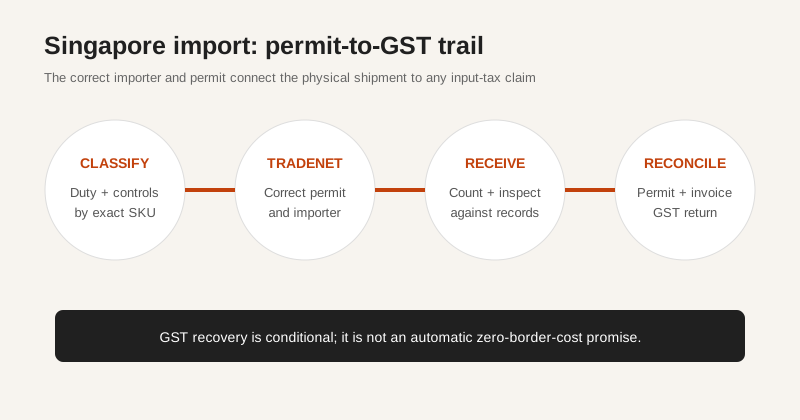
Bottom line: Singapore has a structured digital import process. The commercial advantage comes from accurate permits, recoverable-cost evidence and efficient current logistics—not from assuming every importer has zero border cash or a guaranteed retail margin.
5 official checks before a Singapore import
- Classify the SKU. Separate plastic clips, wedges, pliers, kits and powered tools.
- Check duty and controls. Singapore Customs' import procedures identify the main dutiable categories and require importers to check HS and competent-authority controls.
- Select the movement. Local consumption, FTZ or warehouse storage, temporary entry and re-export use different permit logic.
- Submit through TradeNet. The official TradeNet service is the national single window for import, export and transhipment permit applications.
- Confirm GST records. Follow IRAS import GST guidance for taxable value, eligibility and supporting permits.
Non-dutiable does not mean no import process
Singapore Customs lists intoxicating liquors, tobacco, motor vehicles and petroleum products as the broad dutiable groups. A tile tool may therefore be non-dutiable after correct classification, while import GST and permit requirements can still apply. Check whether the item is controlled and whether the movement qualifies for a special scheme, exemption or suspension.
Import GST recovery depends on evidence
IRAS explains that GST is generally charged on CIF value, duties and relevant incidental charges. A GST-registered business may claim paid import GST subject to input-tax conditions. The import permit should name the correct importer, and the permit value must be reconcilable with invoices and the GST return. Do not describe GST as automatically “coming straight back.”
Choose the correct TradeNet permit
The importer or declaring agent should determine whether goods enter local consumption, storage, temporary import or another procedure. Prepare invoice, packing list, transport document and any competent-authority approval. If the declared importer, value or quantity is wrong, correct the permit and tax records through the applicable process.
Build the landed-cost model without retail-margin claims
Separate goods value, origin charges, freight, insurance, customs value, duty if any, import GST, permit or agent fees, destination handling and delivery. Show the GST cash event and any eligible claim separately. Use current freight and actual received saleable units. A local retail listing does not prove a distributor's margin because channel fees, warehousing, damage, marketing and tax differ.
A 6-record Singapore receiving file
- SKU facts and classification rationale
- Control-status check and approvals where applicable
- TradeNet permit naming the correct importer
- Invoice, packing list and transport document
- GST and input-tax reconciliation
- Warehouse carton, size, count and damage record
Review our tile leveling clips, tile leveling wedges and tile leveling system wholesale supplier pages, then calculate current charges with the tile leveling landed-cost method.
Importer, declaring agent and supplier roles
The supplier provides accurate model, composition, value, origin and packing information. The importer decides the commercial movement and remains responsible for correct records. A declaring agent submits the TradeNet application from those instructions. Review the draft product description, importer identity, value and quantity before permit approval.
Private-label packaging needs traceability
Freeze the model, joint size, pack count, importer or responsible-party details, barcode and warnings before printing. Keep the same model name across packaging, invoice, permit data and receiving system. If the factory substitutes a kit component or changes composition, recheck classification and control status before dispatch.
Correct discrepancies before claiming input tax
At receipt, compare cartons and quantities to the permit and packing list. If the importer name, value or quantity is wrong, follow the official correction process and reconcile the revised documents before making the GST claim. Warehouse photographs and count records help connect the physical shipment to the permit.
Frequently asked questions
Are tile leveling products automatically duty-free in Singapore?
Singapore Customs identifies four broad categories of dutiable goods, but the importer should still classify the exact clips, wedges, pliers, kits or powered tools and check whether they are controlled, exempt or subject to another requirement.
Is import GST automatically recovered?
No. IRAS says a GST-registered importer may claim import GST only when the input-tax conditions are met and the import permit supports the claim with the correct importer.
What permit is used for a commercial import?
Singapore Customs requires the importer or declaring agent to determine the movement and obtain the appropriate TradeNet permit. The permit type depends on whether goods enter local use, storage, temporary admission or another scheme.
How long does shipping from China to Singapore take?
Obtain a current quote tied to the cargo-ready date, service, consolidation, permit, clearance and final delivery. A historical direct-sailing range is not a door-to-door commitment.