
Confirm all five before production release.
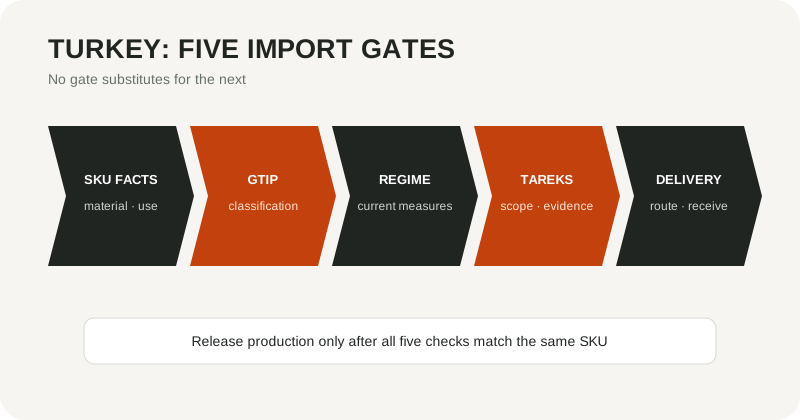
Bottom line: Turkish import controls are product-specific and current-date dependent. Match the physical model to tariff, product-safety and declaration records.
5 official checks
- Create a product fact sheet.
- Use Ministry of Trade tariff classification guidance.
- Check the current Turkish tariff schedule.
- Check exact product scope in TAREKS.
- Quote the confirmed shipment and warehouse.
GTIP cannot be copied across the range
Plastic clips, mixed-material pliers, retail kits and powered tools have different facts. Retain composition, function, photos and packaging. When uncertainty affects a planned import, consider binding tariff information.
Add net weight, origin, unit count and how each item is presented at the border. Give the same file to the supplier, importer and customs representative. Archive the dated classification rationale and reopen it after changes to material, motor, kit contents or retail presentation.
TAREKS is risk-based
The Ministry describes TAREKS as an electronic, risk-based control system for product safety and technical compliance. Check whether the exact GTIP and regulation enter its scope and what evidence the importer must submit. Do not treat a CE file as automatic clearance.
Record which product rule was checked, the result, required registration or evidence and the person responsible for submission. The answer can differ between a passive plastic clip and a powered tool. Complete this check before artwork and production release so missing Turkish information can be corrected at source.
Build current landed cost
Separate goods, origin charges, freight, insurance, customs value, duties/taxes, product-control costs, destination handling and inland delivery. Date the inputs and list exclusions.
Use the exact importer, cargo-ready date and warehouse in the model. State the currency and exchange-rate date. Because tariff measures and logistics inputs can change, preserve formulas and source dates instead of publishing one permanent landed percentage.
Packaging and receiving
Freeze Turkish product name, model, origin, importer details, count and warnings where applicable. Match these to invoice and declarations. At receipt, quarantine substitutions or mismatched labels before sale.
Retain approved artwork, a photographed production sample and a pre-shipment inspection record. Count cartons by SKU, open a defined sample and check joint size, pieces per bag and visible damage. Link every discrepancy to the purchase order and production batch.
Choose the route from the final warehouse
Compare current sailings, transshipment, free time, destination charges, customs support and inland delivery using final carton measurements. A quoted port transit is only one segment. Requote after the ready date, packing plan or delivery city changes, and identify which party carries delay and inspection charges.
Give the broker the approved product and label file before booking, then confirm whether control processing affects the proposed port or schedule. Put documentation deadlines beside the production milestones. This prevents a finished shipment from waiting while the importer rebuilds evidence that could have been agreed before loading.
Six retained records
- SKU facts
- GTIP rationale
- Import-regime/TAREKS result
- Approved labels/evidence
- Shipment documents
- Entry and receiving reconciliation
Review our tile leveling clips, tile leveling wedges and tile leveling system wholesale supplier, then use the landed-cost method.
Frequently asked questions
What GTIP applies to tile leveling systems?
Determine the Turkish tariff classification from the exact material, function and presentation. Clips, pliers, kits and powered tools should be reviewed separately; binding tariff information is available for planned imports.
Does every tile leveling product go through TAREKS?
No universal answer should be assumed. Check the current product-safety legislation and risk-based TAREKS scope for the exact GTIP and product.
Can an EU or CE document guarantee Turkish clearance?
No. Documents may support the file when relevant, but classification, current import regime and product-specific Turkish requirements control the entry.
How long does China-to-Turkey shipping take?
Use a current quote tied to cargo-ready date, service, transshipment, customs and final delivery. Historical port ranges are not commitments.