
A clip may perform both jobs only when its molded spacing width matches the required joint and the model instructions approve that use. Keep separate spacers available for boundaries, openings, layout changes, and wider joints.
Bottom line: do not assume every leveling clip replaces every tile spacer. Read the clip’s stated joint width, compare it with the drawing or tile specification, and add separate spacers wherever the clip cannot define or hold that joint.
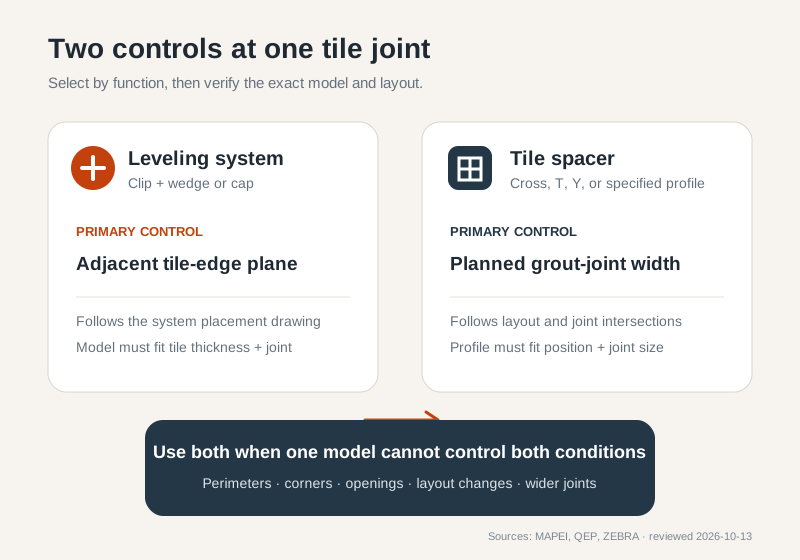
Tile Leveling System vs Spacers: The Functional Difference
A spacer is a width reference. It holds tile edges apart so the installer can maintain the planned grout joint. A clip-and-wedge system adds restraint across the joint: the clip sits beneath adjacent tiles and the wedge applies pressure through the clip opening, helping hold those edges in the same plane while the setting material cures.
That difference explains why the categories overlap without becoming identical. MAPEI describes its EasyWDG components as lippage-control clips available in defined widths from 1.5 to 5mm. Its reusable Easy T product is suitable by itself for a 1.5mm joint; MAPEI instructs users to combine it with conventional tile spacers for wider joints up to 6mm. See the MAPEI EasyWDG system and MAPEI Easy T guidance.
| Decision | Leveling clip + wedge | Ordinary spacer |
|---|---|---|
| Primary control | Adjacent edge alignment | Grout-joint width |
| Width selection | Use the model’s molded width | Use the specified joint size |
| Placement | Along edges per system drawing | At joints or intersections per layout |
| Quantity basis | Tile dimensions and clip pattern | Tile pattern and spacer positions |
When One Leveling Clip Can Perform Both Jobs
A clip may provide lippage restraint and establish a joint at the same location when three conditions are satisfied: its stated spacing width matches the planned joint, the tile thickness fits the clip’s working range, and the manufacturer’s instructions approve the application. QEP’s LASH instructions, for example, describe its clips and wedges as components that level, align, space, and hold tiles. That claim applies to the identified LASH system, not automatically to another clip with a similar shape. See the QEP LASH product sheet.
For ZEBRA models, select the tile leveling clips by the published tile-thickness and joint-width specification. A buyer should identify the model and thickness on the quotation, approved sample, package label, and packing list. Color or visual similarity is not a reliable substitute for those records.
5 Places Where Separate Tile Spacers Still Help
Even when the clip creates the correct joint along ordinary tile edges, a layout can contain positions where the clip base does not fit or does not define the full geometry. Keep separate spacers for these five cases:
- Perimeters and wall returns: the final edge may not accept a clip beneath two neighboring tiles.
- Door frames and penetrations: cut pieces can leave too little access for the leveling component.
- Inside and outside corners: the joint direction changes and may require a different spacer profile.
- Pattern transitions: running bond, borders, inserts, and mixed formats create intersections that do not match the standard clip pattern.
- A wider specified joint: if the clip creates 1.5mm but the drawing requires 3mm, use the appropriate separate spacer rather than estimating the extra gap.
QEP’s floor-and-wall installation manual treats ordinary spacers as the tool for uniform grout lines and recommends leveling clips and wedges for large-format tile alignment. RONA’s installation guide likewise advises keeping matching spacers for locations where clips cannot fit, including wall edges, door frames, and difficult corners. See the QEP installation manual.
Do Not Copy the Clip Count Into the Spacer Order
There is no universal one-to-one or fixed clip-to-spacer ratio. A clip pattern follows tile perimeter, tile dimensions, system instructions, and the approved placement drawing. Cross, T-shaped, or other spacers follow joint intersections and the layout pattern. One position may use a clip as the joint reference; another may require only a spacer; a difficult boundary may require a different profile.
Calculate the two lines independently. Use the tile spacer quantity guide for layout-based spacer planning and the separate clip calculation for the chosen system. Then add only a documented project allowance. A distributor should avoid marketing one bag count as universal coverage across tile formats.
What Neither Product Can Correct
Neither clips nor ordinary spacers repair an unsuitable substrate, create mortar coverage, remove inherent tile warpage, or replace movement-joint requirements. The Tile Council of North America explains that substrate plane, actual tile warpage, joint width, and lighting all influence perceived lippage. It also notes that tile installed over an uneven substrate may fail to meet lippage standards. See the TCNA lippage FAQ.
Check substrate requirements before selecting accessories. Our tile substrate flatness requirements page separates the substrate decision from the edge-restraint decision. If the base is outside the applicable requirement, correct it before relying on a leveling system.
A Buyer’s 4-Line Specification
For a wholesale or private-label order, specify four linked inputs: clip model and molded joint width; supported tile-thickness range; matching wedge or cap; and the separate spacer sizes needed by the target layouts. Include approved samples and package labels so warehouse staff can distinguish products after color customization.
ZEBRA’s cross tile spacers cover multiple joint widths, while other profiles serve different layouts. Ask the tile leveling system wholesale supplier to quote each model as a separate line rather than bundling “clips and spacers” into an undefined assortment.
Frequently Asked Questions
Do you need tile spacers when using a leveling system?
Sometimes. A clip can perform both roles only when three conditions match: its molded spacing width, the specified grout joint, and the model instructions. Separate spacers remain useful at perimeters, corners, openings, layout transitions, or whenever the required joint is wider than the clip.
Can tile leveling clips replace cross spacers?
Not universally. The two primary functions are edge restraint and joint-width control. Some clips perform both, but cross, T-shaped, or other spacers may still be required by the layout and system instructions.
Do leveling clips and tile spacers use the same quantity calculation?
No. Use two separate calculations: clips are positioned along tile edges according to the selected system placement drawing, while ordinary spacers are positioned according to the tile pattern and joint intersections.
Can spacers prevent tile lippage?
Ordinary spacers maintain grout-joint width but do not actively restrain two tile edges in the same plane. At least four other inputs matter: substrate flatness, actual tile warpage, mortar coverage, and installation workmanship.