
How Many Tile Spacers Do I Need? Per-m² Chart by Tile Size
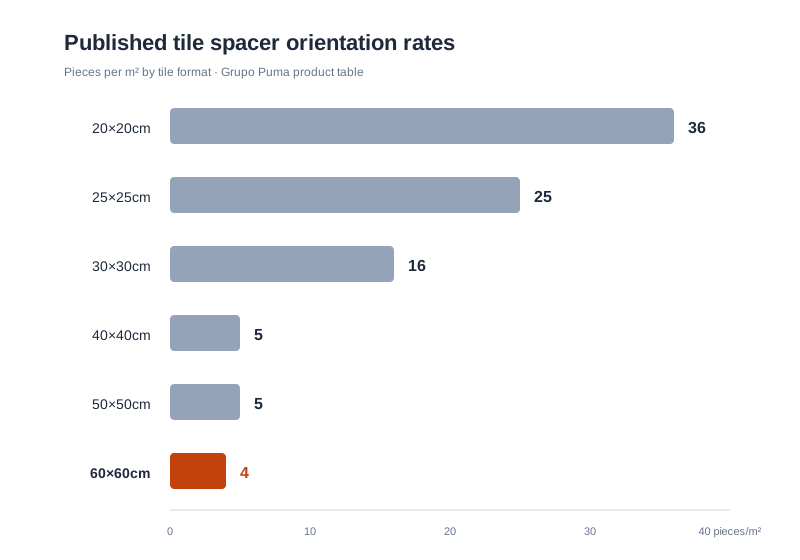
"How many tile spacers do I need?" has no honest one-number answer. The tile format matters, but so do the spacer profile and laying pattern. MAPEI states that spacer consumption depends on the layout and operational requirements; Grupo Puma publishes an orientation table ranging from 36 pieces/m² for 20×20cm tile to 4/m² for 60×60cm tile.
ZEBRA TOOLS manufactures cross, T-shaped and Y-shaped tile spacers in Zhejiang, China and supplies them wholesale to tile distributors. This guide separates published manufacturer guidance from planning examples so buyers can quote bags without copying a leveling-clip count into a different product.
Those Grupo Puma figures are an orientation table, not a universal standard. MAPEI says consumption depends on the tile layout, pattern and operational requirements.
Bottom line: use a published table only as a starting point. For 60×60cm tile, Grupo Puma lists 4 spacers/m², so 50m² needs 200 spacers, or two ZEBRA 100-piece bags before contingency. Confirm the final number from the chosen profile and placement drawing.
Why Tile Spacer Counts Do Not Use One Universal Formula
A cross spacer sits at a four-tile intersection in a straight grid. A T spacer serves a running-bond junction. A Y spacer is designed for a three-way intersection. Perimeter cuts, niches and changes in pattern add positions that square meters alone cannot describe.
That is why MAPEI lists consumption as dependent on the laying layout, pattern and specific operational requirements. It is also why the quantity of tile leveling clips per square meter should not be copied into a spacer order: leveling systems often place clips along edges, while ordinary spacers sit at pattern junctions.
Published Tile Spacer Chart: 4–36 Pieces per m²
The following consumption rates come from Grupo Puma's Tile Spacer orientation table. Project totals multiply the published rate by area; ZEBRA bag totals use 100 pieces per bag and round up. No contingency is included.
| Tile Size | Published Rate | One 100-pc Bag Covers | 50m² Project | 200m² Project |
|---|---|---|---|---|
| 20×20cm | 36/m² | 2.78m² | 1,800 (18 bags) | 7,200 (72 bags) |
| 25×25cm | 25/m² | 4.0m² | 1,250 (13 bags) | 5,000 (50 bags) |
| 30×30cm | 16/m² | 6.25m² | 800 (8 bags) | 3,200 (32 bags) |
| 40×40cm | 5/m² | 20m² | 250 (3 bags) | 1,000 (10 bags) |
| 50×50cm | 5/m² | 20m² | 250 (3 bags) | 1,000 (10 bags) |
| 60×60cm ★ | 4/m² | 25m² | 200 (2 bags) | 800 (8 bags) |
Sources: Grupo Puma Tile Spacer orientation table and MAPEI general catalog, retrieved September 29, 2026. Manufacturer rates are product and layout specific.
Bag Math: Divide 100 by the Published Rate
ZEBRA cross, T and Y spacers are packed 100 pieces per bag. Bag coverage is therefore 100 ÷ the selected rate. Using the published table above:
- 60×60cm: one bag covers 25m² at 4/m².
- 30×30cm: one bag covers 6.25m² at 16/m².
- 20×20cm: one bag covers 2.78m² at 36/m².
Do not treat those coverage figures as guarantees for another spacer profile. Check whether the job uses X, T, Y, vertical tombstone placement or another method, then count the drawing.
Worked Example: 200m² of 60×60cm Tile
This example starts with Grupo Puma's 4/m² orientation rate and shows a separate 5% project assumption. The allowance is illustrative, not an industry rule.
Replace the 5% example with the estimator's documented allowance after checking cuts, breakage, openings and pattern changes. A 200m² project needs eight full bags before contingency under this published rate.
Walls and Running Bond Need Their Own Layout Count
There is no universal percentage to add for walls. A straight wall may follow the same junction pattern as a floor, while niches, windows, outside corners and cut courses add placement points. QEP also notes that traditional removable spacers can be inserted vertically in tombstone style, which changes how many pieces are active at one time.
Running bond replaces some four-way intersections with T-junctions. Use a T-shaped tile spacer layout and count the elevation rather than multiplying a floor rate by a fixed wall factor.
Select the Profile Before You Set the Quantity
Cross tile spacers serve straight grid intersections, T profiles serve running-bond junctions, and Y-shaped tile spacers serve three-way layouts. Joint width is a separate specification: ZEBRA cross and T families cover 1.0–10.0mm, while the Y family covers 1.5–4.0mm.
For a wholesale order, record the profile, joint width, tile format, pattern and quantity basis on the quotation. The tile spacer types guide compares the product families; the tile leveling system wholesale supplier page covers mixed-container enquiries.
Frequently Asked Questions
How many tile spacers do I need per square meter?
There is no universal rate. Grupo Puma publishes 36/m² for 20×20cm tile, 16/m² for 30×30cm and 4/m² for 60×60cm, while MAPEI states that consumption depends on the layout, pattern and operational requirements. Use the selected product guidance and placement drawing.
How many tile spacers do I need for a 50m² floor?
Using Grupo Puma's published 4/m² rate for 60×60cm tile, 50m² needs 200 spacers, or two ZEBRA 100-piece bags before contingency. At its 16/m² rate for 30×30cm tile, the same area needs 800 spacers, or eight bags.
How many square meters does one bag of tile spacers cover?
A 100-piece bag covers 25m² at 4 spacers/m², 6.25m² at 16/m², or 2.78m² at 36/m². These examples correspond to Grupo Puma's published rates for 60×60cm, 30×30cm and 20×20cm tile respectively; another product or layout can differ.
Do walls need more spacers than floors?
There is no universal wall multiplier. Count niches, openings, outside corners, cut courses and the chosen installation method on each elevation, then apply the project-documented contingency.
How many spacers do 12×24 inch tiles need?
Tile dimensions alone do not establish an exact spacer count. A 12×24 inch tile is approximately 30×60cm, but the number changes with straight, running-bond or vertical spacer placement. Follow the selected spacer manufacturer's layout instead of reusing the 22/m² leveling-clip rate.
What size tile spacers should I order?
Match the spacer thickness to the specified grout joint and choose the shape for the pattern. ZEBRA cross and T-shaped spacers cover 1.0–10.0mm, while Y-shaped spacers cover 1.5–4.0mm. Confirm the architect or tile manufacturer's joint requirement before ordering.
Send the Layout Before You Order
Share the tile format, laying pattern, joint width and project area. We will match the spacer profile and confirm the bag basis before quoting.