
Tile Spacer Sizes: 1mm, 1.5mm, 2mm or 3mm?
Then match the joint geometry to Cross, T or Y and select a BM-P01–BM-P09 model that publishes that width.
Tile spacer sizes do not follow tile length: a 600×600mm tile does not automatically require a 2mm or 3mm spacer. The correct joint starts with the tile documentation, measured dimensional variation, installation method and project specification—not tile length by itself.
For distributors, contractors and OEM buyers, this guide maps those inputs to ZEBRA TOOLS' BM-P01–BM-P09 manufacturing records and separates catalog availability from installation guidance. Bottom line: establish the required joint first, choose the profile for the actual intersection, then approve the exact model and physical sample.
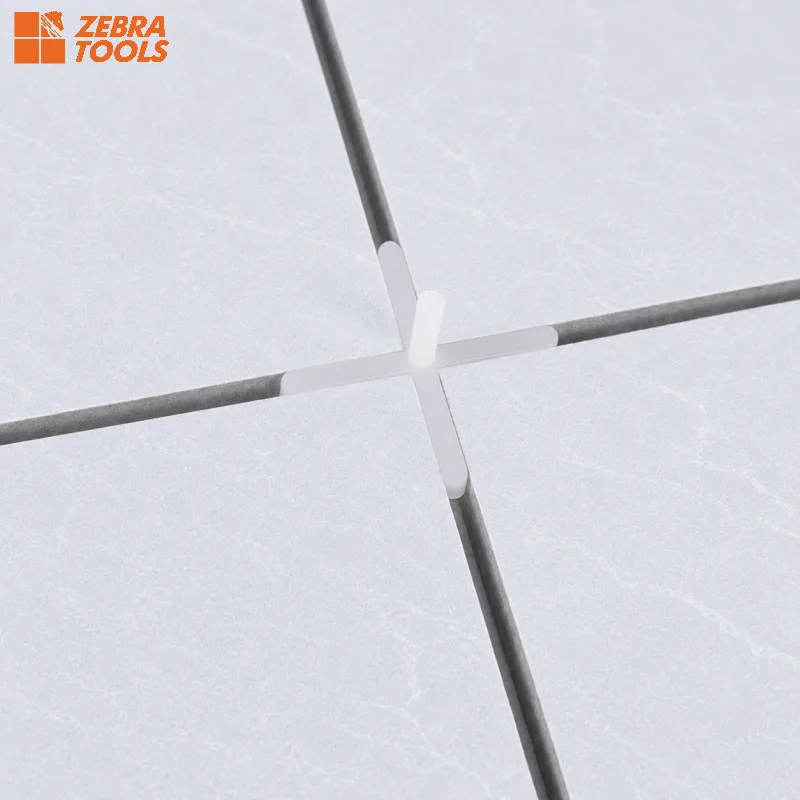
Tile Spacer Sizes: How to Choose One in 5 Checks
- Find the specified joint. Start with the tile manufacturer's installation instructions, architectural finish schedule or approved placement drawing.
- Check dimensional variation. A narrow nominal joint cannot absorb more tile-size variation than the project allows. LATICRETE TDS 193 uses a joint of at least three times the actual range of facial dimensions in its guidance.
- Check the installation scope. MAPEI's large-format guide specifies at least 2mm for that method and calls for wider joints as tile type, location and service stress require.
- Check the grout data sheet. Confirm that the selected grout product permits the specified joint width and application.
- Match profile and model. Cross, T and Y shapes solve different intersection geometries. Confirm the exact model, width, material, colour and sample before production.
Technical sources: LATICRETE TDS 193 and MAPEI Instructions for Installing Large-Format Ceramic Tiles, retrieved October 23, 2026. Each statement above remains limited to the source's installation scope.
1mm vs 1.5mm vs 2mm vs 3mm Tile Spacers
| Nominal size | Exact inch conversion | Use only when | ZEBRA model coverage | Critical boundary |
|---|---|---|---|---|
| 1.0mm | 0.0394in | The exact project documents permit a 1mm joint | 8 of 9 models | Availability does not establish compliance |
| 1.5mm | 0.0591in | A 1.5mm joint is specified after variation is checked | 9 of 9 models | Still a narrow joint; verify the installation method |
| 2.0mm | 0.0787in | A 2mm joint is specified for the selected tile and location | 9 of 9 models | Not a universal large-format rule |
| 3.0mm | 0.1181in | The specification requires more joint width | 9 of 9 models | Not automatically the floor-tile size |
The model counts come from ZEBRA spacer dataset 2026-10-25.4. They describe offered variants, not a global installation standard. Inch figures are exact mathematical conversions, so do not silently substitute a rounded market label: 1/16in is 1.5875mm and 1/8in is 3.175mm. Confirm which nominal unit controls the drawing, sample and purchase order. The same dataset also records 2.5mm, 4mm, 5mm, 6.5mm, 8mm and 10mm options on named models.
Tile Spacer Size Chart by Tile Size: 300×300, 600×600 and 600×1200mm
Bottom line for 600×600mm floor tile: order 3mm spacers for a UK floor (BS 5385-3 minimum), 4mm for rectified tile under ANSI A108.02 (average minimum 1/8in = 3.18mm) and 5mm for calibrated, non-rectified tile under ANSI (average minimum 3/16in = 4.76mm). The same minimums apply to 300×600, 800×800 and 600×1200mm, because every side over 15in (381mm) triggers the ANSI large-tile rule.
| Tile size | US minimum (ANSI A108.02) | UK minimum (BS 5385) | Smallest ZEBRA width that meets it |
|---|---|---|---|
| 300×300mm (all sides ≤15in) | 3× measured facial variation, never below 1/16in (1.59mm) | Floors 3mm (BS 5385-3) | US 2.0mm (9 of 9 models) · UK floor 3.0mm (9 of 9) |
| 300×600mm (12×24in) / 600×600mm | Rectified 1/8in (3.18mm) average; calibrated 3/16in (4.76mm) average | Floors 3mm; walls 3mm for 0.1–1m² tiles (BS 5385-1) | Rectified 4.0mm (BM-P01–BM-P06) · calibrated 5.0mm (BM-P01–BM-P05) · UK 3.0mm |
| 600×1200 / 800×800mm | Same as above: any side over 15in | Floors 3mm; walls 3mm when no side exceeds 1,200mm | Rectified 4.0mm · calibrated 5.0mm · UK 3.0mm |
Sources: ANSI A108.02 §4.3.8 and §4.3.8.1 as quoted by the Ceramic Tile Education Foundation (Scott Carothers, updated January 23, 2024); BS 5385-3 and BS 5385-1 as summarised in The Tile Association tiling guide; both retrieved November 7, 2026. BS 5385-3 also says a joint should not exceed the tile thickness as a general rule. ZEBRA widths come from spacer dataset 2026-10-25.4. These are minimums: a wider joint from the tile manufacturer or project specification overrides them, and a 3.0mm spacer is 0.18mm narrower than a written "minimum 1/8in".
Tile Spacer Sizes in Inches: 1/16, 1/8, 3/16 and 1/4 in mm
ZEBRA spacer widths are metric, so none is an exact inch size. Convert the inch joint at 25.4mm per inch, then take the nearest published width:
| Inch joint | Exact mm | Nearest ZEBRA width | Models offering it |
|---|---|---|---|
| 1/32in | 0.79mm | 1.0mm | 8 of 9 (BM-P06 starts at 1.5mm) |
| 1/16in | 1.59mm | 1.5mm | 9 of 9 |
| 3/32in | 2.38mm | 2.5mm | 9 of 9 |
| 1/8in | 3.18mm | 3.0mm | 9 of 9 |
| 3/16in | 4.76mm | 5.0mm (4.0mm also offered) | BM-P01–BM-P05 |
| 1/4in | 6.35mm | None within 1mm; nearest 5.0mm or 8.0mm | BM-P05 offers 5.0mm and 8.0mm |
| 3/8in | 9.53mm | 10.0mm | BM-P05 only |
Source: ZEBRA spacer dataset 2026-10-25.4 (reviewed October 25, 2026); inch values are exact conversions. A 1/16in specification met with a 1.5mm spacer is 0.09mm narrower, so approve a sample when the project calls for an exact fractional joint. Once the width is set, the tile spacer calculator turns tile size and layout into spacers per m².
BM-P01–BM-P09 Size and Profile Map
ZEBRA publishes selection data for all 9 BM-P01–BM-P09 tile spacers. Choose geometry before width: BM-P01–BM-P04 are standard Cross profiles, BM-P05 is T-shaped, BM-P06 is Y-shaped, and BM-P07–BM-P09 are specialty profiles.
| Profile | Models | Published widths | Order-level material |
|---|---|---|---|
| Standard Cross tile spacers | BM-P01–BM-P04 | 1.0–5.0mm across the named models | PP or PE |
| Specialty spacer profiles | BM-P07 multifunction, BM-P08 star, BM-P09 round-cross | 1.0–3.0mm across the named models | PP or PE |
| T-shaped tile spacer | BM-P05 | 1 / 1.5 / 2 / 2.5 / 3 / 4 / 5 / 8 / 10mm | PP or PE |
| Y-shaped tile spacer | BM-P06 | 1.5 / 2 / 2.5 / 3 / 4mm | PP or PE |
Source and scope: ZEBRA product specifications and packing records, dataset 2026-10-25.4, reviewed October 25, 2026. Selection data is published for all 9 models. Carton evidence is complete for 2 models, mixed for 2 and pending for 5; final shipment data must follow the approved packing list.
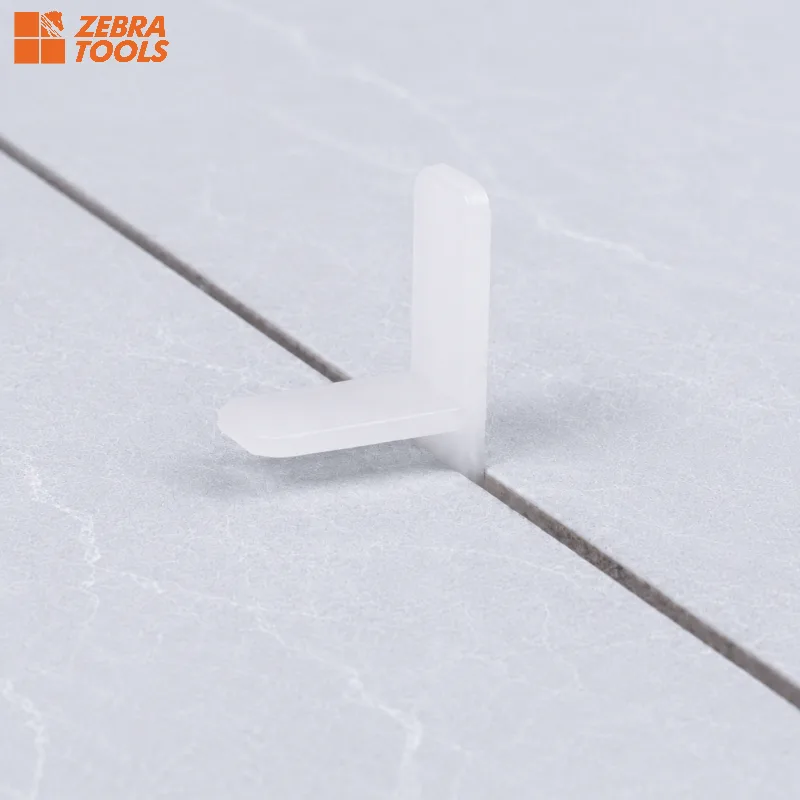
Does Rectified Tile Automatically Mean a 1mm Joint?
No. Rectification can tighten edge dimensions, but the label alone does not prove that the delivered lot, pattern, substrate, installation location and applicable method permit a 1mm joint. Measure or obtain the actual dimensional range and follow the tile manufacturer's minimum joint requirement.
LATICRETE TDS 193 states that the actual joint should be at least three times the actual range of facial dimensions and not less than 1/16 inch (1.5mm) within its published guidance. MAPEI's large-format guide uses a 2mm minimum within that separate method. These scoped instructions show why “rectified” and tile length cannot replace the project specification.
Choose Cross, T or Y Before Ordering the Width
Joint width and joint geometry are separate decisions. Cross spacers suit the corresponding four-way intersections, T-shaped spacers suit three-way junctions such as positions in a running pattern, and Y-shaped spacers serve layouts designed around that profile. The types of tile spacers guide maps those shapes in more detail.
Spacers control the nominal joint; they do not flatten the substrate or pull two tile faces level. If edge-height control is required, treat it as a separate leveling-system decision. If the project quantity is the next question, use the tile spacer quantity chart only after the profile and placement method are fixed.
Put 7 Fields on the Spacer Purchase Order
A purchase order that says only “2mm spacer” leaves several decisions open. Record:
- Profile and ZEBRA model
- Nominal joint width
- PP or PE material
- Approved colour or Pantone reference
- Pieces per bag and number of bags
- Approved physical sample or sample ID
- Current quotation and approved packing list revision
Product weight per 100 pieces identifies the model-width record; it is not a carton calculation. The versioned tile spacer model CSV carries model, dimensions, widths, product-weight range, material scope, pack, MOQ and evidence status.
Tile Spacer Size FAQ
What size spacers for 600x600 floor tiles?
3mm for a UK floor, because BS 5385-3 sets a 3mm minimum joint. In the US, ANSI A108.02 §4.3.8.1 requires an average of at least 1/8in (3.18mm) for rectified tile and 3/16in (4.76mm) for calibrated tile with any side over 15in, so order 4mm (ZEBRA BM-P01–BM-P06) or 5mm (BM-P01–BM-P05). A wider joint from the tile manufacturer overrides these minimums.
What is the standard tile spacer size?
There is no single standard size, but 1.5mm, 2mm and 3mm are the three widths offered on all 9 ZEBRA spacer models (BM-P01–BM-P09), and 3mm is the BS 5385-3 minimum joint for UK floors. In the US, ANSI A108.02 sets an average minimum of 1/8in (3.18mm) for rectified tile and 3/16in (4.76mm) for calibrated tile with any side over 15in, which means 4mm or 5mm spacers.
What size tile spacers should I use?
Use the joint width stated by the tile manufacturer, project specification or approved installation drawing, then select the same nominal spacer width. Tile dimensions alone do not decide the answer. ZEBRA BM-P01–BM-P09 collectively cover 1.0–10.0mm, but each model has its own available range.
Can I use 1mm tile spacers with rectified tile?
Only when the tile documentation, measured dimensional variation, applicable installation standard and project specification permit a 1mm joint. A 1mm catalog option is not a universal recommendation. LATICRETE TDS 193 states that the joint should be at least three times the actual range of tile facial dimensions and not less than 1/16 inch (1.5mm) within the guidance it publishes.
Are 2mm tile spacers suitable for large-format tile?
They can be when the project specification calls for a 2mm joint. MAPEI's large-format installation guide specifies at least 2mm within that method and says the width should increase according to tile size and type, floor or wall location, interior or exterior use, and expected service stress.
Do tile spacers prevent lippage?
No. Tile spacers establish the specified joint width and intersection geometry. They do not flatten the substrate or restrain adjacent tile faces. A compatible leveling system addresses edge-height control, while substrate flatness and mortar coverage require separate preparation and installation checks.
Send the Joint Specification, Not Just the Tile Size
Share the joint width, pattern, profile, material, colour and order quantity. We will map them to a BM-P model and prepare the correct sample basis.
Build a Spacer Quotation →