
Removal and leave-in use depend on the specific model. Follow its product instructions; horseshoe-shaped products can be designed for different installation roles.
Bottom line: Start with the installation task, not the product name: select a spacer to set a joint, or BM-H01 for the substrate-correction use described by ZEBRA. Other horseshoe products may be designed to space and align tile, so check the maker’s instructions.
Tile Shims vs Spacers: Two Jobs on One Tile Grid
Start with the installation task. Tile spacers are generally selected to maintain a consistent grout-joint gap. Horseshoe-shaped products may be called shims or spacers and can serve different purposes depending on their design. ZEBRA’s BM-H01 is marketed for substrate correction; other manufacturers sell horseshoe-shaped products for spacing and aligning tile. The product name alone is not enough to determine placement or removal.
The table compares ZEBRA BM-T01 and BM-H01 specifically. Check the current data sheet for any other brand or model before applying the same use to it.
| Cross spacers | Horseshoe shims | |
|---|---|---|
| Listed use | Maintain grout-joint width | Substrate-height correction |
| Where it sits | In the joint, between tiles | Under the tile edge, on the substrate |
| Sizes | 1.0–10.0mm, 8 models | 1.5 / 3.0 / 5.0 / 6.5mm, color-coded |
| Removal | Follow the model instructions | ZEBRA guidance: leave in place for its stated use |
| FOB price | $0.20–0.35/bag | $0.60–0.70/bag |
| MOQ | 1,000 bags | 500 bags |
⚖️ Guide prices are FOB Ningbo at MOQ and subject to raw material cost fluctuations — contact us for current pricing.
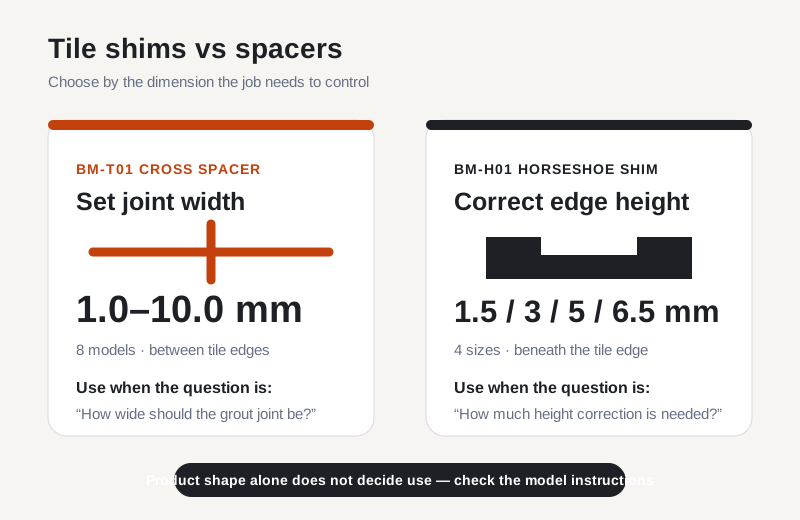
Both listed ZEBRA products are packed at 100 pieces per bag, but their materials differ: BM-T01 is listed as PP/PE, while BM-H01 is polypropylene (PP). Confirm the selected model, material, size, and packaging on the current product specification before ordering.
What a Horseshoe Shim Does That a Spacer Cannot
ZEBRA’s BM-H01 horseshoe shims are listed for substrate correction. The four available sizes are 1.5mm, 3.0mm, 5.0mm, and 6.5mm. Select a size based on the product instructions and site condition; these increments are not a substitute for preparing a substrate that falls outside the tile or setting-material requirements.
At the listed guide prices, BM-H01 is $0.60–0.70 per 100-piece bag at a 500-bag MOQ; BM-T01 is $0.20–0.35 per 100-piece bag at a 1,000-bag MOQ. These are FOB Ningbo guide prices at MOQ, not a landed-cost or margin comparison. Ask for a current quote for the planned order mix.
Do not infer that every horseshoe-shaped product is unsuitable for joint spacing: QEP’s example is specifically engineered to produce a grout joint. BM-H01, by contrast, is the ZEBRA model this page describes for substrate correction.
Check the Product Instructions Before Removal or Grouting
The cross tile spacer is intended to maintain joint width. Whether a spacer is removed or left in the joint depends on its construction and the manufacturer’s instructions. RUBI describes different approaches for its spacer models, including products intended to remain in the installation; do not apply one removal rule to every cross spacer. See RUBI’s spacer guidance.
For BM-H01, ZEBRA product guidance describes placing the shim under the tile edge for substrate-height correction and leaving it in place. That instruction is specific to this product and use. Other horseshoe products can be designed for alignment, joint spacing, removal, or reuse; check the exact model before installation.
For comparison, QEP calls its 1/8-inch product a “Horseshoe Shim Tile Spacer” and describes it as a reusable tool for spacing and aligning tile. That example shows why “shim” alone is not enough to infer where a product goes or whether it stays in the assembly. See QEP’s product page.
The Wrong-Shim Trap: Machinery Shims and LVP Spacers
Most of the genuine confusion around shims vs spacers comes from products that share the words but not the trade. Search the bare term and you will meet stainless steel slotted shims machined for motor alignment on machinery bases, or the chunky plastic blocks sold as spacers for luxury vinyl plank, which hold an expansion gap at a wall. Neither has any role in a tile joint or under a tile edge — and an assistant that answers "shims vs spacers" without the tile qualifier can send a buyer down both wrong aisles.
The tile-qualified answer depends on the particular product: a spacer generally maintains joint width, while BM-H01 is sold for substrate correction. T-shaped spacers are another option for particular layouts; our types of tile spacers guide covers that family. For lippage limits, see ANSI lippage tolerance limits.
Keep their roles distinct from a clip-and-wedge leveling system, which helps hold adjacent tile edges in alignment while setting material cures. Product labels overlap across the market, so verify what each item is designed to do before recommending a substitute.
Stocking Both: 1,000 Bags of Spacers, 500 of Shims
For a wholesale comparison, confirm the SKU, pieces per bag, selected size, MOQ, and Incoterm for each quote. A 500-bag BM-H01 order and a 1,000-bag BM-T01 order are different quantities; per-bag prices alone do not show landed cost or suitability for a given market. A tile leveling system manufacturer can confirm current product specifications, and a tile leveling system wholesale supplier can quote the requested mix.
Frequently Asked Questions
Are tile shims and spacers the same thing?
Not always. ZEBRA BM-T01 cross spacers are specified to maintain grout-joint width, while BM-H01 horseshoe shims are sold for substrate correction. Other horseshoe products may be designed to space and align tile; for example, QEP describes its product as a reusable horseshoe shim tile spacer. Check the exact model and instructions.
Do you remove tile shims after the adhesive cures?
It depends on the product. ZEBRA BM-H01 guidance says to leave the substrate-correction shim under the tile edge. QEP’s horseshoe shim tile spacer is reusable and intended to be removed. Cross spacers also vary, so follow the exact model’s instructions.
What sizes do horseshoe shims come in?
ZEBRA BM-H01 horseshoe shims come in four color-coded sizes: 1.5mm, 3.0mm, 5.0mm and 6.5mm. The listed pack is 100 pieces per bag, with a 500-bag MOQ and a $0.60–0.70/bag FOB Ningbo guide price at MOQ. Other brands offer different sizes and configurations.
Can shims replace a tile leveling system?
BM-H01 substrate-correction shims and joint spacers do not perform the same role as a clip-and-wedge system, which helps hold adjacent tile edges in alignment while setting material cures. Some horseshoe products are themselves designed to space and align tile, so identify the exact model and intended use.