
Choose the profile from the placement drawing. Neither profile corrects tile lippage, and packing evidence must be checked by model and width.
Bottom line: there is no universal winner. Choose BM-P06 when the approved placement drawing calls for its Y profile and a 1.5–4.0mm joint. Choose the Cross family when the drawing calls for a four-arm profile or a width outside BM-P06's range. Neither spacer replaces clips and wedges for lippage control.
Y-Shaped Tile Spacers vs Cross Spacers at the Cross Junction
The two profiles are different placement tools. A cross tile spacer uses a four-arm geometry. A Y-shaped tile spacer uses the BM-P06 profile. The project drawing must show which geometry belongs at each junction; the product name alone does not prove interchangeability.
Both families use 100-piece listed bags and a 1,000-bag MOQ. PP and PE are material options selected for the order, with the approved sample and PO governing the shipment. The current model data does not publish one family-wide dimensional tolerance, so a tolerance requirement must be written into the approved specification and inspection method.
What a Spacer Actually Does — and Doesn't Do
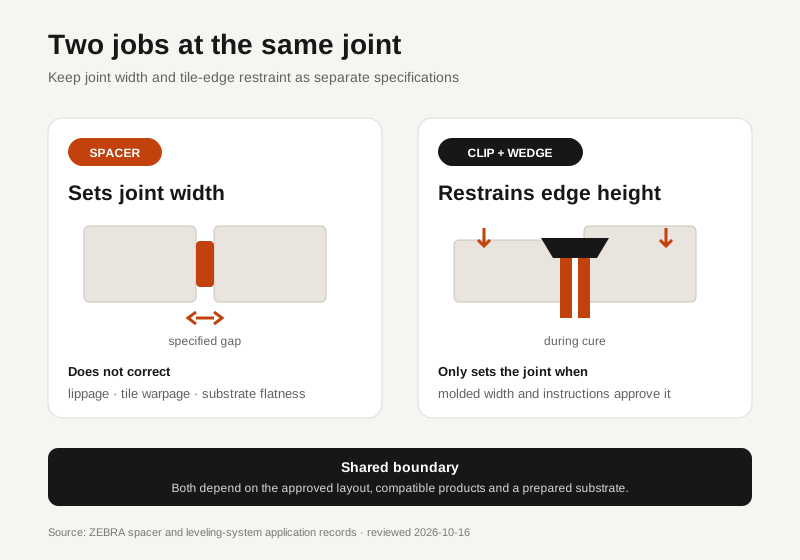
Before the shape decision, it is worth being precise about the job. A spacer sets the grout line width. It does not level the tile — pulling a tile flat against a lippage difference requires a compatible clip-and-wedge system that restrains adjacent edges while adhesive cures. No spacer, Y or cross, replaces that system.
That distinction sets the purchasing boundary: BM-P06 is another spacer profile, not a cheaper leveling system. A buyer should compare the placement drawing, joint width, material, product weight and packing record rather than assuming one profile performs an untested leveling function.
Wall Tile: Validate the Profile on the Placement Drawing
Wall work adds gravity, openings, trims and cut courses, but those conditions do not prove that one spacer profile will hold tile edges in plane. The spacer establishes the specified joint geometry. Adhesive coverage, substrate flatness, tile warpage and a compatible leveling system govern lippage control.
For a wall-heavy market, request the intended elevation or placement drawing and approve BM-P06 against the actual tile format. For a Cross order, select among BM-P01–BM-P04 and BM-P07–BM-P10 by profile and width. Do not convert a profile description into an unsupported performance guarantee.
Size Coverage: 1.0–10.0mm vs 1.5–4.0mm
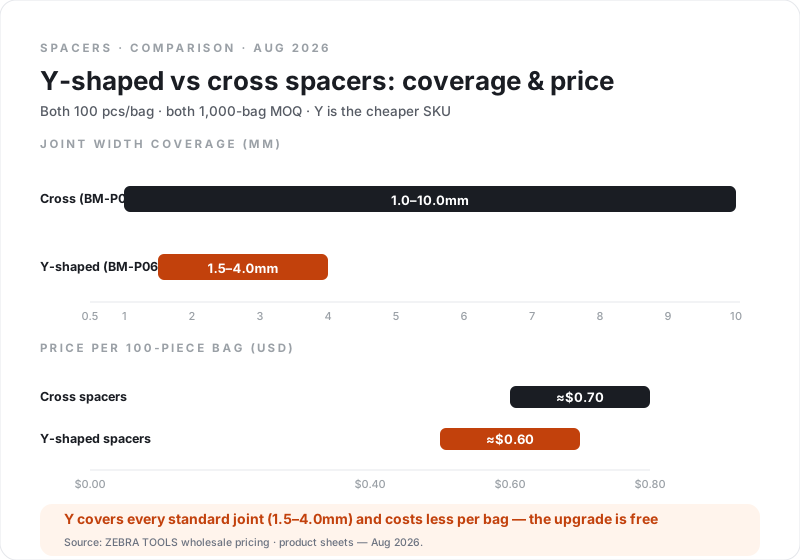
The Cross family collectively spans 1.0–10.0mm across BM-P01–BM-P04 and BM-P07–BM-P10. BM-P06 publishes 1.5, 2.0, 2.5, 3.0 and 4.0mm. This is family coverage, not a claim that every Cross model covers every width. Choose a specific model/width record before quoting. Source: ZEBRA spacer dataset 2026-10-15.1, reviewed October 15, 2026.
| Spec | Y-Shaped BM-P06 | Cross BM-P01–P04, P07–P10 |
|---|---|---|
| Joint widths | 1.5–4.0mm | 1.0–10.0mm |
| Body size | 25×25×3.15mm | Model-specific |
| Product weight / 100 pcs | 10.6–30g | 11.5–480g across published records |
| Material | PP or PE by order | PP or PE by order |
| Pcs / bag | 100 | 100 |
| MOQ | 1,000 bags | 1,000 bags |
| Packing evidence | Mixed | 3 published models; 5 pending |
Price Per Bag: The Counterintuitive Part
Here is the commercial difference: the ZEBRA wholesale price source lists Y-shaped spacers at $0.20–0.30/bag and Cross at $0.20–0.35/bag. Project cost still depends on the selected layout and profile quantity; MAPEI does not publish one universal consumption rate across X, T and Y spacers.
⚖️ Guide prices are FOB Ningbo at MOQ and subject to raw material cost fluctuations — contact us for current pricing.
The price ranges overlap, but project cost cannot be calculated from bag price alone. The selected placement method determines quantity, and model-specific carton data determines freight. Use the approved packing list instead of multiplying the product weight into an assumed carton weight.
Model Data and Packing Evidence Are Separate
The BM-P01–BM-P10 tile spacer model data publishes model, dimensions, joint widths, product weight per 100 pieces, material option and packing-evidence status. It does not turn a partial carton row into a shipment specification.
BM-P06 has mixed evidence because some width-specific packing rows are complete and others remain pending. Within the Cross family, BM-P08–BM-P10 have complete published packing references; BM-P01–BM-P04 and BM-P07 remain pending. Confirm the named width and approved packing list before calculating CBM or gross weight.
Dataset 2026-10-15.1 contains the named Cross records and all five BM-P06 width records.
Which to Stock
The stocking decision is simpler than the geometry suggests:
- Layouts specifying the BM-P06 Y profile — choose among its five widths from 1.5–4.0mm.
- Layouts specifying a four-arm profile — choose the matching Cross model and width.
- Widths outside 1.5–4.0mm — use a compatible Cross model only after confirming its listed width.
- Distributors stocking both — track sell-through separately by model and width; do not treat the two families as interchangeable inventory.
For a mixed order, write the profile, model, width, PP/PE choice, bag quantity and carton configuration on the quotation. The types of tile spacers guide maps Cross, T and Y placement roles; shared origin does not make their packing records interchangeable.
Frequently Asked Questions
Are Y-shaped tile spacers better than cross spacers?
Neither is universally better. BM-P06 covers five widths from 1.5–4.0mm, while the eight-model Cross family collectively covers 1.0–10.0mm. Choose the profile shown on the placement drawing; neither profile is a substitute for a leveling system.
What is the difference between a Y-shaped spacer and a cross spacer?
The Cross family uses four-arm profiles across BM-P01–BM-P04 and BM-P07–BM-P10. BM-P06 uses a Y profile. Both establish joint geometry; neither corrects substrate flatness, tile warpage or lippage.
What sizes do Y-shaped tile spacers come in?
BM-P06 covers 1.5mm, 2.0mm, 2.5mm, 3.0mm and 4.0mm in a 25×25×3.15mm body, with product weights of 10.6–30g per 100 pieces. The eight-model Cross family collectively covers 1.0–10.0mm; confirm the chosen model because every model does not carry every width.
How many Y-shaped tile spacers do I need per m²?
Spacer quantity follows the selected profile and layout rather than the leveling-clip count. Grupo Puma publishes 4 ordinary spacers/m² for 60×60cm tile, while MAPEI says consumption depends on pattern and operational requirements. For a Y-profile order, confirm the supplier placement drawing before multiplying the project area.