
Amazon Variation Guide: Tile Leveling Clip Sizes & Models
Use model → joint width → pack count → packaging revision → marketplace identifiers, then verify the live category theme.
ZEBRA supplies private-label tile tools from China to marketplace sellers. This Amazon tile leveling clips variation guide shows how those sellers can translate clip model, joint width, pack count and packaging revision into controlled catalog records before they request GTINs, print barcodes or create parent-child relationships.
Bottom line: approve the physical product hierarchy first, then map only eligible child products into the variation theme currently allowed by the target Amazon store and category.
Amazon Tile Leveling Clips Need a 5-Level Data Tree
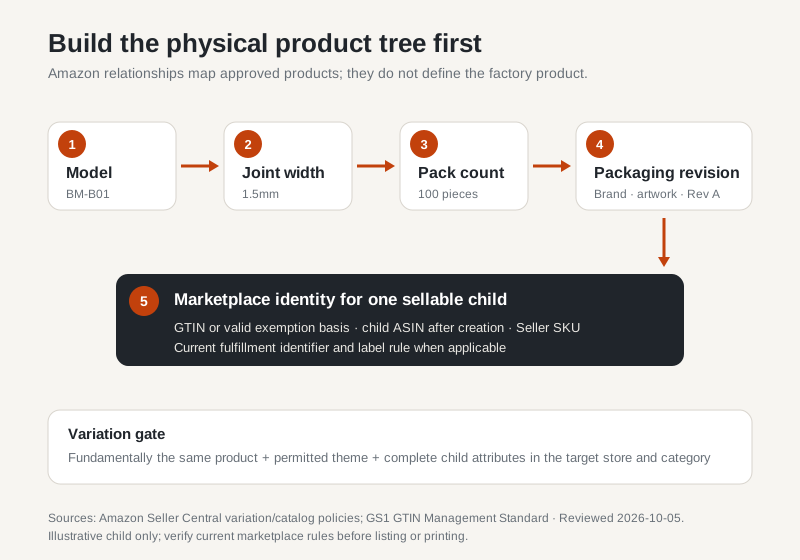
- Model: the physical clip geometry, such as BM-B01.
- Joint width: the clip-base thickness sold to the customer, such as 1.5mm.
- Pack count: the quantity in the sellable package, such as 100 pieces.
- Packaging revision: brand, artwork, language, claims, barcode placement and approved revision.
- Marketplace identifiers: GTIN or approved exemption basis, ASIN after creation, Seller SKU and applicable fulfillment identifier.
The tree prevents one barcode or Seller SKU from drifting across two physical products. It also lets the OEM order, packing list, carton mark and listing file use the same model and pack identity.
Parent and Child ASINs Have Different Jobs
Amazon's Variation Relationship FAQ describes a parent ASIN as a virtual product used to connect related children. It is not the purchasable pack. Each child represents a unique sellable variation and carries the attributes that distinguish that option.
Use a parent only after confirming that the children are fundamentally the same product and differ through a permitted variation theme. A parent name inside a spreadsheet is not permission to combine unrelated model geometries, kits, wedges and clips on one detail page.
Do Not Put BM-B01–BM-B10 Into One Family Automatically
ZEBRA's current clip catalog contains 10 offered models and 45 published model/thickness combinations. Those numbers describe the factory catalog. They do not establish Amazon eligibility. Models can differ in base geometry, opening, dimensions, tile-thickness capacity and compatible components.
A defensible candidate family normally begins with one physical model whose children differ by a permitted attribute such as joint width or sellable quantity. Confirm the current product type, required attributes and variation themes inside the target store before deciding. If a geometry or function changes materially, keep it outside that family.
GTIN, ASIN and Seller SKU Are Not Interchangeable
| Identifier | Primary role | Control point |
|---|---|---|
| GTIN / UPC / EAN | Identifies a trade item | Use only an identifier the brand owner owns or authorises, or follow a valid exemption path |
| ASIN | Amazon catalog identifier | Search the catalog before creating another detail page |
| Seller SKU | Seller-controlled offer and inventory reference | Map one SKU consistently to the intended child and pack |
| FNSKU / fulfillment label | Amazon fulfillment identification when applicable | Check the current target-program barcode and labelling rule before printing |
Amazon's catalog policy says sellers must use GTINs they own or are authorised to use and must not create another detail page for a product already in the catalog. The exact product-ID requirement and exemption route can differ by category and store.
Pack Count and Packaging Revision Need Their Own Controls
A 100-piece bag and a 300-piece bag are different sellable quantities. Do not use the single-bag product ID for a multipack or kit. GS1's pack/case quantity rule states that changing the number of trade items in a case requires a new GTIN for that higher packaging level.
Artwork revision does not always create a different consumer product, but it still needs control. Record the approved barcode data, legal text, language, pack count and revision. If a product change affects size, material, features, brand or another catalog identity field, verify Amazon's current new-ASIN policy before reusing the listing.
Build the Child Matrix Before OEM Packaging Approval
Create one row per intended child with model, joint width, color if commercially distinct, count, packaging revision, dimensions, packaged weight, brand, GTIN or exemption status, Seller SKU, image set and target store. Mark incomplete fields as pending. Do not invent packed dimensions or weight from loose product data.
Use the OEM packaging sample checklist to approve the physical pack and barcode evidence. The broader OEM tile tools guide for e-commerce sellers covers product selection, MOQ and marketplace preparation. Request current product data from the tile leveling clips page before building the listing file.
Verify the Live Store Before Upload
On the upload date, check the target marketplace, product type, permitted variation theme, required child attributes, brand authorization, GTIN or exemption status, image requirements and fulfillment barcode rule. Save the template version or screenshot used for approval. Amazon can change category fields and program requirements, so this article provides a data-control method rather than guaranteed listing eligibility.
Frequently Asked Questions
Can different tile leveling clip thicknesses share one Amazon variation family?
Only when the products are fundamentally the same, the current target-store category permits the relevant variation theme and every child accurately represents one sellable option. Joint width may fit a permitted size-style attribute, but the seller must verify the live category template before creating the family.
Should every ZEBRA clip model be one Amazon variation family?
No. BM-B01 through BM-B10 include different geometries and tile-thickness ranges. Do not combine all catalog models merely because they are clips. Build families around products that remain fundamentally the same and differ only through a permitted theme.
Does an Amazon parent ASIN need inventory or a price?
No. Amazon describes the parent ASIN as a virtual connector for related child ASINs. The child is the sellable product record. Keep product identity, offer and fulfillment records attached to the correct child.
Do pack-count or packaging changes require a new product identifier?
A different sellable quantity needs its own accurate product identity. GS1 states that a change to the number of trade items in a case requires a new GTIN for that higher packaging level. Amazon catalog treatment and any GTIN exemption remain marketplace- and category-specific, so verify the current rule before printing packaging.
Freeze the Child Matrix Before Printing
Send the model, thickness, pack count, target store and approved identifiers for an OEM packaging review.
Review the private-label scope →