
Suction Cup for Tile Installation: How to Use It in 4 Steps
On floors the cup lifts and sets the tile; on walls it only helps place it — mortar, spacers or clips hold the tile, never the cup alone.
A suction cup for tile installation — also sold as a tile lifter or suction lifter — turns a large, smooth tile into something one or two people can lift, carry and set with control. It does not make a heavy panel weightless, and it only grips as well as the surface and the model allow.
ZEBRA TOOLS, a tile leveling system manufacturer in Zhejiang, China, supplies seven suction-cup models, BM-K01–BM-K07, to distributors and tile contractors. This guide gives installers the working routine and gives buyers the checks to pass on with every tool they sell.
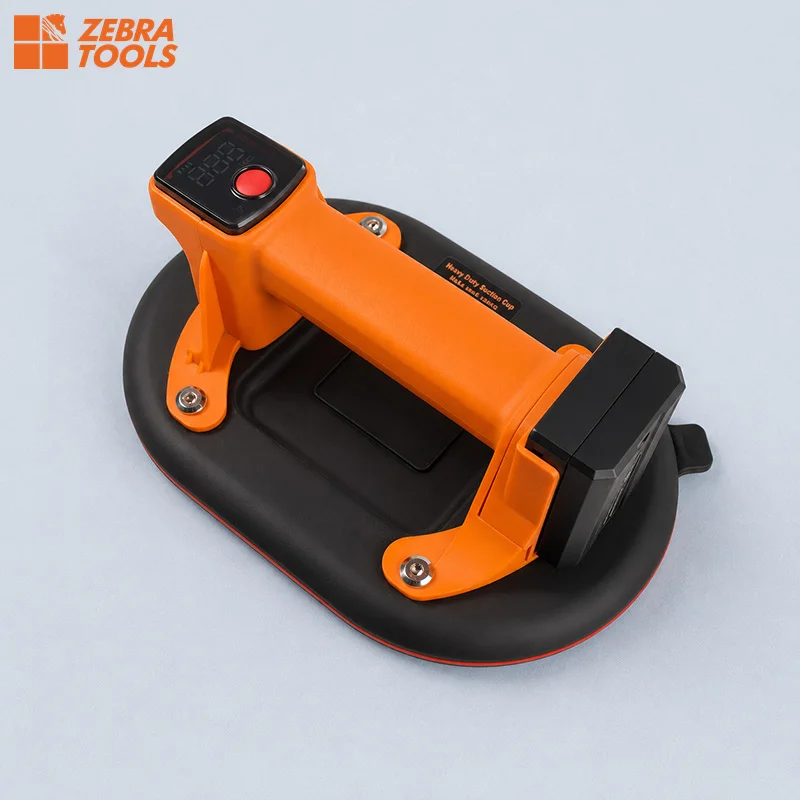
Bottom line: the routine matters more than the tool. Check the model, clean both faces, confirm the grip and lift low first — every time, on every tile — and treat the cup as a handling aid, not as the thing that holds tile in place.
How to Use a Suction Cup for Tile Installation in 4 Steps
- Confirm the model. Match the tool, accessories and instructions to the model code on the quotation or packaging. Controls, gauges and release methods differ between models, so do not work from another cup's habits.
- Inspect the tool and clean the surface. Check the pad, handle and controls or gauge. Clean the actual tile face and the pad before every lift: dust, water and adhesive residue break the seal.
- Establish and verify the grip. Place the pad flat on the tile and follow the model instructions to create the vacuum. On a gauge model, read the gauge; on any model, confirm the grip before the load leaves the ground.
- Perform a low-height trial. Lift a few centimetres close to a supported surface before carrying the tile. If the cup creeps, releases or the tile flexes, set it down and correct the cause — surface, pad, model or number of people.
Release the cup only once the tile is resting on its bed or a support, using the release method stated for that model.
Floor vs Wall Tile: What a Suction Cup Does on Each
Floors. The cup lifts the tile from the stack, carries it and lowers it onto the mortar bed. While the mortar is workable, it also lets the installer make small position adjustments before the leveling system is tensioned.
Walls. The cup helps place and adjust the tile, but the tile is held by the mortar, spacers or leveling clips. Never leave a cup as the only support for a wall tile. For selection details by surface, see the porcelain tile suction cup guide.
A vibrating suction cup is a different tool: its maker describes it as spreading mortar evenly under the tile, not only carrying it (Detroit Diamond Tools, retrieved October 30, 2026). Do not substitute one for the other without checking the tool's stated purpose.
Electric vs Manual Suction Cups: What Changes in Use
ZEBRA offers 7 tile suction cup models: 5 electric (BM-K01–BM-K05) and 2 manual (BM-K06 with a pressure gauge, BM-K07 without).
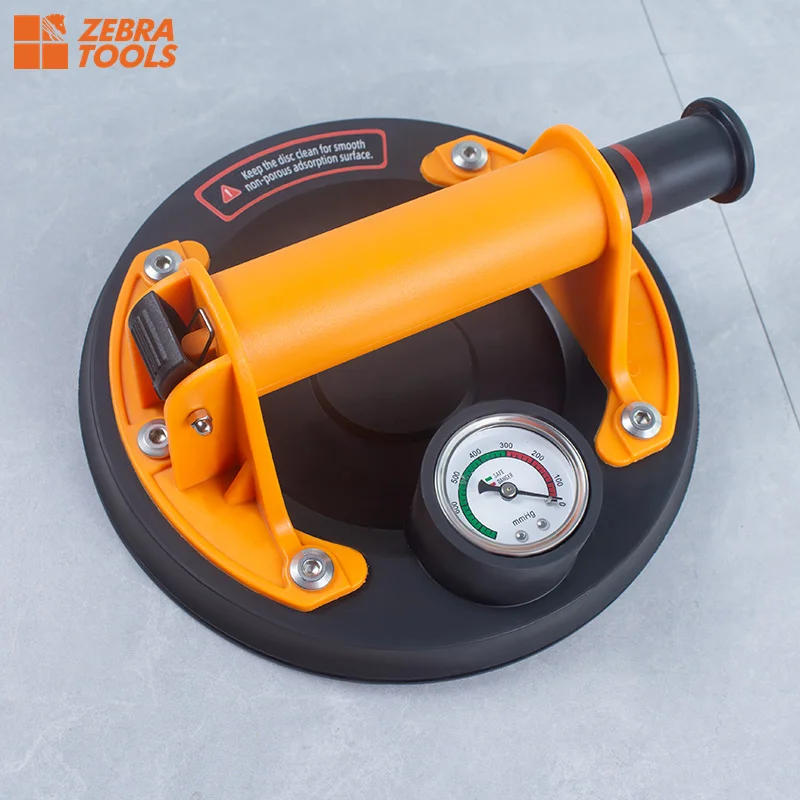
| Models | Type | How you confirm the grip |
|---|---|---|
| BM-K01–BM-K05 | Electric | Follow the model's control instructions; battery is model-level |
| BM-K06 | Manual, pressure gauge | Read the gauge before and during the lift |
| BM-K07 | Manual, no gauge | Rely on the instructions and the low-height trial |
The choice is a task decision rather than a quality ranking. The manual vs electric tile suction cup comparison covers when each type fits.
When a Suction Cup Is Not Enough
- The surface will not seal: textured, grooved, porous or cracked faces, or tile that cannot be cleaned to a smooth, dry face.
- The load is outside the model: capacity is model-level; do not apply one figure to the whole BM-K01–BM-K07 family.
- The panel is heavy or awkward: use team lifting or mechanical support for the load and job conditions.
- The tile needs holding, not handling: on walls, the installation materials hold the tile; the cup is removed once it is placed.
Selling Suction Cups: 3 Records to Keep
Distributors pass the same checks to their customers when every tool ships with clear records:
- Model code and type on the quotation, purchase order and retail pack.
- Accessories and instructions for that model, including the release method.
- Approved sample tested on the tile surfaces your customers actually buy.
ZEBRA's electric tile suction cup range starts at a 50-set MOQ, with a wholesale guide price of $8–10 per set FOB Ningbo. The electric tile suction cup guide lists the buying checks behind a model-level quotation.
⚖️ Guide prices are FOB Ningbo at MOQ and subject to raw material cost fluctuations — contact us for current pricing. (price book updated 2026-11-19)
Tile Suction Cup FAQ
Do suction cups work on ceramic and porcelain tile?
Yes, on a smooth, clean face that the selected model is approved for. Texture, grooves, porosity, dust, water or adhesive residue reduce the seal, so clean the actual tile and test the quoted model on that surface before relying on it.
Why won't my suction cup stick to the tile?
Check four things in order. The surface: textured, grooved, porous or cracked faces will not seal. The faces: dust, water or adhesive residue on the tile or the pad breaks the vacuum, so clean both. The pad: replace a cut, hardened or deformed pad. The model: follow its own procedure for creating the vacuum and read the gauge on BM-K06. If it still creeps in a low-height trial, the surface is not suitable for that cup.
Can a suction cup hold a tile on the wall?
No. On a wall the cup helps you place and adjust the tile; the mortar, spacers or leveling clips hold it. Never leave a suction cup as the only support for a wall tile.
How much weight can a tile suction cup lift?
It is a model-level specification. ZEBRA does not apply one capacity to BM-K01–BM-K07: confirm the figure for the quoted model, test the approved sample on the actual tile, and use team lifting or mechanical support for heavy or awkward panels.
Should I choose an electric or a manual suction cup?
Choose by task. BM-K01–BM-K05 are electric; BM-K06 is manual with a pressure gauge; BM-K07 is manual without a gauge. A gauge gives a visible check of the vacuum, while a model without one relies on the supplied instructions and a low-height trial.
Test the Cup on Your Customers' Tile
Tell us the tile formats and surfaces you sell and the electric or manual mix you need. We will match BM-K models and prepare a sample basis for your test.
Plan a Suction Cup Order →