
Mold Ownership China Contract: 6 Clauses for OEM Buyers
Write the ownership trigger, mold ID, approved configuration, custody and maintenance, third-party-use restriction, and release procedure before tooling payment begins.
You paid for the mold. Can you identify it, inspect it and move it if the supplier relationship ends? A mold ownership China contract for wholesale OEM work must answer those questions before a China manufacturer cuts steel. A tooling invoice records price; it does not, by itself, describe every right and duty attached to the physical tool.
Bottom line: treat title, possession, permitted use and release as four separate subjects, then connect all four to one mold ID and one approved drawing.
The 6 Clauses a Mold Ownership China Contract Needs
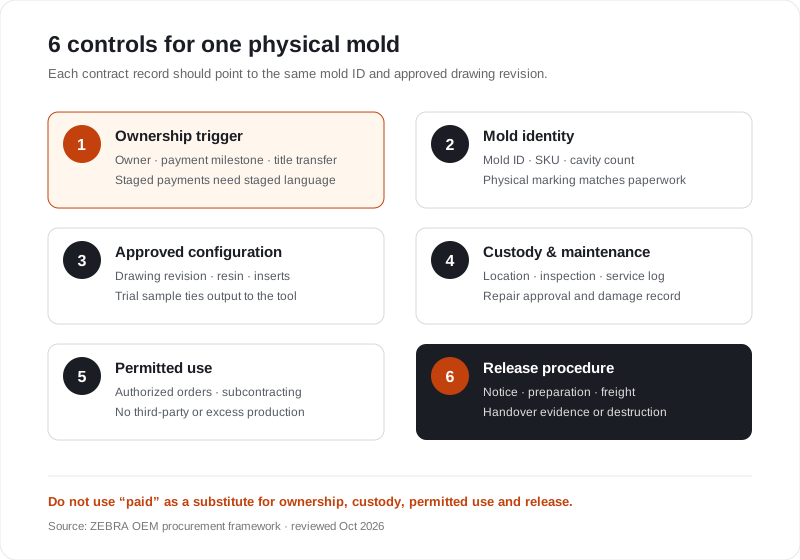
- Ownership and payment trigger. Name the legal owner and state whether title transfers at deposit, at full tooling payment, or at another written milestone. If payments are staged, say what happens at each stage.
- Unique mold identity. Assign a mold number and connect it to the product SKU, drawing revision, cavity count and tooling invoice. Marking the physical mold with that identity creates a practical check against the paperwork.
- Approved configuration. Attach or reference the drawing, material, cavity plan, interchangeable inserts and trial-sample revision. Ownership of an unidentified “clip mold” is too vague for operational control.
- Custody and maintenance. State where the mold is held, who may inspect it, who performs routine maintenance, how damage is recorded and who approves major repair.
- Permitted use. Define the orders for which the factory may use the mold and prohibit production for another party without written authorization. Address subcontracting and excess production explicitly.
- Release and end-of-life. Define the request process, preparation condition, lead time, freight responsibility and handover evidence for transfer. If destruction is chosen, require written authorization and evidence.
These are commercial drafting points, not jurisdiction-specific legal advice. The agreement should be reviewed for the parties, governing law and enforcement forum. A current practitioner guide likewise recommends aligning the tooling invoice, PO and manufacturing agreement around the owner, mold description, custody, use and transfer terms (China IP Gateway, retrieved October 1, 2026).
$2,000–8,000: Separate Tooling Price From Ownership
ZEBRA publishes a planning range of $2,000–8,000 and 15–25 development days for custom molds. That range is a starting point, not a fixed offer for every geometry. The approved drawing, resin, cavities, inserts, expected output, trial rounds and acceptance tests determine the quotation.
⚖️ Guide prices are FOB Ningbo at MOQ and subject to raw material cost fluctuations — contact us for current pricing.
A clear tooling price also makes ownership easier to document: the quote can name the mold, the payment schedule and the ownership trigger. If a proposal calls the mold “free,” ask for the same disclosures anyway. The economic cost may sit in the unit price, a volume commitment, an exclusivity period or a later buyout.
Compare 3 Tooling Payment Structures on the Same Basis
| Structure | Ask for | Unresolved risk |
|---|---|---|
| Buyer pays separately | Price, milestones, title trigger, mold ID | Payment still does not define custody or release |
| Amortized in unit price | Tooling value, recovery quantity, balance and buyout formula | Changing volume can leave the balance disputed |
| Supplier-funded | Owner, permitted use, purchase commitment and exit terms | The buyer may have no transfer right |
Do not compare only the upfront cash. Compare the total order commitment, unit-price effect, ownership outcome and cost of leaving the factory. If the buyout balance changes with volume, require a statement after each completed order.
Connect the Mold ID to the Approved Sample
The contract controls the asset; the approved drawing and sample control its output. Record the mold ID, drawing revision and trial revision on the sample approval sheet. For multi-cavity tooling, define whether cavities need individual marks or measurement records. This makes a later defect investigation more useful than a generic statement that the factory used “the same mold.”
Use the approved sample manufacturing process to connect the tool to a controlled reference, then carry both into the tile leveling system purchase order checklist.
Use a Release Procedure That Can Be Executed
“Return on request” leaves several operational questions open. A usable procedure names the notice contact, response window, outstanding-payment treatment, cleaning and rust protection, included drawings and inserts, collection point, loading responsibility and handover record. The receiving factory should inspect the mold before accepting responsibility for its condition.
For a new tile-tool design, send those requirements with the RFQ to a tile leveling system OEM manufacturer. For standard products that need packaging or color changes rather than a new tool, compare the current program through our tile leveling system wholesale supplier page before paying for custom tooling.
Frequently Asked Questions
Who owns a mold that the buyer paid for in China?
Payment alone should not be treated as a complete ownership record. The tooling quote, invoice, purchase order and manufacturing agreement should identify the mold, state who owns it, define when title transfers, and explain the factory's custody and release duties.
What should a mold ownership clause include?
At minimum, connect six controls: the ownership and payment trigger, a unique mold ID, the approved drawing and configuration, custody and maintenance, a ban on unauthorized third-party use, and a release or transfer procedure with costs and timing.
Is a free mold really free?
A supplier-funded or amortized mold may be economically recovered through unit prices or purchase commitments. The buyer should request the tooling value, amortization basis, buyout formula, remaining balance and ownership outcome in writing before comparing it with a separately paid mold.
How long and how much is ZEBRA custom mold development?
ZEBRA's published tooling planning range is $2,000–8,000. Development timing is confirmed in the written quotation after the drawing, material, cavity plan, trial scope and acceptance requirements are approved; shipping and buyer revision time are separate.
Put the Tooling Scope in Writing
Send the drawing, resin, quantity and intended ownership structure for a mold feasibility review.
Ask for a mold quotation with ownership terms →