
7 Reusable Tile Leveler Wholesale Buying Checks
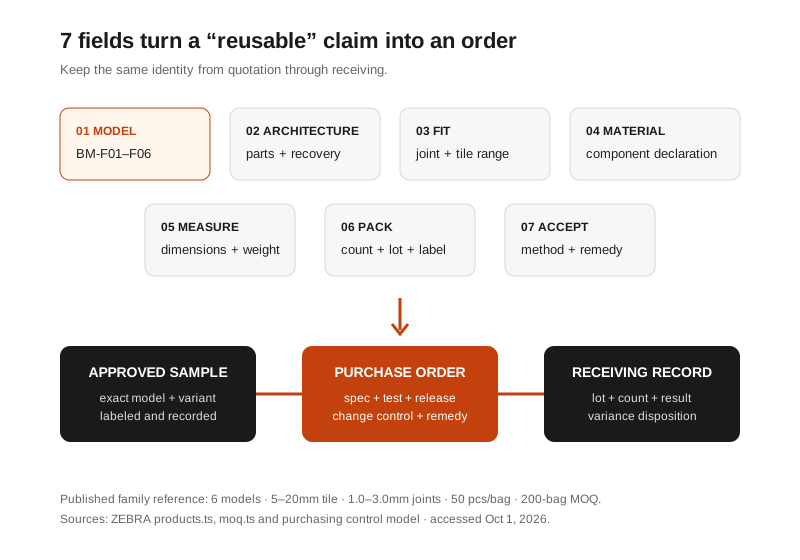
- Model code: put BM-F01–F06 or the supplier’s equivalent on the quotation, sample label, purchase order and packing list.
- Component architecture: identify every removable, recovered, embedded and replaced part with a drawing or labeled photograph.
- Fit: state the joint-width option and tile-thickness range separately. One does not substitute for the other.
- Material declaration: name the material of each component. If a particular steel or polymer grade matters, make the grade and evidence contractual.
- Dimensions and weight: define the variant’s dimensions and piece weight, plus the agreed measurement method and permitted variation.
- Pack and label: state pieces per bag, bags per carton, carton dimensions, net/gross weight, lot code and artwork revision.
- Acceptance: attach the approved sample, test steps, sampling plan, defect classes, release decision and remedy.
Bottom line: “reusable” is a product attribute, not an acceptance rule. A buyer needs an exact SKU, an agreed sample and records that connect the production lot to the inspection result.
6 Models Share a 5–20mm Tile Range
The current ZEBRA master record lists six designs. All six show a 5–20mm tile-thickness range, while cap shape, overall dimensions, piece weight and base options differ:
| Model | Form / dimensions | Weight | Recorded base |
|---|---|---|---|
| BM-F01 | Circular · Ø36.4×76.3mm | 10.2g | 0.9 / 1.5mm |
| BM-F02 | T-type · 35.6×31×70mm | 9.1g | 0.9 / 1.5mm |
| BM-F03 | Cylindrical · Ø35.48×75.4mm | 10.1g | 0.9 / 1.5mm |
| BM-F04 | Square grid · Ø36×84.3mm | 13.6g | 0.9 / 1.5mm |
| BM-F05 | Spherical · 30×30×72mm | 10.6g | 1.5mm |
| BM-F06 | Clamp type · 29.7×29.7×37.5mm | 8.28g | 0.9 / 1.5mm |
The page-level joint range is 1.0–3.0mm, so the order must name the selected joint variant rather than treating the family range as one physical item. Use the reusable tile leveler product record to review the current family, then approve one physical sample for every model and variant ordered.
200 Bags Means 10,000 Pieces at the Published MOQ
The shared pricing and MOQ sources list 50 pieces per bag, a 200-bag MOQ and a current guide price of $1.30–1.70 per bag FOB Ningbo. One MOQ therefore contains 10,000 pieces and has a product value of $260–340 before freight, duty, tax, customization and local costs.
⚖️ Guide prices are FOB Ningbo at MOQ and subject to raw material cost fluctuations — contact us for current pricing.
That arithmetic is a purchasing reference, not a retail margin forecast. Selling price, returns, marketplace fees, field losses and replacement demand belong in the buyer’s own commercial model. The disposable vs reusable tile leveling buyer model explains how to calculate TCO from observed results without assigning a universal reuse count.
How to Approve a Sample Before the 200-Bag Order
Label the sample with model, joint option and date. Photograph the components, record dimensions and piece weight, and test the system on representative tile and setting material. The trial should confirm fit, tightening, removal at the setting-material manufacturer’s stated time, recoverable-part condition and the break or release behavior of the consumed component.
If repeated use matters to the order, write the test first: number the parts, define tightening method and force, state cleaning and conditioning, set the inspection points, and record failures or retirement reasons. A supplier’s cycle claim has little purchasing value when the fixture, load, removal method, conditioning and pass rule are missing.
Material Claims Need Component-Level Evidence
The current product master declares PP PE + stainless steel for the product family. It does not, by itself, establish a specific stainless grade, polymer grade, UV package, break force, corrosion life or dimensional tolerance for every component. If any of those properties drives the buying decision, add it to the purchase order with an agreed evidence source and finished-product test.
For example, a steel grade can be supported by a supplier declaration or material certificate linked to the production lot, while finished thread engagement still needs a functional check on the assembled leveler. Material paperwork and a finished-product test answer different questions; request both when both matter.
OEM Packaging and Color: Lock the Revision
The site’s commercial program lists 3,000 bags for private-label packaging and 5,000 bags per custom color, with a 15–25 day production window. Confirm these terms in the current quotation. Put the Pantone reference, resin/color approval sample, artwork file name, artwork revision, barcode owner, legal marks, bag count and carton marks in one approval record.
Do not release printing from an email description alone. Approve a rendered proof and a physical pre-production sample where color or print accuracy is material. The tile leveling systems catalog helps keep reusable components, consumables and adjacent SKUs under consistent naming.
Container Quantity Comes from Cartons and Gross Weight
There is no safe universal bag count for a reusable-leveler container. Obtain bags per carton, carton length/width/height, gross kg per carton, pallet basis and the final SKU mix. Calculate each line’s CBM and gross weight, sum them, then compare both totals with the forwarder-confirmed available volume and payload. Door clearance, weight distribution and carrier acceptance still apply.
A mixed order should be planned from measured demand rather than a fixed 70/30 or 60/40 model split. Record quote requests, sample acceptance, sell-through, replacement-base demand and returns by exact SKU. Use those results for the reorder. Ask the tile leveling system wholesale supplier team for current carton data and a SKU-level quotation.