
Selling Tile Leveling Systems Starts with 5 Metrics
- Qualified accounts: customers whose tile types, joint widths, project types and buying role are recorded.
- Documented project demand: clips and other consumables calculated from actual area, layout and the selected system’s placement guidance.
- Consumable sell-through: bags sold minus returns, measured by exact SKU and period.
- Recovered-part replacement: wedges, caps and tools replaced because of loss, wear, damage or additional crews.
- Contribution margin: net sales minus landed product cost, discounts, returns, fees and attributable fulfillment costs.
Bottom line: clip consumption creates the possibility of repeat purchases, but only customer project records and SKU-level sell-through establish the timing and value of those purchases.
17 Clip Bags Is a Project Calculation, Not a Forecast
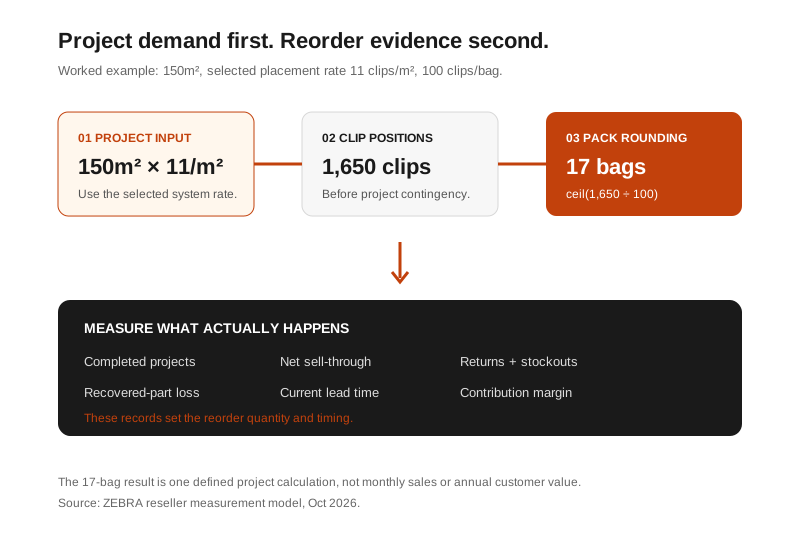
Use a transparent worked example. A 150m² floor using a system placement rate of 11 clips/m² requires 1,650 clips. At 100 clips per bag, round 16.5 up to 17 bags before adding the project estimator’s documented contingency. The calculation is:
Required bags = ceil(project area × selected placement rate ÷ pieces per bag)
The 11 clips/m² figure is a planning rate for a regular 60×60cm layout under the method described in the tile leveling clip quantity guide. Large formats, walls, running bond, cuts and other systems may use different positions. Follow the selected system’s placement drawing when it differs.
Consumable Clips and Recovered Wedges Need Separate Ledgers
In a clip-and-wedge system, tile leveling clips break off after the setting material reaches its removal time. The under-tile portion remains in the joint, so used clips do not return to stock. Wedges are normally removed, cleaned and inspected for another installation. Pliers are tools assigned by crew and system.
For one sequential crew, the established 1:3 wedge-to-clip planning ratio turns 1,650 active clip positions into about 550 wedges, or 6 bags of 100. This is a working-set estimate, not a lifecycle claim. Add sets for simultaneous crews and record lost, damaged and retired wedges. That field record determines replenishment; a fixed cycle-count statement does not.
Published MOQ Cash Wall for 4 Product Lines
The current shared price and MOQ sources produce this purchasing reference:
| Line | MOQ | FOB guide | Value at MOQ |
|---|---|---|---|
| Clips · 100/bag | 500 bags | $0.70–0.85 | $350–425 |
| Wedges · 100/bag | 500 bags | $0.80–1.00 | $400–500 |
| Pliers | 100 pcs | $1.10–1.50 | $110–150 |
| Cross spacers · 100/bag | 1,000 bags | $0.20–0.35 | $200–350 |
| All four at one MOQ | 4 lines | — | $1,060–1,425 |
⚖️ Guide prices are FOB Ningbo at MOQ and subject to raw material cost fluctuations — contact us for current pricing.
This is the cash required to meet one published MOQ on every listed line. It is not a recommended assortment. Cross-spacer demand follows spacer profile and layout and cannot be copied from the clip count. Choose joint widths, profiles and tool quantities from sampled customers and documented projects.
Gross Margin Needs Current Landed Cost and Net Sales
FOB is only the product-cost starting point. A reseller margin calculation needs current freight and insurance, customs value adjustments, duty, nonrecoverable import tax, brokerage, destination handling and saleable units. Net sales should deduct discounts, refunds and returns; marketplace or payment fees and attributable fulfillment costs should be visible rather than buried.
Contribution margin = net sales − landed product cost − returns − channel fees − attributable fulfillment
Run the formula for the same SKU and period. A $6 shelf price and $1 landed cost cannot be assumed across markets, so the old $5-per-bag result is not a reliable reseller benchmark.
Use Reorder Data to Change the Second Order
For each clip variant, store the opening stock, receipts, net units sold, returns, closing stock and stockout days. Add the customer segment and project type where available. The second order should reflect measured sell-through and lead time, with a separate safety-stock decision based on the reseller’s service target.
Do not use an automatic monthly reorder interval. A contractor’s demand changes with project area, tile format, layout, weather, staffing and scheduled work. The tile leveling systems catalog shows the available product families, and the tile leveling system wholesale supplier page provides current quotation inputs.