
What a Tile Leveling System Specification Must State
A spec sheet that omits any of these eight fields is asking you to buy on faith: (1) model number — a coded system so a reorder in six months lands on the same mold; (2) material and grade — "PP" alone is not a material, "100% virgin PP" is; (3) base thickness per variant — for clips this equals the grout joint it fits; (4) tile thickness capacity — the clamp depth the clip can hold; (5) piece weight — the cheapest consistency check that exists; (6) units per bag and carton quantities; (7) dimensional tolerance — ±0.1mm is the working standard for molded tile tools; (8) MOQ and FOB price per unit. The tables below carry all eight for our own range, so you can hold any quotation against them.
Five Product Lines at a Glance
The range spans five functional lines — disposable leveling, reusable leveling, spacing, caps, and accessories. The one-table version, priced FOB Ningbo at MOQ (every product below lives in the full tile leveling systems catalog):
| Line | Models | Key specification | FOB price | MOQ |
|---|---|---|---|---|
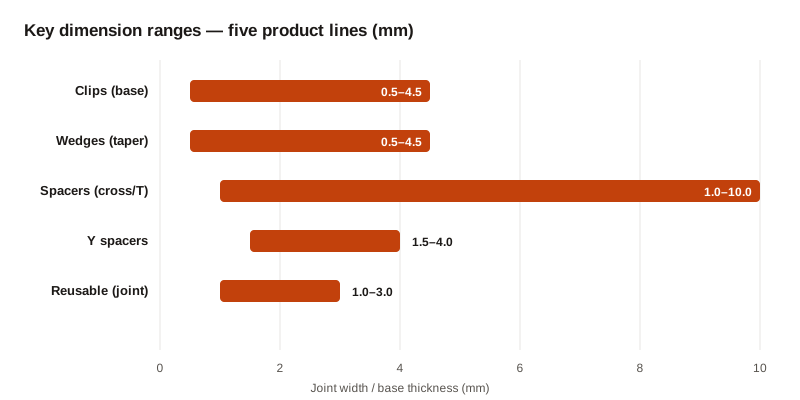
| Leveling clips | BM-B01–B10 (10) | Base 0.5–4.5mm (9 sizes) · tile 3–14mm (B06: 14–24mm) · 0.8–3.8g | $0.70–0.85/bag (100 pcs) | 500 bags |
| Wedges | BM-A01–A11 (11) | Reusable PE · taper 0.5–4.5mm · 0.4–6.2g | $0.80–1.00/bag (100 pcs) | 500 bags |
| Spacers & shims | 10 (8 cross + T + Y) | Cross/T joints 1.0–10.0mm · Y 1.5–4.0mm · shims 1.5–6.5mm · ±0.1mm | $0.20–0.70/bag | 1000 bags |
| Reusable levelers | BM-F01–F06 (6) | Tile 5–20mm · base plates 0.9/1.5mm · 8.28–13.6g | $1.30–1.70/bag | 200 bags |
| Spin-doctor caps | BM-D01/D02 (2) | Tile 3–18mm (57mm cap) · 3–25mm (49mm cap) | $1.45–1.60/bag | 500 bags |
| Pliers | BM-E01–E04 (4) | Steel+PP or all-nylon · 250–390g | $1.10–1.50/pc | 100 pcs |
| Kits | 6 set variants | 300 clips + 100 wedges + 1 pliers · joints 1.5–4.0mm | $4.50–5.50/set | 200 sets |
⚖️ Guide prices are FOB Ningbo at MOQ and subject to raw material cost fluctuations — contact us for current pricing.
Bottom line: when two quotations differ, diff the spec sheets line by line before you diff the prices — a 1.5mm and a 2.0mm-base clip are different products with the same photo, and the parameter that decides your joint quality (base thickness = joint width) is the one lazy spec sheets hide.
Clips: Base Thickness Is Joint Width
The most misread parameter in this category: a clip's base thickness is the plastic that must physically fit inside the grout joint — so it equals, and is quoted as, the joint width. A 2.0mm-base clip cannot enter a 1.5mm joint; a 1.0mm base under a 3mm joint rocks instead of clamping. The ten models divide into four working groups:
Current model and packing reference: BM-B01 through BM-B10 are all currently offered. The model table publishes the exact unit weight for every listed thickness; those figures support variant identification and QC. The separate logistics table records bag and carton references measured on 1.5mm for standard sizes, with small differences possible at 2.0mm, 2.5mm and 3.0mm. Do not derive final pack weight by multiplying unit weight. Explicit BM-B05 0.5mm and 4.5mm rows use their own records. Source: ZEBRA product and packing records reviewed October 4, 2026; the approved packing list governs the shipment.
- Fine-joint (0.5–2.0mm) — BM-B09 (0.5–2.0mm, 5 sizes) and BM-B10 (0.8–2.0mm, tile 3–10mm). For rectified tile installation and lippage control, where a standard 3mm clip base cannot enter the joint at all.
- Standard (1.0–3.0mm) — BM-B01–B04, B07, B08, in 4–5 thickness variants each, tile 3–14mm. Covers most floor work; the B04 is the lightweight option at 1.5–1.96g per piece.
- Full-span BM-B05 — the only model covering 0.5–4.5mm in 7 sizes (2.33–3g) — one SKU for mixed-joint projects.
- Thick-tile BM-B06 — the only model rated for 14–24mm slabs (bases 1.0–3.0mm, 2.44–3.04g): pavers, thick porcelain, stone. Nothing else in the range takes a 24mm slab.
For the size-by-size selection logic — which base serves which joint, and the weight ladder that verifies a delivery — see the dedicated tile leveling clip thickness guide.
Weight is a consistency check only when the comparison uses the exact model and thickness. Adjacent thicknesses can differ by only a few hundredths of a gram, and the sequence is not universally monotonic across every model. Compare a received sample with its published model-and-thickness value, then apply the written sampling tolerance and measurement method agreed for that order.
Wedges: Taper Range and the 11-Model Family
Wedge "size" works differently from clips: what matters is the taper range — how much height adjustment the wedge geometry offers as it slides into the clip. The 11 models (PE, 0.4–6.2g) split into four functional families:
- Standard and rounded (A01–A05) — the general-purpose family, tile classes 1–14mm, smooth taper gradient for precise height adjustment.
- Single/cross (A06/A07) — flat-profile wedges for cross-cap systems; the factory table records the pairing explicitly — A06 pairs B07/B09 clips, A07 pairs the B08.
- Mini (A08–A10) — small-format and mosaic work; shorter body, lower profile under the tile edge.
- U-type (A11) — U-channel profile for wall work where a full wedge sits too proud.
Note the parameter trap: the wedge taper is quoted 0.5–4.5mm — the same numbers as the clip base range, but a different dimension entirely. The taper is vertical adjustment; the clip base is horizontal joint fill. Spec sheets that quote one number for both are the ones that generate the "the wedge does not fit my clip" claims.
Wedges are reusable PE components, while clips are designed to break off after installation. Reuse count depends on taper wear, edge deformation and job conditions, so inspect wedges between jobs rather than assigning a fixed cycle claim. The wholesale kit structure uses a 3:1 planning format: 300 disposable clips + 100 reusable wedges per set.
Spacers and Shims: Joint Widths and the ±0.1mm Standard
Cross and T-shaped spacers carry the widest joint range in the catalog — 1.0–10.0mm (T model BM-P05 in 9 sizes; 8 cross models with standard, star, circular and U-type profiles) — color-coded by size for visual QC on site. Y-shaped BM-P06 covers 1.5–4.0mm in 5 sizes for cross joints; horseshoe shims run 1.5–6.5mm for height adjustment under the tile. All molded at ±0.1mm tolerance — the reason two spacers from the same bag feel identical in the joint, and the number to demand on any spacer quotation. Quantity planning is profile and layout specific: use the published manufacturer rates and limitations in our tile spacer quantity guide instead of copying the leveling-clip count.
Reusable Levelers and Spin-Doctor Caps: When the Tool Outlives the Project
Two lines exist for buyers whose customers need the tool to survive more than one job. The reusable levelers (BM-F01–F06) are stainless-steel-plus-PP/PE construction — six cap styles (circular, T-type, cylindrical, square-grid, spherical, clamp-type) — covering tile 5–20mm on base plates of 0.9 or 1.5mm, at 8.28–13.6g per piece. Note the extra spec dimension disposable clips do not carry: base plate thickness is listed per variant (F05 offers only the 1.5mm plate), so a reusable order needs one more decision line on the PO.
The spin-doctor caps (BM-D01/D02) thread on and off instead of breaking: D01 takes tile 3–18mm with a large 57mm cap, D02 the compact 49mm cap for tile 3–25mm — the deepest capacity in the range, sized for thick slabs. Both lines share the same joint constraint: 1.0–3.0mm, because a threaded cap needs a wider footprint than a fine-joint clip can offer. If your market mixes 2mm joints with 20mm slabs, the honest spec answer is two SKUs, not one "universal" part.
Accessories: Pliers, Suction Cups, Mallets
Pliers (BM-E01–E04) — 250–390g: E01/E02 are standard steel+PP pliers (OPP bag vs blister retail pack), E03 is the wall-leveling variant, E04 is all-nylon for lighter duty and lower freight. One pliers serves a whole crew, which is why the kit ratio is one pliers per 300 clips. Suction cups — nylon body with NBR rubber pad, $8–10/set FOB at 50 sets MOQ, in the 100 kg class that large-format slab work demands. Mallets — 25#–40# rubber-handle and 8–32 oz wooden-handle versions, $0.80–2.00/pc, the low-ticket line that fills container corners. Accessories carry the loosest spec sheets in the trade, which is exactly why weight (grams per piece) and material (steel vs nylon, NBR vs generic rubber) belong on your RFQ anyway.
Reading the Order Math: MOQ and FOB Together
Specifications and commercials are the same document. The kit proves it: one set is 300 clips + 100 wedges + 1 pliers. Priced as parts — 3 bags of clips at $0.70–0.85 ($2.10–2.55), 1 bag of wedges at $0.80–1.00, 1 pliers at $1.10–1.50 — the parts sum to $4.00–5.05, and the kit price is $4.50–5.50. The kit is not a premium; it is the parts bill plus pick-and-pack, which is why kit MOQ (200 sets) sits below the clip MOQ (500 bags) it would otherwise consume. The MOQ ladder across the range — 50 sets (suction cup) → 100 pcs (pliers) → 200 sets/bags (kit, reusable leveler) → 500 bags (clips, wedges, spin-doctor, shims, mallets) → 1000 bags (spacers) — tells you where trial containers are cheapest to assemble: around the 500-bag lines, with pliers and suction cups riding along.
Five Red Flags in a Supplier Spec Sheet
- No model number — or a model number that changes between proforma and shipment. Without a code, a reorder lands on whatever mold is on the machine that day.
- "PP" with no grade — virgin and recycled PP differ by 20–40% in cold-weather break strength; a sheet that will not state the grade is choosing it for you.
- Tolerance missing, or claimed tighter than ±0.1mm with no measurement method behind it. Ask how it is inspected, not just what it is.
- No piece weight — you lose the only free QC gate: weigh a sample, compare against the ladder within the model.
- Container-only pricing — "as low as $X per container" without per-bag FOB hides the mix. Every serious sheet quotes per bag, per set, per piece at a stated MOQ.
Run any quotation against the master table above and most of these surface in ten minutes. For the deeper version — certificates, machine nameplates, AQL sampling — the factory verification checklist in our supplier red flags guide continues from here.
Frequently Asked Questions
What does base thickness mean on a tile leveling clip?
It is the thickness of the clip's flat base — and it equals the grout joint width the clip fits, because the base must sit inside the joint. Our tile leveling clips cover 0.5–4.5mm in 9 sizes across 10 models, from 0.5mm fine-joint clips for rectified tile to 4.5mm for wide outdoor joints, at 0.8–3.8g per piece.
What tolerance should I demand on molded tile spacers?
±0.1mm is the working standard for injection-molded tile tools, and it is what our cross, T and Y spacers are molded to. Demand the tolerance on the quotation and ask how it is inspected — batch dimensional sampling before shipment is the normal verification.
Are tile leveling wedges reusable?
Yes — wedges are PE rather than PP, so they flex instead of snapping, and one wedge set survives multiple projects. Our range is 11 models (BM-A01–A11) with a taper range of 0.5–4.5mm at 0.4–6.2g. There is no honest fixed "number of reuses": inspect for taper wear and edge deformation between jobs and retire the worn ones.
What is inside a standard wholesale tile leveling kit?
Our six kit variants each contain 300 clips + 100 wedges + 1 pliers, in joint widths 1.5–4.0mm (one clip thickness per set). Kits run $4.50–5.50/set FOB Ningbo at 200 sets MOQ — approximately the sum of the parts bought separately, with pick-and-pack included.
Have a spec sheet to benchmark?
Send us the sheet you are holding. We will mark it line by line against our factory tables — thicknesses, tolerances, weights, MOQ — and quote FOB Ningbo on the parts that matter to your market.
Benchmark My Spec Sheet →Frequently Asked Questions
What does base thickness mean on a tile leveling clip?
It is the thickness of the clip's flat base — and it equals the grout joint width the clip fits, because the base must sit inside the joint. Our tile leveling clips cover 0.5–4.5mm in 9 sizes across 10 models, from 0.5mm fine-joint clips for rectified tile to 4.5mm for wide outdoor joints, at 0.8–3.8g per piece.
What tolerance should I demand on molded tile spacers?
±0.1mm is the working standard for injection-molded tile tools, and it is what our cross, T and Y spacers are molded to. Demand the tolerance on the quotation and ask how it is inspected — batch dimensional sampling before shipment is the normal verification.
Are tile leveling wedges reusable?
Yes — wedges are PE rather than PP, so they flex instead of snapping, and one wedge set survives multiple projects. Our range is 11 models (BM-A01–A11) with a taper range of 0.5–4.5mm at 0.4–6.2g. There is no honest fixed "number of reuses": inspect for taper wear and edge deformation between jobs and retire the worn ones.
What is inside a standard wholesale tile leveling kit?
Our six kit variants each contain 300 clips + 100 wedges + 1 pliers, in joint widths 1.5–4.0mm (one clip thickness per set). Kits run $4.50–5.50/set FOB Ningbo at 200 sets MOQ — approximately the sum of the parts bought separately, with pick-and-pack included.