
A compatible system is most useful when adjacent edges need restraint during cure. It cannot flatten a bad substrate, create mortar coverage, or make an incompatible tile and clip work together.
For large-format or rectified tile, wall work, and installations where small edge differences are difficult to control by hand, a correctly selected system can be worthwhile. Bottom line: the value comes from temporary edge restraint and repeatability; it does not come from repairing the assembly beneath the tile.
Are Tile Leveling Systems Worth It? Start With the Job
The useful comparison is not “clips versus installer skill.” It is the installation with a compatible restraint method versus the same installation without one. A wedge or cap can hold adjacent edges in relative alignment while the mortar cures. That extra control is more valuable as tile size, edge precision, surface reflectivity, or vertical placement makes lippage easier to see.
MAPEI describes its EasyWDG system as an edge-leveling system for floors and walls that reduces the effects of slight variations in substrates and tiles. TCNA explains that perceived lippage also depends on actual tile warpage, joint separation, substrate plane, and lighting. Together, those sources establish the boundary: the accessory helps manage the edge relationship, while the installation system still determines the finished result. See MAPEI EasyWDG and the TCNA lippage FAQ.
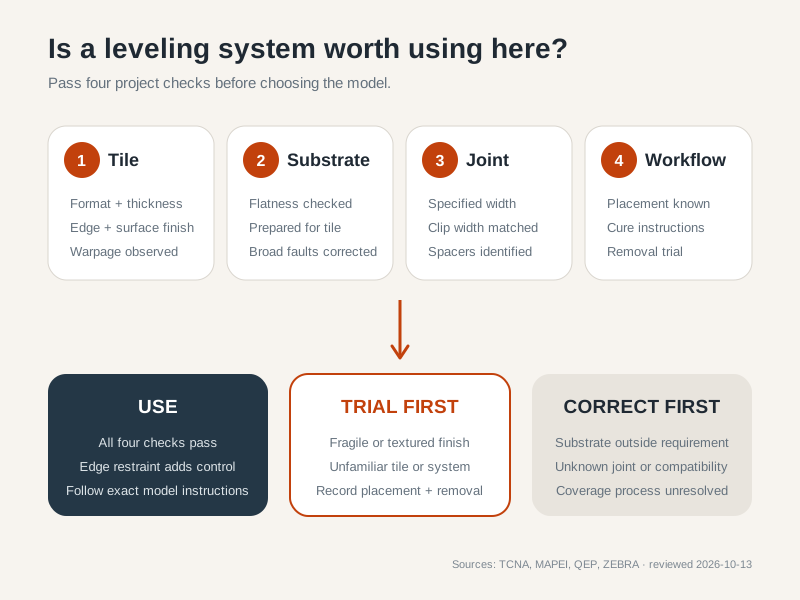
4 Checks Before You Buy or Specify a System
- Tile: confirm format, actual thickness, edge profile, surface finish, and the manufacturer’s installation requirements.
- Substrate: verify that the floor or wall meets the applicable flatness and preparation requirements before setting tile.
- Joint: match the clip or spacer width to the specified grout joint; add separate spacers when the system does not create that width.
- Workflow: confirm placement, tightening, cleaning, cure, and removal instructions for the exact model.
If any answer is unknown, a bag labeled “universal” does not resolve it. Use the model specification and a representative trial. For a procurement review, the tile leveling system specification guide lists the fields that should appear on an RFQ and approved sample record.
Where the Extra Edge Control Usually Helps
Large-format and rectified tile often make small edge differences more visible, particularly under grazing light. Walls introduce gravity and handling constraints. Long plank formats add perimeter and potential bowing considerations. In these cases, a compatible system provides repeatable temporary restraint while the installer checks plane and coverage.
QEP’s floor-and-wall manual recommends clips and wedges to keep large-format tile aligned, while its ordinary spacers maintain uniform grout lines. MAPEI publishes a large-format workflow that places clips according to tile size and keeps them away from corners. These are system-specific instructions, but they show why the value rises with demanding formats. See the QEP installation manual and MAPEI large-format workflow.
For product selection, compare a disposable tile leveling clip system with a reusable tile leveler only after confirming tile range, joint width, contact surfaces, and removal method.
When the Benefit Is Limited or the System Is Unsuitable
A system may add little value when the tile is too small for the clip base, the surface is intentionally irregular, the edge is fragile, or the joint geometry does not accept the component. Mosaics and textured finishes need particular caution: a base can interfere with mortar contact, and a wedge or cap can mark a surface during tightening or removal.
Do not generalize one brand’s minimum tile size or thickness range to every system. RUBI’s TILE LEVEL QUICK product guidance, for example, publishes model-specific format and thickness limits. QEP’s LASH instructions specify their own trowel and placement conditions. Those numbers describe the named systems only. A private-label buyer should approve the intended tile range through the product specification and sample test rather than copying a competitor’s limit.
A Leveling System Cannot Fix These 4 Problems
- Unsuitable substrate plane: clips follow the assembly; they do not grind high areas or fill broad depressions.
- Insufficient mortar coverage: edge restraint does not prove that the tile back has the required contact.
- Inherent tile warpage: a system may help manage neighboring edges but cannot remove fired-in curvature.
- Incorrect movement or joint design: plastic installation accessories do not replace project requirements.
TCNA states that tile installed with thinset generally follows the plane of the substrate and that thinset is not intended to correct surface level or flatness. Review the substrate flatness requirements before deciding that more clips are the answer.
Cost and Reuse: Compare the Whole Working Set
“Worth it” is also an operating question. In a clip-and-wedge system, the clip is normally the breakaway part while wedges are reused. A screw-cap or spin system may organize reusable and disposable components differently. Compare the consumable quantity, active working set, tool requirement, cleaning, replacement record, and labor process for the exact model.
Do not claim a universal reuse count without a documented test and retirement rule. Inspect reusable parts before each cycle and remove cracked, deformed, contaminated, or poorly engaging pieces. A distributor can compare published product prices, but final value also depends on the project’s tile mix, crew workflow, freight, and replacement experience.
How to Make the Decision Repeatable
Use one sample area that represents the actual tile, substrate preparation, setting material, joint width, and removal process. Record the model, tile thickness, placement pattern, tightening method, cure condition, surface marks, break behavior, and reusable-part condition. Approval of that sample gives the buyer a defined reference; it does not certify every future project condition.
If the trial shows a benefit, document the exact system instead of buying a generic assortment. The tile leveling systems catalog separates clips, wedges, caps, spacers, pliers, and reusable products by role. For a commercial order, ask the tile leveling system wholesale supplier for model-level specifications and current terms.
Frequently Asked Questions
Are tile leveling systems worth it for beginners?
They can be useful after four checks—tile, substrate, joint, and workflow—confirm compatibility, because they restrain adjacent edges while mortar cures. They do not replace substrate preparation, mortar coverage, layout checks, or workmanship.
Do professional tile installers use leveling systems?
Some professionals use them in at least three demanding groups: large-format, rectified, and wall installations. Others use different methods for particular tile and layouts, so the project specification and selected product instructions govern the decision.
Can a tile leveling system fix an uneven floor or wall?
No. A leveling system controls one relationship—the relative position of adjacent tile edges during installation. An unsuitable floor or wall substrate must be corrected according to the tile and setting-material requirements before tile is installed.
Are leveling clips suitable for every tile?
No. Check six model and project fields: minimum and maximum tile thickness, joint width, surface finish, edge profile, tile format, and removal method. Make a representative trial when the surface is fragile, textured, or unfamiliar.