
Key Findings 2026
Five numbers do most of the work on this page. Each is excerptable as-is, with its section below carrying the full context and source.
- Factory price: tile leveling clips are listed at $0.70–0.85 per 100-piece bag FOB Ningbo at the 500-bag MOQ. This is a B2B product value before freight, duty, channel fees and local taxes.
- MOQ spread: minimum orders run from 100 pcs (pliers) to 1,000 bags (spacers) across a 12-SKU line; OEM customization starts at 3,000 bags (packaging) and 5,000 bags per color.
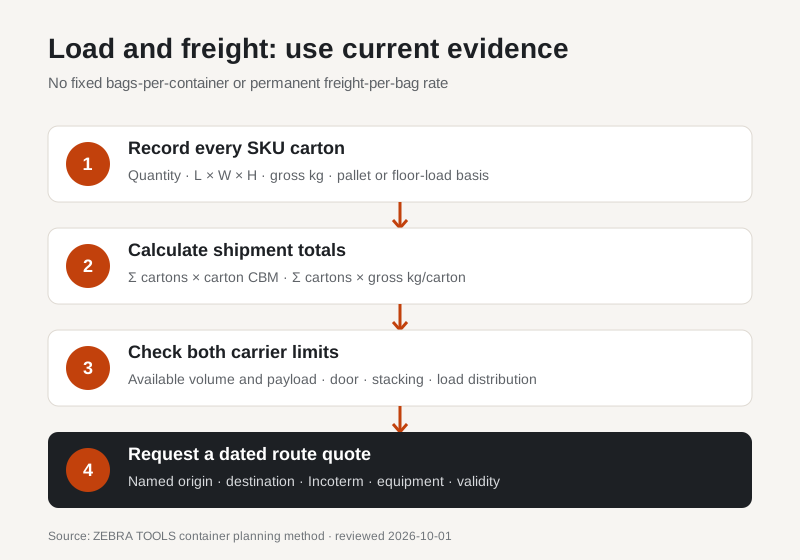
- Load planning: there is no universal bags-per-container or freight-per-bag value. Calculate carton-level CBM and gross weight for the exact SKU mix, then compare LCL and FCL with a dated forwarder quote.
- Field consumption: the disclosed four-position model gives 11.111 clips per m² for 60×60cm tile, so 200m² uses about 2,222 clips or 23 full bags before project contingency. No fixed wall multiplier applies; use the selected system placement drawing. The 23-bag project quantity is below the listed 500-bag MOQ and should not be presented as a small-order quote at MOQ unit rates.
- Standards reality: ASTM C648 covers ceramic-tile breaking strength, not plastic leveling clips. QEP and RUBI describe clip removal behavior functionally rather than establishing a shared numeric force target; define the buyer's test and acceptance criteria in the purchase order.
Bottom line: the useful citable assets are the SKU-level price and MOQ table, the disclosed clip-use formula and the carton-level load method. Freight, duty and compliance conclusions must be refreshed for the actual shipment and destination.
Price Benchmarks: The Full FOB Line (September 2026)
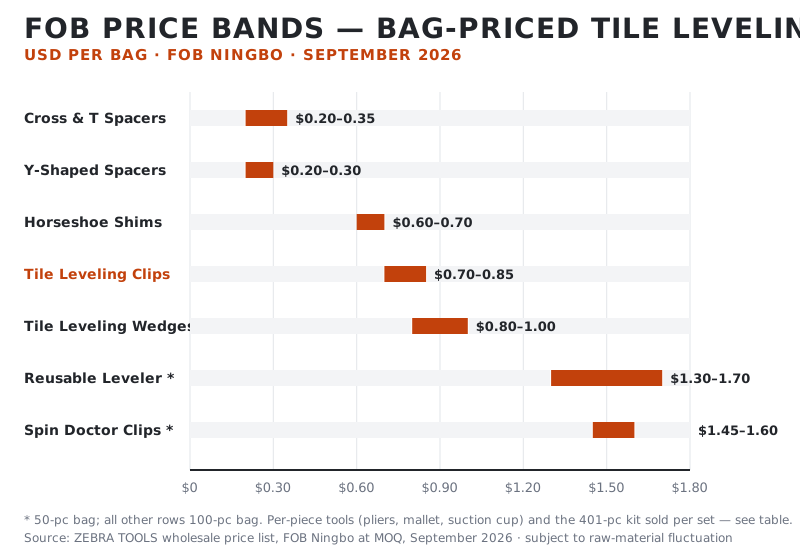
The table below is the complete 12-SKU wholesale line as published in our price files — the same rows our tile leveling clips and sibling product pages render from, so the numbers cannot drift between pages. Prices are FOB Ningbo at each SKU's MOQ.
| Product | Unit | FOB Price | MOQ | Material |
|---|---|---|---|---|
| Tile Leveling Clips | 100-pc bag | $0.70–0.85 | 500 bags | PP |
| Tile Leveling Wedges | 100-pc bag | $0.80–1.00 | 500 bags | PE |
| Cross Tile Spacers | 100-pc bag | $0.20–0.35 | 1,000 bags | PP/PE |
| T-Shaped Spacers | 100-pc bag | $0.20–0.35 | 1,000 bags | PP/PE |
| Y-Shaped Spacers | 100-pc bag | $0.20–0.30 | 1,000 bags | PP/PE |
| Horseshoe Shims | 100-pc bag | $0.60–0.70 | 500 bags | PP |
| Reusable Leveling System | 50-pc bag | $1.30–1.70 | 200 bags | SS + PP/PE |
| Spin Doctor System | 50-pc bag | $1.45–1.60 | 500 bags | PP |
| System Kit (401 pcs) | set | $4.50–5.50 | 200 sets | PP/PE + Steel |
| Leveling Pliers | piece | $1.10–1.50 | 100 pcs | Steel/Alu |
| Tile Mallet | piece | $0.80–2.00 | 500 pcs | Rubber + Wood |
| Electric Suction Cup | set | $8–10 | 50 sets | Nylon + NBR |
⚖️ Guide prices are FOB Ningbo at MOQ and subject to raw material cost fluctuations — contact us for current pricing.
Two benchmark references put those numbers in market context. Rubi Delta and QEP LASH public retail listings provide channel benchmarks, but retail and FOB are different cost bases. A buyer should compare landed cost and channel fees before drawing a margin or savings conclusion. And within our own line, clip price is flat across the base-thickness range: the same $0.70–0.85 band covers 1.5–3.0mm bases, so joint width changes the order mix, not the unit price — the full tile leveling clip thickness matrix maps sizes to grout joints.
For buyers quoting the full line into a distribution business, our tile leveling system wholesale supplier page carries the same table with order terms.
MOQ Tiers and Container Economics
Minimum orders follow product physics, not one flat rule: consumable bags sit at 500 (clips, wedges, Spin Doctor, shims), high-volume spacers at 1,000 bags, steel-handled tools at 100 pieces, and low-volume/high-value items lower still — 200 bags for reusable levelers, 200 sets for the 401-pc kit, 50 sets for the electric suction cup. Customization moves the goalposts by design: private-label packaging starts at 3,000 bags ($150–500 setup, 15–25 production days), Pantone color matching at 5,000 bags per color ($100–300 per run), and custom mold development quotes per project with 15–25 day tooling at $2,000–8,000 per mold.
Load planning starts with the actual packing data. For each SKU, multiply carton quantity by carton length × width × height to obtain CBM, and multiply carton quantity by carton gross weight. Add the SKU totals, state whether dimensions are palletized, and ask a forwarder for a dated LCL/FCL comparison to the named destination. Container equipment, payload limits, routing, surcharges and rates change; a fixed bag count or per-bag freight value is not transferable between mixes.
The volume-tier logic behind these numbers — when MOQs flex, how trials graduate to containers — is laid out step by step in our tile leveling clips wholesale sourcing guide.
Materials and Performance Benchmarks
Four numbers separate spec-grade product from landfill-grade, and all four come with a temperature, a cycle count or a deadline attached:
- Material checks: record the resin type and any recycled-content declaration by product and batch. If the intended market has temperature-related performance requirements, agree a conditioning range and test method with the supplier before including results in acceptance.
- Reusable working set: the 1:3 wedge-to-clip ratio is a purchasing and workflow planning ratio, not a service-life guarantee. Clean wedges after removal and inspect the teeth, taper and body before reuse.
- Outdoor exposure: if UV resistance matters, name the resin, stabilizer requirement, conditioning and test method in the purchase specification. Do not apply an unsupported universal percentage loss to every PP grade.
- Dimensional control: record the drawing characteristic, measurement method, instrument and sampling plan. A tolerance claim applies to the named feature and approved model, not to an assumed container quantity.
Manufacturing Landscape: Where the World's Clips Come From
China has a visible manufacturing cluster for injection-molded tile accessories, including suppliers in Wenzhou and Foshan. No authoritative public dataset found in this audit supports a precise global production-share percentage or a universal cross-country mold-cost ratio, so those figures are excluded. Buyers should compare named supplier quotes, mold ownership, resin declarations, approved samples and batch records.
Our own capacity sits inside that cluster: one Wenzhou factory of 2,700+ sqm, 12 product lines molded on 16 injection machines (120T–380T), over 50 million components per month, two hours from the Port of Ningbo, exporting to distributors in 50+ countries since 2019 — the full line is browsable under tile leveling systems. Buyers auditing any supplier in the cluster (us included) should weight the same three proofs: certification depth, batch QC records, and mold ownership.
Standards and Compliance Map: What's Regulated and What Isn't
This is the section most of the industry gets wrong in writing. The category splits cleanly into regulated and unregulated halves:
| Item | Status 2026 |
|---|---|
| Clips, wedges, spacers (plain plastic) | No CE marking — no EU directive covers them, and affixing CE where none applies is forbidden. GPSR (EU) 2023/988 (in force 13 Dec 2024) + REACH (EC) 1907/2006 govern instead. |
| Electric suction cup | CE required — Machinery Directive 2006/42/EC (lifting accessory) + EMC Directive 2014/30/EU, with Declaration of Conformity and technical file. |
| Break force | ASTM C648 applies to ceramic tile strength, not plastic clips. Set the clip model, test setup, sample plan, failure mode, and acceptance criteria in the PO. |
| Lippage tolerance | ANSI A108.02 §4.3.7: 0.8mm permitted lippage plus inherent tile warpage, on a 4-ft level. |
| Tile warpage (the input) | ANSI A137.1 caps curvature at ±0.5% of nominal dimension (ASTM C485 / ISO 10545-2) — a 600mm tile may crown 3mm and still ship compliant. |
Factory-side certification rounds out the file: our shipments carry CE product certificates, ISO 9001 (cert. OKC1QS24452), a TÜV Rheinland factory audit verifiable on Certipedia, SGS factory certification, and RoHS compliance — the documents EU importers attach to the GPSR/REACH file above.
Methodology, Sources and How to Cite This Page
Product prices and MOQs on this page come from the same ZEBRA data used by the product and wholesale pages and were reviewed October 1, 2026. Prices are guide values FOB Ningbo at MOQ and remain subject to raw-material changes. Shipment capacity and freight are intentionally calculated from current carton data and a dated forwarder quote. Third-party retail references use the cited public listings and are not presented as landed-cost or margin comparisons.
ZEBRA TOOLS. (2026). Tile Leveling System Industry Snapshot 2026: Price, MOQ & Standards. Retrieved September 19, 2026, from https://zebratiling.com/blog/knowledge/tile-leveling-industry-snapshot-2026/
Frequently Asked Questions
What is the factory price of tile leveling clips in 2026?
$0.70–0.85 per 100-pc bag FOB Ningbo at the 500-bag MOQ. Matching wedges run $0.80–1.00 per bag, and the full 12-SKU line spans $0.20 (spacers) to $10.00 (electric suction cup set). Brand retail for comparison: $10–20 per 100 clips (QEP LASH, July 2026).
What MOQ do tile leveling system manufacturers require?
It varies by SKU, not one flat number: 500 bags for clips, wedges, Spin Doctor and shims; 1,000 bags for spacers; 200 bags or sets for reusable levelers and the 401-pc kit; 100 pieces for pliers; 50 sets for suction cups; 500 pieces for mallets. Customization tiers start higher — private-label packaging at 3,000 bags, Pantone colors at 5,000 bags per color.
How many tile leveling clips does a square meter of tiling need?
The disclosed four-position model gives 11.111 clips per square meter for 60×60cm tile. A 200m² project therefore uses about 2,222 clips, rounded to 23 full bags, before the project’s documented contingency. There is no fixed wall multiplier; confirm the selected system placement drawing. This project quantity is below the listed 500-bag MOQ.
Do tile leveling clips need CE marking in the EU?
No — and affixing CE to them is forbidden, because no EU directive covers plain plastic leveling clips. The applicable law is GPSR (EU) 2023/988 plus REACH chemistry compliance. Powered tools differ: an electric suction cup falls under the Machinery Directive and does require CE with a Declaration of Conformity.
Send your market and order size — we'll return the same table with your landed cost per bag, not just FOB.
Get the Landed-Cost Version →