
Tile Leveling System Warranty: Claims and Evidence
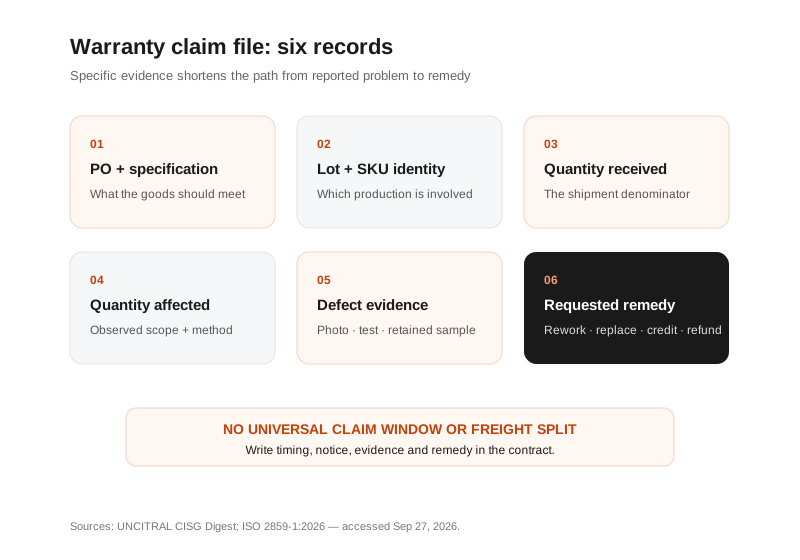
Send the PO and specification, lot identity, received quantity, affected quantity, clear defect evidence and requested remedy within the notice period written in your contract.
A tile leveling system warranty is useful only when it connects a measurable product requirement to a notice process and a remedy. This guide is for importers and distributors buying from a China wholesale manufacturer. It explains what belongs in the agreement before production and what evidence the buyer should preserve if clips, wedges, packaging or quantities do not match the purchase order.
Bottom line: there is no universal 14-day, 30-day or 90-day claim window for tile leveling tools. Write the inspection period, notice route and remedy into the contract, then report a suspected nonconformity promptly with lot-level evidence.
Five Terms Every Tile Leveling System Warranty Needs
- Covered nonconformities: identify the dimensions, model, quantity, packaging, artwork and functional requirements controlled by the warranty.
- Inspection and notice: state when receiving inspection starts, the contractual notice period and the email or portal that constitutes notice.
- Evidence: define which lot records, photos, counts, measurements and retained samples are required.
- Decision process: name who reviews the claim, whether joint or third-party testing is allowed, and how conflicting results are handled.
- Remedy and costs: specify rework, replacement, credit or refund options plus responsibility for testing, disposal and freight.
These terms should agree with the tile leveling system purchase order. A warranty cannot rescue a PO that never defined the accepted model, dimensions or test method.
The 6-Record Claim File
| Record | What to preserve | What it proves |
|---|---|---|
| 1. Order reference | PO, approved specification, sample identity and artwork revision | The requirement the goods should meet |
| 2. Lot identity | SKU, production lot/date, bag labels, carton marks and pallet | Which production lot is involved |
| 3. Quantity received | Packing list, receiving count and damaged/missing cartons | The shipment denominator |
| 4. Quantity affected | Units or bags checked, nonconforming count and sampling method | The observed scope without extrapolating blindly |
| 5. Defect evidence | Dated photos/video, measurement records, test setup and retained samples | What failed and how it was tested |
| 6. Requested remedy | Replacement, rework, credit or refund request and deadline | The commercial resolution sought |
Separate Product, Transit and Installation Problems
Product nonconformity means the supplied SKU, quantity, packaging or tested characteristic differs from the PO. Transit damage concerns loss or damage occurring during carriage and should be documented at receipt against the transport and insurance terms. Installation outcome may involve substrate flatness, mortar, tile warpage, placement or removal technique rather than the clip itself.
Preserve unused items from the same bag and lot. A comparison between unused clips, installed failures and a known conforming sample gives both parties more information than a photo of a finished floor alone. For break complaints, record the method described in the clip break-force guide.
Do Not Convert AQL Into a Warranty Percentage
ISO 2859-1:2026 provides sampling schemes indexed by acceptance quality limit for continuing lot-by-lot inspection. AQL 2.5 does not state that 2.5% of every shipment may be defective and automatically accepted. The decision depends on the agreed plan, lot and defect classification.
A receiving claim also needs its own evidence. A pre-shipment lot may have passed the agreed sampling decision while a later receiving check still finds shipping damage, a labeling problem or a defect that the sample did not reveal. Compare the receiving record with the pre-shipment inspection report rather than treating one document as proof of every unit.
Notice Timing Comes From the Contract and Applicable Law
When the UN Convention on Contracts for the International Sale of Goods applies, Articles 38 and 39 address examination and notice of lack of conformity. The UNCITRAL CISG Digest explains that examination and notice are connected and that notice should identify the nature of the nonconformity. The exact result depends on the contract, applicable law and facts.
Operationally, inspect soon after receipt and send specific written notice promptly. Do not wait for every item to be counted before preserving the lot, notifying the supplier of the suspected issue and agreeing how the investigation will proceed.
Frequently Asked Questions
What evidence is needed for a tile leveling system warranty claim?
Keep six records: the PO and specification, lot and SKU identity, quantity received, quantity checked and affected, dated defect evidence with retained samples, and the requested remedy.
How many days does a buyer have to report defective clips?
There is no universal claim period for tile leveling clips. Use the period written in the purchase contract and consider the applicable law. Inspect after receipt and send specific written notice promptly rather than relying on an assumed 14-, 30- or 90-day industry rule.
Does AQL 2.5 allow 2.5% defective products in every shipment?
No. AQL indexes a sampling scheme for continuing lots. It does not automatically allow 2.5% defective units in each shipment; the plan, lot, defect classes and acceptance numbers must be agreed.
What remedies can a B2B warranty provide?
The contract can provide rework, replacement, credit or refund and should allocate testing, disposal and freight costs. No single remedy or freight split applies to every order, so write the mechanism before production.
Put the Claim Process in the Order
Want to discuss how these warranty records apply to your SKUs, packaging and inspection plan? Talk to our team before production.
Discuss Warranty Terms →