
Best Tile Leveling System for Large Tiles
The product range must match the tile. Placement count and spacing come from the selected system's instructions and the installation specification.
For a distributor sourcing large-format tile leveling systems from a China manufacturer, “large tile” is not enough for model selection. The factory needs tile thickness, required joint width and the installation method. A clip that fits 10mm porcelain may not fit a 20mm paver, while an edge-restricted job may favor a different tightening mechanism.
Bottom line: the best system is the model whose published compatibility fits the job and whose placement method the installer can follow consistently.
4 Inputs That Decide the Large-Tile System
- Tile thickness: compare the finished tile to the model's stated thickness range.
- Joint width: choose the clip or spacer size called for by the design and installation specification.
- Edge access: confirm there is room to insert a wedge, turn a cap or remove the system after cure.
- Installation method: follow the product instructions for placement, tightening and removal; validate the setup on the actual tile.
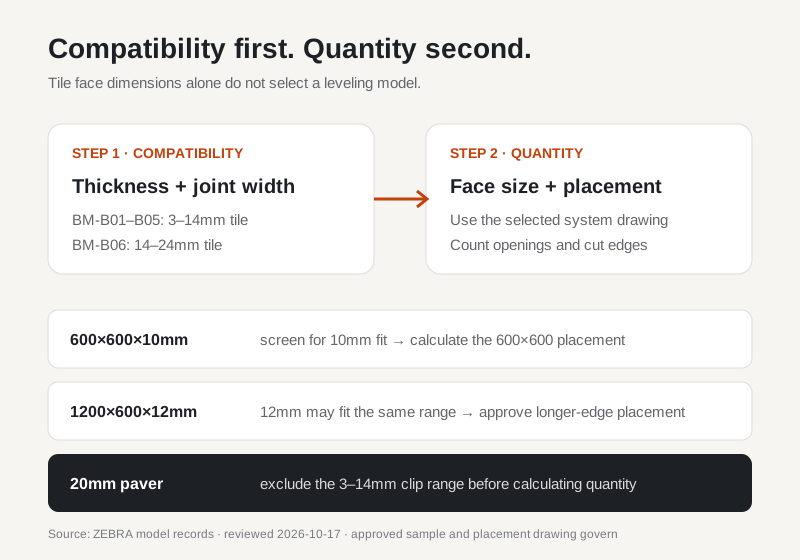
Tile Size Chooses Quantity; Thickness Chooses Compatibility
| Project input | Decision it controls | Published boundary |
|---|---|---|
| Tile thickness | Excludes models that cannot fit below and above the tile | BM-B01–B05: 3–14mm; BM-B06: 14–24mm |
| Required joint width | Selects the clip stem or separate spacer variant | ZEBRA clip family: 0.5–4.5mm, model-specific |
| Tile face dimensions | Changes the number and positions needed per area | Use the selected system's placement drawing or calculator |
| Edge access and method | Screens wedge, screw-cap or spin-cap operation | Validate the actual tile and approved sample |
For example, a 600×600×10mm tile still needs a model that fits 10mm thickness and the designed joint; the 600×600mm face then informs the placement count. A 1200×600×12mm tile can remain inside the same thickness range, but its longer edges need their own approved placement drawing. A 20mm paver excludes BM-B01–BM-B05 before quantity is calculated because those models publish a 3–14mm tile range.
Best Tile Leveling System Comparison by Role
| System | Published fit | Selection role |
|---|---|---|
| Standard clip + wedge | BM-B01–B05: 3–14mm tile; model-specific joints | Disposable clip sets the joint; reusable wedge applies restraint |
| Thick-tile clip + wedge | BM-B06: 14–24mm tile; 1–3mm versions | For tiles outside the standard clip height range |
| Reusable screw-cap | 5–20mm tile | Reusable mechanism where cap access and removal suit the job |
| Spin-cap system | Variant-dependent: 3–25mm or 3–18mm tile | Hand-tightened cap with model-specific post or spacer |
Published compatibility is a screening step. Request samples and test the selected model with the actual tile, joint and working method before approving a wholesale SKU.
Record the approved sample, model code and placement drawing together so purchasing, installers and inspectors evaluate the same configuration.
Why There Is No Universal Clip Spacing
A fixed distance such as “one clip every 20cm” cannot be applied to every system. Placement depends on tile dimensions, edge condition, warpage, mortar and the clip design. Use the manufacturer's instructions and the project specification. When the method is new, make a trial panel and record the approved placement pattern.
Do not use the leveling system to force a severely warped tile or compensate for an out-of-flat substrate. The TCNA lippage guidance explains that installation allowance and tile warpage both affect the resulting edge difference. For the field diagnosis sequence and measured limits, see lippage on large tiles; the separate guide explains why rectified tile still develops lippage.
Where Handling Tools Fit
A suction cup can assist with positioning when its instructions permit the tile surface and handling task. It does not set the grout joint and does not replace a planned lifting system, required personnel or safe-work procedure. ZEBRA's BM-069 electric suction cup lists a 100kg rated load, a 200mm NBR pad, 1800mAh battery and 1.4kg tool weight. Rated load must not be treated as a safe working load for every surface or handling configuration.
What Wholesale Buyers Should Put on the RFQ
- Tile thickness range and sample tile or technical drawing.
- Required joint widths and quantities by SKU.
- Preferred wedge, plier, reusable-cap or spin-cap method.
- Packaging count, barcode and private-label scope.
- Sample approval and the pre-shipment inspection checks.
Frequently Asked Questions
What is the best tile leveling system for large tiles?
There is no single system for every large tile. Match the system's published tile-thickness range and joint width to the tile, then confirm edge access, substrate preparation and the manufacturer's placement instructions with a trial installation.
Does tile size alone determine the leveling system model?
No. Tile thickness and required joint width screen compatible models; face dimensions affect the placement count. Edge access, tile warpage, substrate condition and the selected system instructions remain separate inputs.
Can leveling clips flatten an uneven substrate?
No. Clips control the relative position of adjacent tile edges while the setting material cures. Substrate flatness and tile warpage must be evaluated and addressed separately.
Is a suction cup part of a tile leveling system?
A suction cup is a handling and positioning accessory, not the component that sets joint width or holds adjacent edges. Its use must follow the tool instructions and the tile surface and handling plan.
Match the System to Your Tile Range
Send tile thickness, joint widths, package count and target quantity for a model comparison.
Compare Wholesale Options →