
Pantone Color Tolerance: 5 Acceptance Controls
Name the physical standard, production material and finish, measurement conditions, color-difference formula, and acceptance threshold. A Pantone code alone is incomplete.
A buyer sends a Pantone code to a China manufacturer, then the molded clip looks different from the phone screen, paper guide or earlier sample. For wholesale OEM orders, Pantone color tolerance only becomes measurable when both parties define the reference and the conditions used to compare it.
Bottom line: do not approve “match Pantone 165 C” as a complete color clause; approve a physical reference, production construction, measurement method and pass/fail rule together.
5 Controls Behind a Pantone Color Tolerance
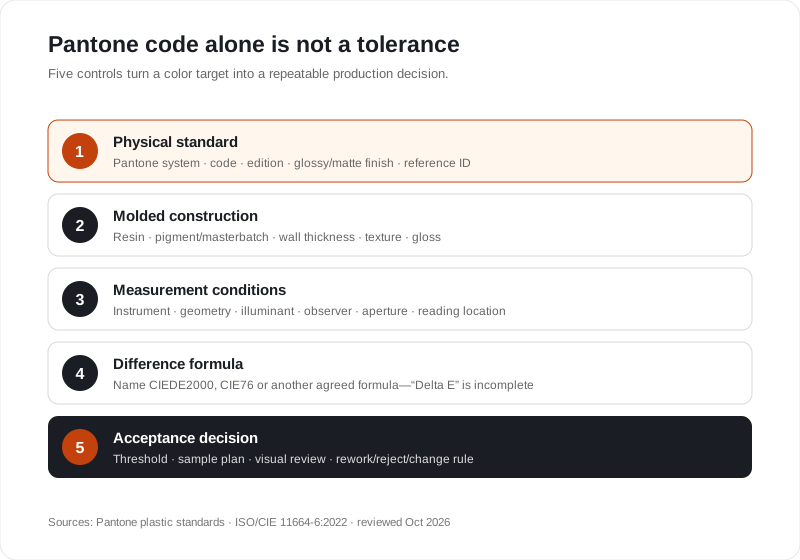
- Physical reference. Record the Pantone system, code, guide or chip edition, finish and individual reference ID. Protect the standard from contamination, fading and uncontrolled handling.
- Production construction. Identify resin, color masterbatch or pigment approval, wall thickness, texture, gloss and any insert or backing that changes appearance.
- Measurement conditions. State the instrument, geometry, illuminant, observer setting, aperture, calibration and number/location of readings.
- Difference formula. Name the formula used to calculate the color difference. “Delta E” without saying whether it is CIE76, CIE94 or CIEDE2000 can produce different values.
- Decision rule. State the numerical limit, sample plan, visual-review condition and what happens when a reading fails or falls into a conditional review band.
There Is No Universal Delta E Acceptance Number
Delta E is a calculated color difference, not a universal commercial tolerance. The acceptable limit depends on the product, reference, materials, surface, measurement setup and brand requirement. A threshold copied from a different material or industry may be tighter or looser than the buyer actually needs.
The International Commission on Illumination defines the CIEDE2000 color-difference formula in ISO/CIE 11664-6:2022. Naming that formula makes calculations comparable, but the standard does not choose the commercial acceptance limit for a tile tool. The buyer and supplier still have to write the threshold and decision rule.
Use a Plastic Standard for a Plastic Part
A printed paper swatch, a plastic chip and a molded part can reflect light differently. Pantone describes its Plastic Standard Chips as polypropylene references available in glossy and matte finishes, sized for spectrophotometer measurement. That makes the reference construction and finish part of the approval record.
If the buyer uses a paper guide because a plastic chip is unavailable, record that limitation and approve a molded physical sample before bulk production. Do not convert an RGB or hexadecimal screen value into an unstated plastic acceptance standard.
Why Resin, Thickness and Texture Change the Result
The same pigment recipe can appear different when the base resin color, opacity, wall thickness, cooling, surface texture or gloss changes. Measurements of resin pellets also do not automatically predict the final molded part. ASTM's scope for D6290-19 states that pellet color measurements are not necessarily directly related to a final molded or extruded product because production variables affect appearance.
Approve color on a representative molded part made with the intended resin, geometry, finish and process. If the production part has several thicknesses or textures, identify the measurement location rather than averaging unrelated surfaces.
Write the Color Clause Before 5,000 Bags
ZEBRA's published custom-color MOQ is 5,000 bags per color, with 15–25 production days after the usable color brief and approval inputs are confirmed. Sample preparation, buyer review, revision and shipping time are separate. A rejected or changed color after material preparation can require a revised feasibility and schedule.
Pantone system/code/edition/finish · approved molded sample ID · SKU/resin/texture · measurement location · instrument and settings · CIEDE2000 or other named formula · numerical limit · sample plan · conditional visual review · rework/reject/change rule.
Connect Color Approval to the Golden Sample
Use the approved sample manufacturing process to assign the molded color reference an ID, revision and approval record. If the Pantone code, resin, texture or measurement rule changes later, use the OEM order change process rather than quietly replacing the sample.
For feasibility, send the target physical reference and product brief to a tile leveling system OEM manufacturer. Standard colors, current models and product minimums remain available through the tile leveling system wholesale supplier page.
Frequently Asked Questions
What Delta E is acceptable for a Pantone color match?
There is no universal Delta E limit for every plastic part. Buyer and supplier must agree the reference, material and finish, instrument and measurement conditions, color-difference formula, sampling plan and numerical threshold before production.
Should an OEM plastic part be matched to a screen or a physical Pantone chip?
Use an identified physical color standard suitable for the product material and record its system, code, edition and finish. Screens, RGB and hexadecimal values depend on display and conversion conditions and should not replace the approved physical reference for production acceptance.
Why can the same Pantone code look different on molded plastic?
Resin base color, pigment formulation, opacity, wall thickness, surface texture, gloss and lighting can change the observed color. Compare production and the approved standard under the same documented conditions.
What is ZEBRA's MOQ and schedule for a custom color?
ZEBRA's published custom-color MOQ is 5,000 bags per color. The written quotation confirms production timing after the usable color brief, resin, approved reference and packaging scope are fixed; sample, review, revision and shipping time are separate.
Turn the Pantone Code Into an Acceptance Rule
Send the physical reference, product SKU, finish and intended measurement method for feasibility review.
Review the custom-color brief →