
Bottom line: do not rank quotations until every supplier has priced the same requirement and every missing cost is either confirmed as included or marked pending.
Why Supplier Quote Comparison Fails Before Price
A quotation is a scope statement as well as a price. One supplier may quote a 100-piece consumer bag with custom artwork; another may quote bulk loose pieces. One may include sample approval and pre-shipment inspection access; another may price only production. A lower number does not prove a lower cost when the deliverables differ.
Freeze one buyer requirement before requesting revisions. The tile leveling system RFQ builder can organize the SKU, quantity, packaging, Incoterm and destination inputs. Send the same revision to every supplier and require each quotation to state exceptions instead of silently substituting a different material, pack or model.
The 12-Field Supplier Quote Comparison Sheet
| Field | What both quotations must state | Mismatch risk |
|---|---|---|
| 1. Specification | Drawing/specification revision, material and measurable acceptance criteria | Different product |
| 2. SKU / quantity / unit | Same model, quantity tier and bags, sets or pieces | False unit-price comparison |
| 3. Packaging | Pack count, artwork, barcode, inner/outer pack and carton data | Unpriced retail work |
| 4. Delivery term | Incoterms rule, version and exact named place or port | Different cost/risk boundary |
| 5. Currency | Quote currency and recorded conversion date/rate if normalized | Hidden exchange assumption |
| 6. Tooling / samples | One-time cost, ownership, included trials and refund rule | Recurring and setup cost mixed |
| 7. Inspection / testing | Method, sampling, access, report and reinspection responsibility | Different release evidence |
| 8. Lead time | Start trigger, production scope and cargo-ready definition | Dates start from different events |
| 9. Payment | Deposit, balance trigger, documents and inspection connection | Different cash and release exposure |
| 10. Validity | Expiry date and material/freight adjustment condition | Expired prices ranked as current |
| 11. Included scope | Documents, labels, origin handling and other named services | Service assumed but absent |
| 12. Exclusions | Every open assumption and buyer-paid charge | Blank treated as zero |
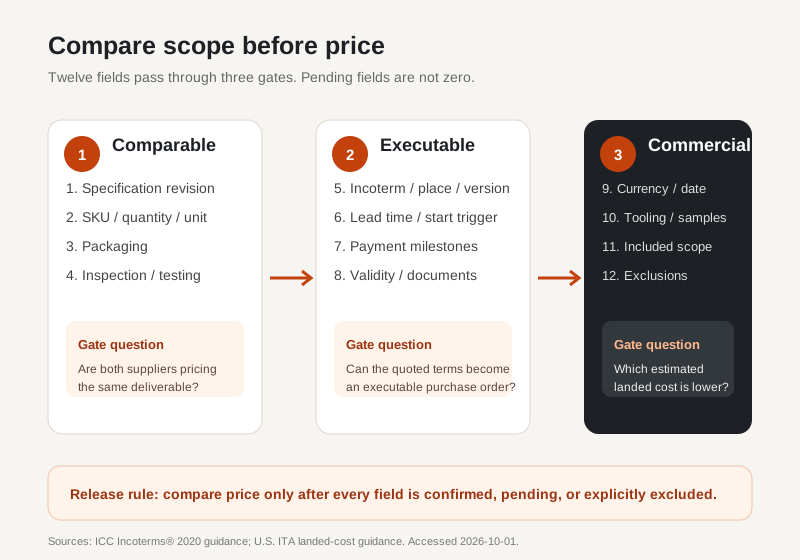
3 Gates: Comparable, Executable, Then Commercial
Gate 1 — Comparable: both suppliers accept the same product revision, quantity, packaging and inspection requirement. A quote that proposes an exception stays in a separate comparison row until the buyer accepts or rejects that exception.
Gate 2 — Executable: the supplier states a usable delivery term, lead-time trigger, payment milestones, validity and documents. “FOB” without a port or “30 days” without a start event is incomplete.
Gate 3 — Commercial: only now compare normalized product value, one-time charges, current logistics and estimated landed cost. Keep product cost and tooling separate so a repeat order does not inherit a setup charge by accident.
Normalize the Incoterm, Named Place, and Version
EXW, FOB, CIF and DAP do not cover the same delivery point or cost scope. The International Chamber of Commerce recommends writing the chosen rule with the precise named place or port and the rules version, such as the applicable location followed by “Incoterms® 2020.” Its official Incoterms guidance explains that the named place helps identify delivery, risk transfer and allocated costs.
Ask suppliers to requote on the same term and named point when possible. If that is not possible, carry the missing pickup, export, carriage, insurance or destination scope into a separate comparison worksheet. Do not add a generic freight allowance to every supplier; use the confirmed cargo dimensions, gross weight, ready date, route and delivery address.
Separate Recurring Cost From Tooling and Approval Cost
Keep the unit product price separate from mold/tooling, samples, artwork, printing plates, testing and inspection. For custom projects, connect the tooling line to its ownership, approved configuration, trial scope and change process. The mold ownership contract guide lists the controls that should accompany a tooling payment.
Samples also need an identity. A quoted sample fee is only comparable when both suppliers are building the same revision and the buyer knows which shipment, test or approval is included. Use an approved sample process to connect the physical reference with the quotation and inspection criteria.
Compare Estimated Landed Cost per Saleable Unit
The U.S. International Trade Administration describes landed cost as the product price plus insurance, freight, tariffs/taxes and other fees, while warning that the result remains an estimate because charges and rules can change. Its landed-cost guidance also points buyers to the current HS classification and destination tariff/tax inputs.
Use the same destination and cost boundary for every supplier. A practical comparison is:
Estimated landed cost per saleable unit = allocated estimated shipment total ÷ expected saleable units
Mark customs classification, duty, tax treatment, freight and local charges with their source and date. Do not convert potentially recoverable tax into permanent product cost without confirming its treatment. The landed cost calculator keeps shipment-specific inputs separate from supplier product value.
Unknown Is a Status, Not a Zero
Use three statuses for every field: confirmed, pending or excluded. “Confirmed” means the quotation states the answer. “Pending” means clarification or a third-party quote is still required. “Excluded” means the buyer knows the charge or task sits outside that supplier’s price.
Send one clarification round before negotiating price. Ask each supplier to fill only the missing fields and confirm the active revision. Once the comparison is complete, move the chosen terms into the purchase order; do not rely on a spreadsheet that was never incorporated into the transaction documents. For the final controls, use the tile leveling system purchase order checklist.
Frequently Asked Questions
How do I compare two supplier quotes fairly?
Put both quotes on the same specification revision, SKU and quantity, unit of measure, packaging, Incoterm and named place, currency/date, tooling and sample scope, inspection requirement, lead time, payment trigger, validity period, and exclusions. Mark unresolved fields as pending rather than assuming they are included.
Can I compare an EXW quote directly with an FOB quote?
No. EXW and FOB allocate delivery, risk and costs at different points. Normalize both to the same Incoterms rule, named place or port, version, cargo facts and excluded services, or carry the missing origin and transport costs into a separate landed-cost comparison.
Is the lowest unit price the best supplier quote?
Not necessarily. A lower unit price may cover a different product revision, quantity tier, package, inspection scope, delivery point or payment trigger. Shortlist only after the technical scope is comparable and estimated landed cost is calculated from current shipment inputs.
What should I do when a supplier leaves a charge blank?
Record the field as pending and request written clarification. A blank tooling, packaging, testing, freight or destination-cost field is not zero unless the supplier explicitly confirms that it is included in the stated price and scope.
Send the active SKU specification, quantity, packaging, Incoterm and destination so the response can be issued on a defined basis.
Request a Comparable Wholesale Quote →