
Material Declaration vs Test Report vs COA for Tile Tools
Match the issuer, product or sample, model, lot, method or requirement, and result or declaration to the item being purchased.
Importers, marketplace sellers and OEM buyers often receive several PDFs carrying words such as “certificate,” “analysis” or “test.” ZEBRA manufactures plastic tile tools and uses this material declaration vs test report guide to show what each document can support, what it cannot establish alone and how to connect evidence to the exact product being ordered.
Bottom line: evaluate the claim, scope and traceability inside the document; never accept the filename as proof.
Material Declaration vs Test Report: 5 Evidence Boundaries
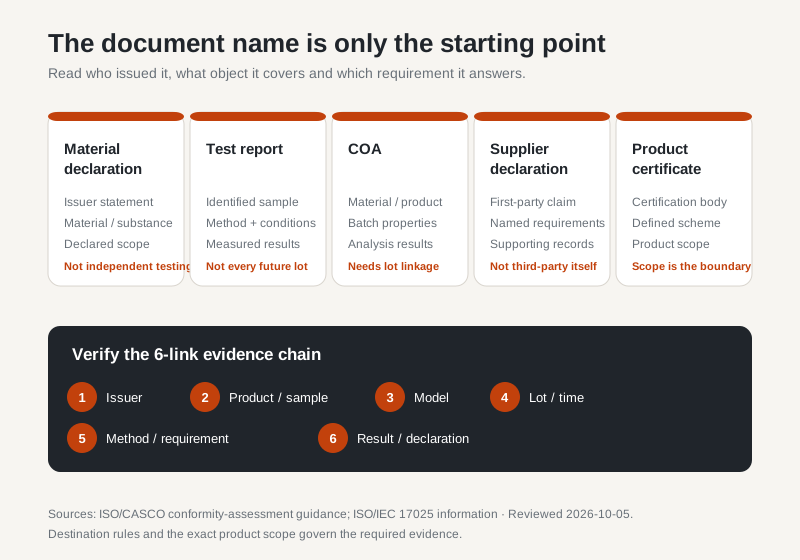
| Document | What it can state | What it does not prove automatically |
|---|---|---|
| Material declaration | Material, substance or composition information within the issuer's stated scope | Independent testing or use in every finished-product lot |
| Test report | Results for the identified sample, method and conditions | Certification of unrelated models or future production |
| COA | Stated analyses or properties for an identified material, product or batch | Linkage from that batch to a particular finished tool unless traceability supplies it |
| Supplier declaration | A first-party conformity statement against named requirements | Third-party certification merely because test evidence supports it |
| Product certificate | Conformity within the issuer, product and certification scope shown | Coverage of models, uses, markets or requirements outside that scope |
Check the 6-Link Evidence Chain
- Issuer: who made the declaration, performed the analysis or issued the certificate?
- Product or sample: what exact object was assessed?
- Model: does the document name the model, family, drawing or unambiguous identifier?
- Lot or time boundary: is it a one-time sample, material batch, production lot or continuing certification scope?
- Method or requirement: which test method, specification, regulation or buyer requirement was used?
- Result or declaration: what measured values, decision or conformity statement was actually issued?
If one link is missing, ask for the supporting record instead of filling the gap with an assumption. A report for generic “tile accessories” may not identify the clip model in the purchase order. A resin COA may identify a raw-material lot but not show which finished cartons used it.
A Material Declaration Is an Issuer Statement
A material declaration can identify polymer grade, intentionally added substances, restricted-substance status or another requested material attribute. Its value depends on the issuer, declaration basis, product identification, date and scope. A supplier can base a declaration on upstream documents, internal controls and testing, but the declaration itself does not become an independent laboratory report.
Ask whether the declaration applies to raw material, one component or the complete packed product. A clip body, printed bag, label and metal tool may require different evidence. Destination requirements decide which substances and thresholds matter; a generic statement should not be presented as universal market approval.
A Test Report Belongs to the Identified Sample
ISO/IEC 17025:2017 sets competence, impartiality and consistent-operation requirements for testing and calibration laboratories. ISO explains that it helps laboratories demonstrate competence and generate valid results. Accreditation scope, method, sample identity and report details still need review.
A valid result for one submitted sample does not automatically cover a different resin, thickness, model, mold cavity or later lot. The buyer needs a documented family rationale or production-control link before extending the conclusion. Laboratory accreditation also does not choose the correct legal requirement for the buyer's destination.
A COA Needs Batch Identity and Measured Properties
A useful certificate of analysis identifies the material or product, batch, measured or reported property, method or specification, unit, result, acceptance limit where applicable, date and authorised issuer. Buyers should distinguish measured batch results from values copied from a general technical data sheet.
To connect a resin COA to finished clips, retain material receipt identity, production record and finished-goods lot relationship. Without that chain, the COA describes the resin batch but cannot prove that a particular carton contains parts made from it.
A Supplier Declaration Is First-Party Evidence
ISO/CASCO guidance describes a supplier's declaration of conformity as a first-party attestation and points to ISO/IEC 17050-1 and 17050-2 for declarations and supporting documentation. The declaration should identify the issuer, object and specified requirements clearly enough for the recipient to understand the claim.
Third-party test results can support a supplier declaration, but they do not change who makes the declaration. Likewise, a management-system certificate concerns the certified management-system scope; it is not automatically a product test result.
Build the Shipment Evidence File Before Approval
Start with the destination, exact model, material claim and applicable requirement. Then request the document type that answers that question. Record issuer, document number, revision, issue date, product/sample identity, model scope, test method or requirement, result, expiry or surveillance status when applicable, and the connection to the ordered lot.
For incoming quality control, combine document review with the tile leveling clips pre-shipment inspection and an agreed batch traceability record. For market-specific claims, use the tile leveling certification guide as an initial scope check, then verify the current destination rule.
Frequently Asked Questions
Is a material declaration the same as a laboratory test report?
No. A material declaration is normally a statement from a supplier or manufacturer about identified material or substance information. A test report records results for an identified sample under stated methods and conditions. One does not automatically replace the other.
Does a test report certify every model from a factory?
No. A test report applies to the sample, methods and scope identified in the report. To use it for another model or later production, the buyer must establish a defensible link between that product and the tested sample and check the destination requirement.
What should a COA contain?
A useful certificate of analysis identifies the material or product, batch or lot, properties tested, methods or specifications, units, acceptance limits where applicable, results, date and authorised issuer. Its title alone does not prove that the stated material was used in a particular finished product.
Is a supplier declaration a third-party certificate?
No. ISO describes a supplier's declaration of conformity as a first-party attestation. It can be supported by testing, inspection or other evidence, including third-party reports, but the declaration itself remains the supplier's statement.
Match the Evidence to the Ordered Model
Share the destination, product model and required claim so the relevant document scope can be reviewed.
Discuss the order evidence →