
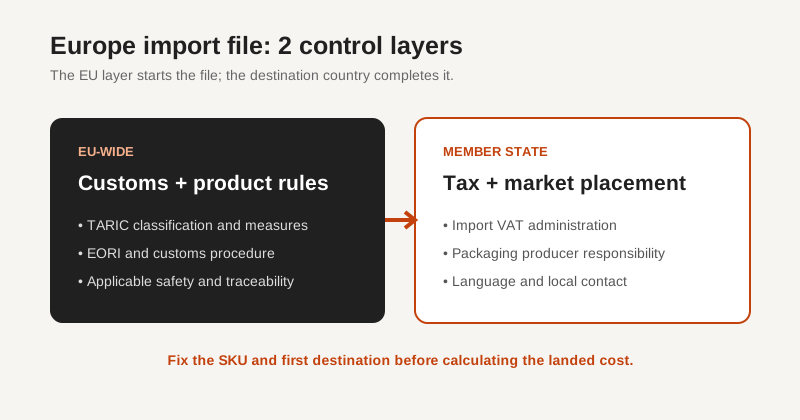
Bottom line: Do not use one fixed “Europe duty and VAT” percentage. Confirm the SKU in TARIC, name the importer and EORI, determine which product rules actually apply, then add the destination country's tax, packaging, language, and receiving requirements.
6 Checks Before Importing Tile Leveling Systems to Europe
- Freeze the SKU. Record material, function, components, retail-set status, origin, photos, and labeling.
- Check TARIC. Search the current classification and measures in the Commission's TARIC database.
- Name the importer. Confirm the EU-established economic operator, EORI, declarant, and customs procedure.
- Map product obligations. Determine applicable safety, chemical, labeling, traceability, language, and market-surveillance rules for the exact item.
- Add national obligations. Confirm import VAT treatment, packaging EPR, registrations, and local-language information in the destination state.
- Quote to the warehouse. Compare live routes with identical cargo, Incoterm, port, inland address, free time, and appointment assumptions.
TARIC Gives Measures, Not a Complete Landed Cost
TARIC combines the EU nomenclature with customs duty and other trade measures. It is the correct starting point once the product facts are stable. A plastic clip, steel-and-plastic reusable leveler, plier, and mixed kit may need separate analysis. Save the code, measures, additional-code questions, origin, and access date.
TARIC does not contain national VAT rates. A broker or tax adviser should connect customs value and procedure to the actual import-VAT treatment in the member state. Add brokerage, port charges, freight, inland delivery, and warehouse costs separately.
CE Marking: One Scope Test, Not a Default Logo
The European Commission's CE marking guidance states that CE is required only for products covered by specific harmonised EU rules that require it. Products outside that scope must not carry CE merely as a general quality symbol.
For each tile leveling product, document the scope decision and the rules that do apply. That may include general product safety, chemical restrictions, traceability, importer identification, warnings, and language requirements. The answer depends on the exact design and channel.
4 Member-State Questions the EU File Cannot Finish
Ask four questions for the first destination: How is import VAT accounted for? Who carries packaging producer responsibility? Which languages must appear on instructions or warnings? Which local operator receives market-surveillance enquiries? The answers can change when the same stock is placed on another national market.
This is why an EU distribution plan should name the first country of import and each target market. Our Germany import guide and Italy import guide show how the shared customs layer connects to a country-specific file.
Route and Warehouse Decide More Than the Port Name
Rotterdam, Hamburg, Antwerp-Bruges, and Mediterranean gateways can all be reasonable depending on the warehouse and service. Compare cargo-ready date, direct or transshipment service, terminal and document fees, customs location, free time, inland mode, fuel or congestion additions, and delivery appointment.
LCL reduces inventory exposure but introduces consolidation and destination handling. FCL can improve handling efficiency at volume, but only when the warehouse can receive promptly. Record quote validity and service assumptions beside the landed-cost model.
Importer File and Repeat-Order Control
Keep the SKU specification, classification reasoning, TARIC result, origin evidence, invoice, packing list, freight records, declaration, product-rule assessment, labels, test evidence, packaging registration decision, and tax instructions together. Version the file when material, design, supplier, packaging, or destination changes.
A repeat order should begin with a delta review: has the product changed, has TARIC changed, has the target market changed, and have freight or warehouse constraints changed? This preserves speed without treating last year's answer as permanent.
Frequently Asked Questions
What duty applies to tile leveling systems imported into the EU?
The answer depends on the exact TARIC classification, origin, customs value, and measures effective on the declaration date. Search the current TARIC with the SKU's material and function, then have the declarant confirm the result. National import VAT is a separate calculation.
Do tile leveling systems require CE marking?
CE marking is required only when the product falls under specific harmonised EU legislation that requires CE. It is not a generic quality mark. Document the scope decision for the exact product and comply with all other applicable safety, chemical, traceability, labeling, and language rules.
Does one EORI cover EU imports?
An EORI identifies the economic operator for customs interactions across the EU, but it does not replace member-state tax, packaging, language, or market obligations. Confirm the importer, customs procedure, and registrations for the destination.
Which European port is best for a tile tool shipment?
Select by current door-to-warehouse cost and operational risk. Compare sailing, transshipment, terminal charges, customs location, free time, inland mode, and delivery appointment using the same cargo and Incoterm.