
Shipping Mark Checklist for Mixed-SKU Tile Tool Cartons
A mixed carton must state every model, variant, quantity and unit inside it and match one packing-list line or subtable.
ZEBRA prepares tile clips, wedges, spacers and other tools for wholesale export orders from China. This shipping mark checklist is for importers, warehouse teams and OEM buyers who need each carton to identify its contents clearly before a mixed-SKU shipment leaves the factory.
Bottom line: give every carton one identity, list every contained product line and make the mark, packing list and physical pack agree before release.
The 9-Field Shipping Mark Checklist
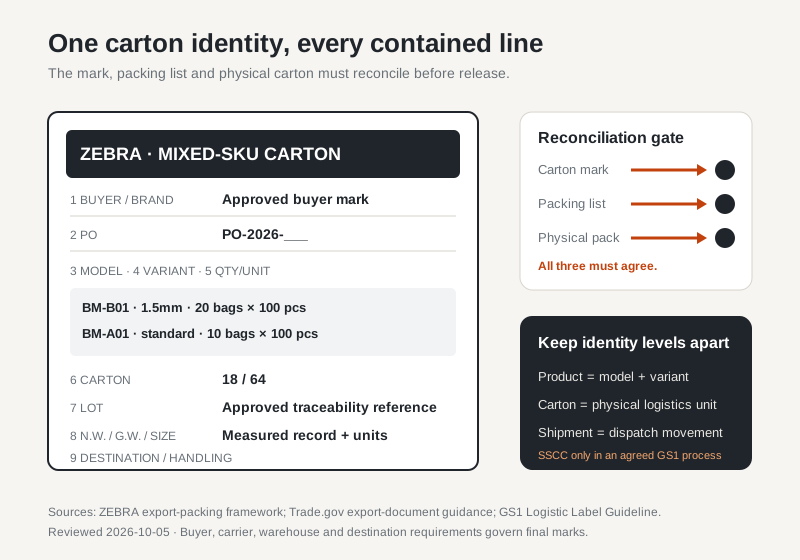
- Buyer or brand: the approved consignee-facing name or mark.
- Purchase order: the buyer's PO or another agreed commercial reference.
- Product model: factory model code for each contained line.
- Variant: joint width, size, color or other order-defining option.
- Quantity and unit: state pieces, bags, sets or another explicit unit.
- Carton sequence: for example carton 18 of 64 within the agreed sequence.
- Lot reference: the production or packing reference required by the traceability plan.
- Logistics data: approved net weight, gross weight and carton dimensions with units.
- Destination or handling mark: only the buyer, carrier or route-specific marks actually required.
Mixed-SKU Means Line-Level Contents, Not “Assorted”
The word “mixed” does not identify what a warehouse will receive. If one carton holds BM-B01 1.5mm clips and BM-A01 wedges, list both lines with quantity and unit. Keep the model code, variant spelling and unit consistent with the PO and packing list. “30” is ambiguous; “30 bags × 100 pcs” is reviewable.
Do not combine variants under a family name when the buyer needs model-level receiving. A line reading “tile leveling clips” cannot reveal whether the carton contains 1.0mm, 1.5mm or 2.0mm product, and a warehouse cannot use color alone as the commercial identifier.
Match the Carton Mark to the Packing List
Trade.gov's export-document guidance says an export packing list itemizes quantity, description, package type, number of packages, total net and gross weight, package marks and dimensions when appropriate. It also explains that the packing list does not replace the commercial invoice.
Build one reconciliation table before release: carton number, contained SKU lines, unit quantities, lot, net weight, gross weight and dimensions. Sum the carton records to the shipment totals. Then compare the commercial description and quantities with the invoice without forcing the packing list and invoice to serve the same purpose.
Use Actual Packing Records for Weight and Dimensions
Use the approved packaging configuration or measure the production-equivalent packed carton. Do not calculate final gross weight by multiplying nominal piece weight. Bag film, labels, inner boxes, carton material, count, thickness and packaging revision affect logistics values.
For ZEBRA clips, published carton references apply to the stated 1.5mm variants. Verified bag weights for other thicknesses do not establish carton quantity or carton weight. The approved packing list governs the shipment. Record units beside every value: kg for weight and cm for dimensions, unless the agreed buyer format states otherwise.
SSCC Is a Logistics Identifier, Not a Carton Number
GS1's Logistic Label Guideline identifies the SSCC as the identifier for a logistic unit within a GS1 logistics-label process. The company creating or branding the logistics unit assigns it using its GS1 Company Prefix. It is not created by adding digits to the PO, carton sequence or GTIN.
Use an SSCC only when the buyer, carrier or warehouse process supports it. The human-readable carton mark still needs the agreed operational fields. A barcode that scans successfully cannot repair a mismatch between the encoded identity, printed text, packing list and physical contents.
Separate Product, Carton and Shipment Identities
| Level | Question answered | Typical record |
|---|---|---|
| Product line | What product and variant is this? | Model, thickness, pack count, unit |
| Carton / logistics unit | Which physical handling unit contains it? | Carton sequence or agreed logistics-unit ID |
| Shipment | Which dispatch or commercial movement includes it? | Packing list, invoice, booking or shipment reference |
Keep the three levels connected but do not substitute one for another. One shipment contains many cartons; one mixed carton contains several product lines; one model can appear in several cartons.
Approve the Mark Before Carton Printing
Freeze the carton artwork or label template, model naming, variable-data fields, units, barcode data where used and print location. Test the template with the longest real model/variant text and the highest expected carton sequence. Record who supplies each variable field and who performs the final reconciliation.
Use the packaging sample checklist for artwork and barcode approval, then use the shipment receiving checklist when the goods arrive. The batch traceability guide defines the record that links the finished pack to production.
Frequently Asked Questions
What should appear on a mixed-SKU carton shipping mark?
Use the buyer-approved fields needed to identify and reconcile the carton. A practical nine-field baseline is buyer or brand, PO, product model, variant, quantity and unit, carton sequence, lot reference, net/gross weight plus dimensions, and destination or handling mark.
Can one carton contain several tile tool models?
Only when the purchase order, packing plan and buyer allow it. List each model, variant, quantity and unit inside the carton, give the carton one unambiguous identity and reproduce the same contents on the final packing list.
Is an SSCC mandatory on every export carton?
No universal rule requires every ZEBRA export carton to carry an SSCC. In a GS1 logistics-label system, the SSCC is the logistic-unit identifier. Use it only when the agreed buyer, carrier or warehouse process supports it, and do not invent one from a purchase order or carton number.
Should net and gross weight be calculated from unit weight?
Use the approved packing record or measured packed carton. Do not multiply nominal unit weight to create final logistics values because packaging, count, variant and measurement boundaries can differ. The final packing list governs the shipped carton.
Approve the Carton Identity Before Release
Send the PO, model breakdown, pack plan, destination and required warehouse identifiers for review.
Review the shipment scope →