
Slow-Moving Inventory for Tile Tool Distributors
Use your own sell-through, customer dependency, stock condition and replacement data; do not apply a universal age or discount rule.
Tile tool distributors need a separate process for stock that remains on the shelf while faster clip sizes, wedges or kits keep moving. ZEBRA supplies wholesalers and importers from China, and this slow-moving inventory for distributors guide defines the records and decisions needed to retain, repair, combine or discontinue a tile leveling SKU.
Bottom line: identify the cause before choosing the action, assign an owner and stop replenishment only after the decision is documented.
Slow-Moving Inventory Is a Review Signal, Not a Verdict
A low sales count does not prove that a SKU has failed. A less common joint width may complete a professional range, serve a named account or support a replacement part. Another item may appear slow because the listing lacks the correct compatibility information, the pack count does not suit the channel or the stock is recorded in the wrong location.
Define the review window from the distributor's normal selling cycle and replenishment pattern. Record both quantity and frequency. Ten bags sold in one project order tell a different story from ten bags sold to ten repeat buyers. Avoid labelling every low-volume item with one arbitrary number of days.
Use 9 Fields Before Deciding What to Exit
- Exact SKU, model, thickness, color and pack count.
- Saleable on-hand quantity separated from damaged or returned stock.
- Sales units and order frequency for a named review period.
- Current inventory position, including confirmed inbound and committed orders.
- Named customers or projects that depend on the item.
- Current contribution using the distributor's actual revenue and costs.
- Compatibility, listing and product-data completeness.
- Replacement or near-duplicate models.
- Open purchase orders, custom packaging and other exit commitments.
The tile leveling inventory planning method calculates when an active SKU should be reordered. This review asks a different question: should the SKU remain active at all?
Download the slow-moving SKU review CSV template →
Choose 1 of 4 SKU Decisions
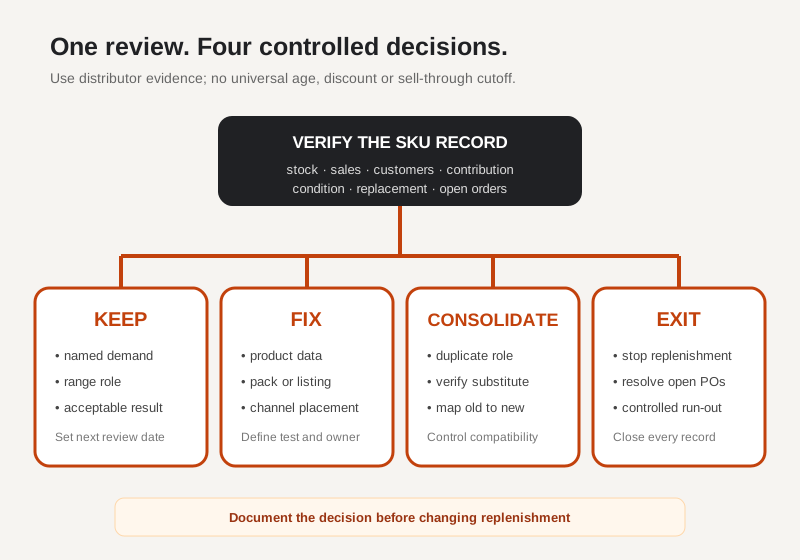
Keep
Retain the SKU when it serves a documented customer, completes an intentional assortment or produces an acceptable contribution within its expected cycle. Record why the low frequency is acceptable and set the next review date.
Fix
Correct a discoverability or execution problem before clearing the product. Examples include missing joint-width information, unclear compatible components, an unsuitable pack count, a poor image or stock assigned to the wrong channel. Define the fix and a review period; do not leave the SKU in an indefinite trial.
Consolidate
When two models serve the same buyer need, choose the retained item and document the replacement mapping. Check whether the old and new wedges, clips or tools are actually compatible before recommending substitution. Use an approved sample rather than assuming similar appearance means interchangeability.
Exit
Stop replenishment, resolve open purchase orders and create a controlled run-out plan. Separate saleable, damaged and uncertain inventory. Align product listings, sales scripts, packaging and system records so the discontinued SKU is not promised after available stock is exhausted.
Stop Replenishment Without Creating a Second Problem
An exit decision fails when an automatic reorder or already-open purchase order brings in another carton. Record the effective date, approver and responsible buyer. Review deposits, custom packaging, printed labels and supplier commitments before changing or cancelling an order.
If an alternative model will replace the old one, give sales and support teams an old-to-new mapping with the compatibility limits. A customer using a specific clip opening, wedge profile or pack count needs a verified replacement, not a generic category name.
Clear Remaining Stock With Evidence and Boundaries
Choose the commercial treatment from the actual stock condition and channel. Options may include normal run-out, transfer to a location with demand, a clearly identified bundle or a controlled price change. Do not hide an obsolete model inside a mixed kit or relabel damaged stock as standard inventory.
If packaging, barcode or product identity changes, preserve the original SKU record. The mixed-SKU shipping mark checklist helps keep remaining and replacement cartons distinguishable during a transition.
Feed the Exit Decision Into the Next Wholesale Order
Record whether the excess came from an untested assortment, MOQ mismatch, duplicate variant, weak product data, customer loss or purchasing error. Use that cause when selecting the next range. The tile tool supplier quote comparison can keep MOQ, packing and model scope visible before another order is approved.
For a new or revised range, validate model-level demand before asking the tile leveling system wholesale supplier team for a mixed quotation. A total category forecast cannot show which individual thickness or profile will consume the working capital.
Frequently Asked Questions
How should a tile tool distributor define slow-moving inventory?
Define it from the distributor's own expected selling cycle, sales frequency, stock position and strategic role. A specialist size that sells occasionally may be intentional range coverage, while a common size with falling sell-through may require action sooner. There is no universal day count for every market.
Should a slow tile leveling SKU be discounted immediately?
No. First check availability, listing quality, compatibility information, pack size, channel placement and replacement models. Discounting cannot fix an unclear listing or a SKU that customers cannot find, and it may destroy value before the cause is known.
When should reordering stop?
Stop or suspend replenishment after an authorised exit or consolidation decision, then check open purchase orders and supplier commitments. Record the effective date and owner so an automatic reorder does not refill the stock being cleared.
What records are needed when discontinuing a tile leveling SKU?
Record the SKU, stock condition, saleable quantity, open orders, customer commitments, replacement model, packaging status, approved action, owner and review date. Keep the old-to-new model mapping available for sales and claims.
Review the Range Before the Next Reorder
Share the active models, saleable stock and replacement needs for a focused mixed-SKU discussion.
Discuss the next assortment →